Physical Address
304 North Cardinal St.
Dorchester Center, MA 02124
Physical Address
304 North Cardinal St.
Dorchester Center, MA 02124

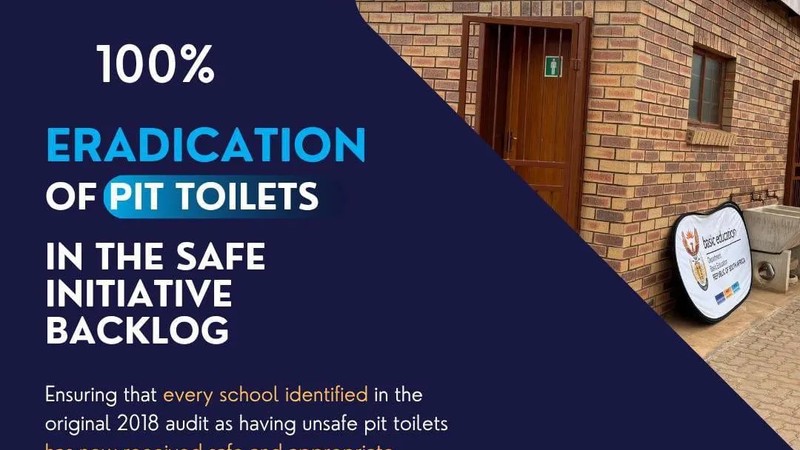
A government announcement celebrated as historic is being called out as deeply misleading. The gap between official claims and classroom reality tells us something important about how power operates — and who pays the price.
On 6 July 2026, Basic Education Minister Siviwe Gwarube stood at Dimbaza Primary School in the Eastern Cape and declared that all 3,372 schools identified in the 2018 Sanitation Appropriate for Education (SAFE) Initiative audit had been provided with safe and appropriate sanitation facilities. She invoked the names of Michael Komape, Lumka Mkhethwa, and Langalam Viki — children who died falling into pit latrines — framing the moment as a tribute to their memory and a turning point in South Africa’s long, shameful struggle with school sanitation. It was a powerful speech. The problem is that the picture it painted does not match what is happening on the ground in communities across the country.
The central thesis here is straightforward: the government’s announcement, however well-intentioned, amounts to a selective reading of progress that obscures a much larger and still unresolved crisis, and civil society organisations are right to push back hard. Pit latrines were declared unlawful in 2013 under the Minimum Uniform Norms and Standards for School Infrastructure, with a deadline for eradication set at 2016. That deadline passed. The President then committed to full eradication by 2022. That deadline passed too. Gwarube herself, upon taking office in 2024, pledged to clear all remaining pit toilets by 31 March 2025. That deadline also passed — quietly, without consequence. A pattern this consistent is not bad luck. It is a structural failure dressed up, periodically, as imminent victory.
What makes the current announcement particularly difficult to accept is the sheer volume of evidence contradicting it. Equal Education (EE), one of South Africa’s most credible education advocacy organisations, has noted that approximately 3,000 schools still rely on unsafe sanitation — a figure the 2018 SAFE audit never captured because it was never designed to be comprehensive. Schools that developed sanitation problems after 2018, schools accidentally omitted from the audit, and early childhood development centres were all left out of the count. The SAFE initiative, in other words, was always a partial map. Declaring victory based on it is like finishing a race on a shortened track and claiming the record. Meanwhile, the Eastern Cape alone — the very province where Gwarube made her announcement — still has more than 840 schools relying on pit toilets, with an estimated R3.61 billion needed to fix them.
The situation at Mathukulula Secondary School in KwaZulu-Natal crystallises what systemic failure looks like in practice. A contractor appointed in 2024 to replace the school’s pit toilets abandoned the site after laying only the foundations for a new toilet block. No replacement contractor has been appointed because the KwaZulu-Natal Department of Education says it lacks the budget. Learners at that school are still using unsafe facilities today — in 2026, more than a decade after pit latrines were declared unlawful. This is not an isolated incident; it is a symptom of a system where accountability has been progressively weakened rather than strengthened. In 2024, the DBE amended the very regulations that were supposed to protect learners, removing deadlines, reducing accountability mechanisms, and making it easier for provincial departments to fall short of minimum standards without consequence. That is a retreat, not progress.
The credibility gap is further widened by the DBE’s own commitments on transparency. In April 2025, the department pledged to conduct a new national audit to identify all schools still using pit toilets. More than a year later, that audit has not been published. Section27, a human rights organisation monitoring sanitation interventions particularly in Limpopo, has flagged that the accuracy of the 2018 audit data has previously been disputed and is now dangerously outdated. Amnesty International South Africa has called on the DBE to conduct a comprehensive updated audit covering all schools and early childhood centres, with clear timelines attached. These are not radical demands. They are the bare minimum of what a functioning government owes its most vulnerable citizens — children who cannot vote, cannot lobby, and cannot walk out when the toilet is a hole in the ground.
The broader implication of all this is uncomfortable but necessary to name. When a minister announces that more than three million pupils and 48,000 teachers now benefit from safer sanitation, that is real and worth acknowledging. Progress has been made, and it would be dishonest to pretend otherwise. But progress is not completion, and a milestone on a road that keeps getting longer is not the same as arriving at the destination. South Africa’s young people — the ones sitting in those classrooms, the ones this generation of politicians claims to be building a future for — deserve a government that tells them the truth about how far there still is to go, rather than one that reaches for the applause before the work is done. The infrastructure backlog stands at more than R120 billion. The pit toilet crisis is one chapter in a much longer story of deferred responsibility, and no announcement ceremony changes that until the audits are published, the contractors are on site, and the deadlines actually hold.



