Physical Address
304 North Cardinal St.
Dorchester Center, MA 02124
Physical Address
304 North Cardinal St.
Dorchester Center, MA 02124

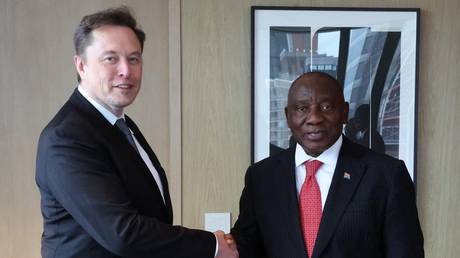
Picture a Silicon Valley conference room, somewhere in California’s sun-drenched tech corridor, where South African President Cyril Ramaphosa sits across from an ABC News camera and speaks plainly about one of the world’s richest men. “Remember his country,” he says. Not as a demand, but almost as a quiet appeal, the kind a parent might make to a child who has moved far away and forgotten to call home.
Ramaphosa was midway through a week-long working visit to California when he gave the interview to ABC News chief Washington correspondent Jonathan Karl. The conversation turned quickly to Elon Musk, the Pretoria-born billionaire who built his fortune in America and has spent recent years firing sharp criticism at the country that raised him. Ramaphosa said discussions about a possible meeting with Musk had taken place but that their schedules had not lined up. He was careful, even generous, in his framing: “I have met Elon Musk in the past and I’ve been awed by his brilliance.” Then came the ask.
The tension between Musk and South Africa’s government is not new, but it has sharpened considerably. Musk has repeatedly attacked the country’s black economic empowerment policies, which were designed to correct the structural advantages that apartheid handed exclusively to white South Africans. He has called Ramaphosa’s government “apartheid 2.0,” a phrase that landed hard and drew fury across the political spectrum back home.
Ramaphosa pushed back without raising his voice. He suggested Musk, as a white South African who benefited from the apartheid system’s educational privileges, may simply not grasp the depth of the damage those policies caused. “He being the white South African, maybe he has not really appropriated and come to understand the harm that the apartheid policies did,” Ramaphosa said, pointing specifically to education. Under apartheid, the quality of schooling a child received was determined entirely by race. Musk’s access to technology and quality education in his formative years, Ramaphosa argued, was itself a product of that system, and a foundation for the success that followed.
That point cuts deep for young South Africans still navigating a country where the economic legacy of apartheid remains stubbornly visible in income gaps, land ownership and access to opportunity. The argument is not abstract. It is lived.
The Starlink question added another layer. Musk’s satellite internet service has not launched in South Africa, and Ramaphosa confirmed that talks are ongoing but stalled around local operating policies. South Africa, like many countries, requires companies to meet specific regulatory conditions before they can operate within its borders, including requirements tied to local ownership and empowerment frameworks. Ramaphosa was direct: “The United States has the same. It has its own policies. And when you want to come and operate here, you’ve got to subscribe to the policies of the country.” This is the same tension at the center of the Resolve Communications lobbying scandal, where efforts to navigate Starlink’s entry into South Africa became entangled in questions about political influence and the integrity of the governing coalition.
What Ramaphosa is really asking, beneath the diplomatic language, is whether someone who made it out can still feel responsible for those who didn’t. Whether success abroad cancels out the debt owed to the place that shaped you. It is a question that resonates far beyond Musk, touching every young African who watches talent and capital leave the continent and wonders what, if anything, flows back.
The meeting between the two men has not happened yet. Maybe it will.



