Physical Address
304 North Cardinal St.
Dorchester Center, MA 02124
Physical Address
304 North Cardinal St.
Dorchester Center, MA 02124

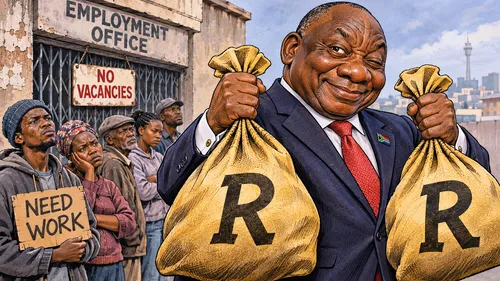
On a single Tuesday, two announcements landed back to back, and together they painted a picture that is difficult to look away from. Statistics South Africa confirmed that the country’s unemployment rate had climbed to 33.7%, with another 97,000 people joining the ranks of the jobless during the third quarter of 2026, bringing the total to 8.6 million unemployed South Africans. Hours later, President Cyril Ramaphosa signed off on salary increases of up to 3.5% for ministers, Members of Parliament and provincial politicians, backdated to April 1, 2026. The juxtaposition was not subtle. It was a collision between two realities that are drifting further apart every quarter.
The increases did not come from nowhere. The Independent Commission for the Remuneration of Public Office-Bearers is the body tasked with recommending salary adjustments for elected officials, weighing factors like inflation, fiscal affordability and broader economic conditions before making its proposals. The process is legally sound, and nobody is seriously arguing that public representatives should work for free or be underpaid to the point where capable people refuse to serve. Running a government carries genuine weight and genuine responsibility, and that deserves fair compensation. But there is a meaningful gap between what the law permits and what the moment demands, and right now that gap is very wide.
The core issue is not the percentage itself, modest as 3.5% might appear on paper. The problem is the signal it sends to millions of households that are struggling to put food on the table, keep children in school and pay bills that keep rising while incomes stay flat or disappear entirely. South Africa’s employment picture is grimmer than the headline unemployment figure suggests. While the economy did add 101,000 jobs during the third quarter of 2026, the number of people actively seeking work grew even faster, which is why the unemployment rate still moved upward. Beyond that, 3.7 million South Africans have stopped looking for work altogether, classified as discouraged jobseekers, people who have effectively concluded that the system has no place for them. These numbers represent real lives, not statistics, and they sit in sharp contrast to a political class that receives annual salary adjustments as a matter of routine.
This is the question that the current situation makes almost impossible to avoid. If a private-sector employee consistently failed to meet targets, a pay rise would be unthinkable. Yet in South Africa’s political system, remuneration is largely disconnected from measurable outcomes like employment levels, economic growth, service delivery quality or fiscal discipline. A performance-linked model would require careful architecture, since politicians cannot single-handedly control every economic variable and the independence of key institutions must be protected. But the principle that taxpayers should see evidence of progress before their elected representatives receive more of the public’s money is not an unreasonable one. It is, in fact, a fairly basic expectation in any functioning democracy.
A salary freeze would not cure unemployment, and it would not reshape the national budget in any transformative way. But leadership is also about the choices made when they are hard and when they are visible. South Africans are regularly told by their government to exercise patience, accept difficult conditions and trust that recovery is coming. The credibility of that message depends entirely on whether those delivering it are willing to live by the same standard. Voluntarily rejecting these increases would cost politicians very little in absolute terms, but it would demonstrate something that policy documents and press conferences cannot manufacture: a genuine understanding of the weight that 8.6 million unemployed people carry every single day. Until South Africa makes real, sustained progress against its unemployment crisis, the country’s elected leaders have a straightforward choice to make, and it should not be a difficult one.