Physical Address
304 North Cardinal St.
Dorchester Center, MA 02124
Physical Address
304 North Cardinal St.
Dorchester Center, MA 02124

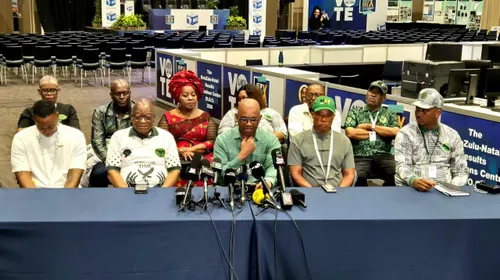
Something significant is shifting in South African politics, and it is happening fast. In eThekwini, South Africa’s second-largest city by population, a coalition is taking shape that would hand power to the uMkhonto weSizwe (MK) Party and lock the Democratic Alliance (DA) out of government entirely. Multiple party insiders have confirmed to IOL that the preferred arrangement brings together the MK Party, the ANC, the EFF and ActionSA, a combination that would command 134 seats in eThekwini’s 223-seat council, well above the 112 needed for an outright majority.
To understand why this matters, you need to grasp the arithmetic. The MK Party holds 86 seats in eThekwini, the ANC 37, ActionSA seven and the EFF four. Together, that is a 22-seat cushion above the majority threshold. The MK Party and ANC alone would hold 123 seats, which places the ANC in a genuinely decisive position: it can either back an MK Party-led administration or pivot toward an alternative bloc involving the DA, the IFP and ActionSA. That second option is, by all accounts, losing support fast inside ANC structures.
One senior MK Party insider, described as close to the party’s founder Jacob Zuma, framed the emerging alliance in generational and ideological terms. “The old man has always said he remains an ANC member. His fight is not with the party, it’s with Ramaphosa. With Ramaphosa on his way out, it’s time to unite. We are looking at 2029 and progressive black parties need to come together to serve those who voted for us,” the source said. That framing, of a coalition built on shared political identity rather than mere electoral convenience, explains why an MK Party-ANC alliance, once considered unthinkable, is now being discussed openly.
ActionSA’s role in all of this deserves particular attention, because the party is not just a minor player in eThekwini; it is a potential kingmaker across multiple metros simultaneously. ActionSA’s provincial leader in KwaZulu-Natal, Zwakhele Mncwango, confirmed that his party has engaged constructively with the MK Party, the ANC and the IFP, but has held no coalition discussions with the DA in eThekwini. His reasoning was pointed: “I find the DA’s position hypocritical. They cannot demand political independence and freedom to negotiate for themselves while attempting to dictate coalition choices to other political parties.” That is not a diplomatic non-answer; it is a door being closed.
The stakes extend well beyond eThekwini. In Johannesburg, a potential ANC-ActionSA-EFF-MK Party coalition would control 138 seats in the 270-member council, just two above the 136 required for a majority. ActionSA leader Herman Mashaba has held talks with DA leader Geordin Hill-Lewis, but the broader coalition calculus points elsewhere. If ActionSA aligns with the MK Party-ANC bloc in Johannesburg, Mashaba could secure the city’s mayoralty despite his party finishing behind the DA. Fellow ActionSA member Nasiphi Moya would retain the Tshwane mayoralty, while the ANC would take control of Ekurhuleni. As South Africa’s fragmented 2026 local election results have forced complex coalition talks across the country, this kind of multi-city deal is exactly the sort of arrangement that parties are now openly engineering.
The logic of such a deal is straightforward: the ANC supports ActionSA’s mayoral ambitions in Johannesburg, while ActionSA backs an MK Party-led coalition in eThekwini. Both parties get something concrete. The DA gets nothing, despite holding enough seats to participate in alternative majority coalitions in both cities.
This is the crux of the matter. The DA’s exclusion is not accidental or incidental; it appears to be a deliberate political objective shared across the negotiating parties. One insider was blunt: “Don’t be fooled by parties talking. We all know who we prefer as coalition partners. Our stance is ANC, EFF, ActionSA, but let’s keep the DA waiting.” Another source added that “the ANC acknowledged their coalition with the DA did not work, so it’s time to give our people what they want: a united, stable coalition led by parties that prioritise the needs of the majority.”
What this means for young South Africans, particularly the millions in Johannesburg and eThekwini who voted in these elections and are watching service delivery stagnate, is that the shape of their city governments will be determined not by who won the most votes, but by which combination of parties can assemble a working majority. The DA finished ahead of ActionSA in Johannesburg, yet Mashaba could become mayor. The MK Party’s internal dynamics in eThekwini have been under pressure, yet the party may emerge leading the city’s government. Electoral results, in a fragmented council, are only the starting point.
Whether these negotiations produce formal governing agreements remains uncertain. Coalition talks are fluid, and parties that signal alignment today can shift positions tomorrow. But the direction of travel is clear: a broad progressive bloc, spanning the MK Party, ANC, EFF and ActionSA, is moving toward shared power in South Africa’s major urban centres, with the DA watching from the outside.



