Physical Address
304 North Cardinal St.
Dorchester Center, MA 02124
Physical Address
304 North Cardinal St.
Dorchester Center, MA 02124

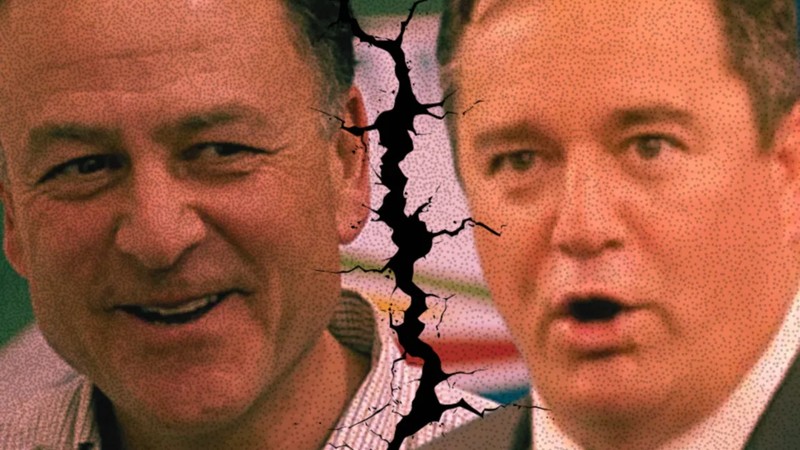
What began as a bitter internal dispute within the Democratic Alliance has rapidly escalated into one of the most politically charged controversies to hit South Africa’s Government of National Unity. At the centre of the storm sits Resolve Communications, a public affairs firm chaired by former DA leader Tony Leon, whose alleged influence over the party’s elected representatives has triggered accusations of improper lobbying — and, in some corners, whispers of something far darker.
The controversy erupted when John Steenhuisen, the recently demoted former DA leader, gave a scorched-earth interview to News24, accusing Leon of using the party’s ministers and officials to advance the commercial interests of Resolve’s paying clients. Steenhuisen, who was stripped of his Agriculture Minister portfolio and pushed down to Deputy Minister of Trade, Industry and Competition by current DA leader Geordin Hill-Lewis, made clear he felt personally betrayed — and he was not staying quiet about it.
The timing matters. Steenhuisen claims he agreed to step down as DA leader on the explicit condition that Hill-Lewis would allow him to serve out his full term as Agriculture Minister. That agreement, he says, was broken. His demotion, he suggests, was at least partly connected to the pressure Resolve was exerting on his office.
The specific claims Steenhuisen levelled are worth unpacking carefully, because they go well beyond a simple complaint about being sidelined. He alleged that Resolve Communications arranged meetings between Starlink — the satellite internet company owned by Elon Musk — and Communications Minister Solly Malatsi, and that he himself was drawn into meetings with farming groups concerning a foot-and-mouth disease outbreak, again through Resolve’s facilitation.
Steenhuisen named three officials he says were targeted by Resolve’s lobbying operation: himself, Malatsi, and current Agriculture Minister Willie Aucamp, who previously served as Minister of Forestry, Fisheries, and the Environment. The clients on whose behalf Resolve allegedly lobbied were identified as Starlink and REDISA, a waste management company. Steenhuisen further alleged that through Resolve’s pressure, he met Starlink officials who complained that Malatsi was not moving fast enough on regulatory matters — a detail that, in his telling, contributed directly to his removal from cabinet.
The Starlink dimension of this controversy is perhaps the most politically explosive, because it connects the lobbying allegations to a concrete and consequential policy decision. In May 2025, Malatsi gazetted a policy direction that significantly diluted South Africa’s Broad-Based Black Economic Empowerment requirements for multinational investors. Under the existing framework, companies were required to give 30% ownership to previously disadvantaged Black South Africans — a cornerstone of post-apartheid economic transformation.
Malatsi’s new direction replaced that ownership requirement with a set of alternative contributions: investment in local suppliers, enterprise and skills development, job creation, infrastructure support, research and innovation, digital inclusion initiatives, and funding for small and medium enterprises. Critics were swift to identify the beneficiary of this change — Starlink, which would now be able to operate in South Africa without surrendering a 30% stake in its local business.
Parliament’s Portfolio Committee on Communications and Digital Technologies, chaired by Khusela Diko, responded by setting a firm deadline of Monday, 6 July, for Malatsi to disclose every meeting and communication his office has had with either Resolve Communications or Starlink since he took office in 2024. Diko also requested the complete documentary record underpinning the policy change Malatsi has been advancing since October 2024 — a change that would allow telecoms firms to sidestep the legal requirement to transfer 30% ownership to historically disadvantaged South Africans.
The parliamentary pressure signals that this controversy will not be contained within the DA’s internal politics. It is now a matter of public accountability, and the committee’s demand for full disclosure puts Malatsi in a difficult position regardless of whether any wrongdoing is ultimately established.
Hill-Lewis and Malatsi have both pushed back firmly, framing the entire controversy as a manufactured non-issue. Hill-Lewis argued that there is nothing improper about ministers meeting stakeholders and lobby groups, pointing out that President Cyril Ramaphosa himself met with Elon Musk, and that no politician is compelled to act on any meeting they take. He dismissed calls from the ANC and ActionSA for an independent investigation, characterising private sector and civil society lobbying as a routine feature of democratic governance.
Tony Leon was equally dismissive. He denied the allegations as politically motivated and lacking evidence, and suggested that Resolve Communications was being used as a convenient external scapegoat for difficulties that are, in reality, internal and political within the DA. Resolve Communications itself issued a statement rejecting comparisons between its work and state capture, insisting that its public affairs activities are legitimate and standard practice within the industry.
The defence is coherent on its face. Lobbying is legal, and ministers meeting industry representatives is indeed routine. But the specific circumstances here — the policy change that appears tailored to Starlink’s needs, the demotion of a minister who resisted pressure, the involvement of a firm chaired by a figure with deep roots in the party — give the “it’s just lobbying” argument a harder sell.
The controversy widened considerably when Dion George, the Environment Minister, told the Sunday Times that Resolve had approached him on behalf of REDISA while the company was actively engaged in litigation against his department. George said he had repeatedly declined to meet. His account is significant because it suggests a pattern of approach rather than isolated incidents, and because he is a DA minister — not an opposition voice with an obvious political motive.
At least three other former DA elected public representatives have spoken on the record about being lobbied by Leon’s firm on behalf of its clients. Their accounts, taken together with George’s, build a picture that is difficult to dismiss as a single disgruntled politician’s grievance. The breadth of the alleged contact points is precisely what has energised the opposition response.
The ANC, through acting spokesperson Nonceba Mhlauli, described the allegations as indicative of possible state capture and called for an independent investigation. ActionSA moved more aggressively, lodging a formal complaint with the Public Protector and urging President Ramaphosa to launch an urgent inquiry. ActionSA MP Lerato Ngobeni announced that the party would submit parliamentary questions to every DA minister and deputy minister serving in the GNU regarding their interactions with Resolve Communications.
ActionSA National Chairperson Michael Beaumont made the sharpest argument of all, contending that the alignment between Leon’s and Hill-Lewis’s responses reflects Leon’s enduring political influence within the DA — influence that, Beaumont claims, is now being leveraged against the party’s own representatives in national government. He drew an explicit parallel to the era of state capture, arguing that what is being labelled lobbying bears a structural resemblance to the way powerful private actors gained access to the state under Jacob Zuma.
That comparison has gained traction in public commentary, with some observers likening Resolve to Bell Pottinger — the British PR firm that worked closely with Zuma-era associates and became a symbol of the corrosive intersection between private communications firms and political power.
For South Africa’s young generation, this controversy is a live lesson in how power actually circulates — not always through formal institutions, but through networks, relationships, and the quiet work of firms that operate in the spaces between business and government. The question of whether what Resolve did constitutes legitimate lobbying or something more troubling is not merely semantic; it goes to the heart of who gets to shape policy and in whose interest.
The B-BBEE policy change is the sharpest illustration of the stakes. Broad-Based Black Economic Empowerment is not a technicality — it is a mechanism designed to address the structural economic exclusion that apartheid entrenched over decades. A policy shift that allows a multinational like Starlink to bypass its ownership requirements, if driven by private lobbying rather than genuine public interest reasoning, represents a real and material setback for transformation. That is a conversation South Africa’s youth cannot afford to sit out.
The coming weeks, as Malatsi’s parliamentary deadline passes and the Public Protector weighs ActionSA’s complaint, will determine whether this controversy produces accountability or dissolves into the familiar fog of political noise. Either outcome will say something important about the health of South Africa’s democratic institutions — and about who, in the end, those institutions actually serve.



