Physical Address
304 North Cardinal St.
Dorchester Center, MA 02124
Physical Address
304 North Cardinal St.
Dorchester Center, MA 02124

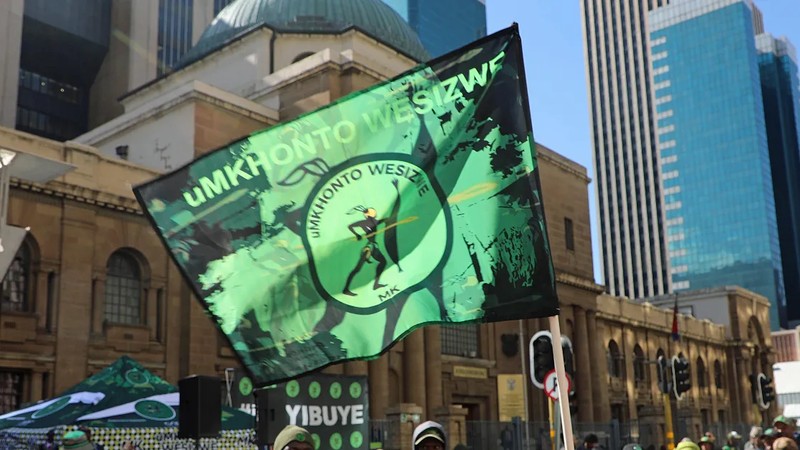
On 28 August, the MK Party stood before cameras and unveiled Zandile Hlophe-Mkhwanazi as its mayoral candidate for eThekwini — the same day nominations officially closed. She was celebrated. A co-founder and CEO of GirlCode, a nonprofit driving technology education for women and girls, she also holds a BSc Honours in computational and applied mathematics. The party hailed her credentials. Twelve days later, she was gone, replaced by Apostle Mxolisi Phakathi, a former African Transformation Movement MPL and the party’s national chairperson. No warning. No gradual transition. Just a swap that sent shockwaves through the party’s base and raised urgent questions about what is really happening inside MK’s structures as South Africa’s November 4 local government elections draw closer.
The replacement of Hlophe-Mkhwanazi is not an isolated incident — it is a symptom of something deeper. The MK Party is simultaneously dealing with allegations that duly nominated candidates were removed from councillor lists submitted to the Electoral Commission of South Africa (IEC), with other names allegedly substituted in their place. That is a serious charge. It suggests that somewhere inside the party’s administrative machinery, individuals may have manipulated the democratic process to favour certain people over others. Hlophe-Mkhwanazi and fellow official Sibonelo Maphumulo have both been removed from the National Party Liaison Committee — the MK Party’s formal channel for engaging with the IEC on electoral matters — pending an internal investigation into these allegations. The party has launched a probe and promised to “leave no stone unturned.”
The MK Party itself acknowledged the gravity of the situation in unusually direct language. “There is no place for manipulation, political gatekeeping or the abuse of organisational processes,” the party stated publicly. It added that anyone found responsible for wrongdoing would be held accountable under the organisation’s own rules and procedures. These are strong words. But words have a deadline problem: the IEC’s window for changing candidate lists has already closed, meaning that even if manipulation is proven, the disputed councillor candidates cannot be swapped out before election day. The damage, in that sense, may already be done.
None of this is happening in a vacuum. Party president Jacob Zuma dissolved the MK Party’s Presidential Task Team for the second time in just six weeks before these latest developments unfolded. That is a striking pattern of instability at the very top of a party that is less than two years old and is now competing in its first major local government elections. Zuma’s repeated interventions signal either a party struggling to consolidate its internal power structures, or a leadership style that keeps disrupting its own momentum at the worst possible time. For young South Africans who backed MK as a vehicle for real change, particularly in KwaZulu-Natal where the party captured a remarkable 45% of the provincial vote in the 2024 elections, these developments must feel like a betrayal of that energy.
Understanding why all of this matters requires understanding what eThekwini represents. This is KwaZulu-Natal’s economic engine — a metro of millions, a port city, a place where real governance decisions shape real lives. Whoever controls eThekwini controls substantial budgets, infrastructure contracts, service delivery for some of South Africa’s most underserved communities, and enormous political symbolism. The MK Party’s original campaign pitch, as articulated through Hlophe-Mkhwanazi, spoke directly to the city’s most visible failures: water shortages, sewage spills, electricity outages, a housing crisis, hijacked buildings, and deteriorating public safety. These are not abstract policy issues. They are daily realities for millions of residents, and they represent exactly the kind of bread-and-butter politics that wins elections.
The competition for this prize is fierce and growing. The Democratic Alliance has fielded former councillor and MP Haniff Hoosen. The Inkatha Freedom Party has entered Deputy Minister of Transport Mkhuleko Hlengwa. ActionSA is running KwaZulu-Natal leader Zwakele Mncwango, and the EFF has named Hlengiwe Mkhaliphi as its candidate. The ANC, meanwhile, remains confident — “the ANC shall retain eThekwini,” a party spokesperson declared — though the party has not yet finalised its own mayoral candidate. In this crowded, high-stakes field, internal chaos is a luxury no serious contender can afford.
Independent political analyst Goodenough Mashego is clear-eyed about the consequences. The internal turmoil, he argues, could meaningfully damage MK’s prospects in a metro where the party was previously considered a genuine frontrunner. But Mashego stops short of writing MK off entirely. The party could still secure a significant number of council seats without necessarily winning the mayoral position outright — and in a fragmented result, coalition arithmetic becomes everything. “If there are any prospects of them governing eThekwini after the elections, they’ll need to go into an alliance with another party that might do well,” he said. The IFP, with its deep roots in KwaZulu-Natal, could prove pivotal in those negotiations if neither the ANC nor the DA emerges with a commanding majority. MK could theoretically win the most seats in the chamber and still find itself locked out of the mayor’s office without the right partners.
For the 15-to-25-year-old generation watching this unfold, the eThekwini battle is more than political theatre — it is a test of whether new political formations can actually deliver on their disruption promises, or whether they simply replicate the same gatekeeping and internal power games that made older parties so disappointing. The MK Party rose to prominence partly on the energy of young, disillusioned voters who wanted something different. Hlophe-Mkhwanazi herself represented a certain vision of that difference: a young, technically qualified woman with a concrete plan for a broken city. Her removal, and the allegations swirling around candidate list manipulation, raise uncomfortable questions about who is really in charge of MK’s direction — and whose interests the party ultimately serves. The party has apologised to affected structures for the disruption. Apologies, however, do not fix ballot papers. November 4 is coming fast, and eThekwini is watching.



