Physical Address
304 North Cardinal St.
Dorchester Center, MA 02124
Physical Address
304 North Cardinal St.
Dorchester Center, MA 02124

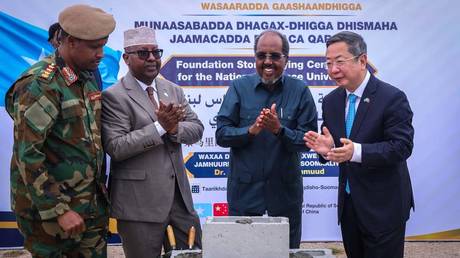
Somalia’s head of state has drawn a sharp line in the sand, naming Israel and Taiwan as direct threats to his country’s survival.
Speaking on Sunday in Mogadishu during the launch of a National Defense University construction project, Somali President Hassan Sheikh Mohamud made the accusation plain: “Today, Taiwan is among the things that threaten Somalia’s existence and its sovereignty… Israel is also a threat.” The event, backed by China, also marked the start of reconstruction work on the Somali National Army Hospital, and the president used the occasion to frame Beijing as one of Somalia’s oldest and closest partners, invoking a shared philosophy of “One China and One Somalia” that he said stretches back to the 1960s.
So what exactly has pushed Mogadishu to this point? The answer lies in the breakaway northern territory of Somaliland, which declared independence from Somalia in 1991 and has since built its own government, military, currency and institutions, though it has spent more than three decades without meaningful international recognition. That changed last December, when Israel became the first and only UN member state to formally recognize Somaliland as an independent entity. Israeli Ambassador Michael Lotem then presented his credentials to Somaliland’s president, Abdirahman Mohamed Abdullahi, late last month, and Israel followed up by accrediting an ambassador and laying a cornerstone for a planned embassy in Hargeisa, all without consulting Mogadishu. Somalia condemned those steps as a direct violation of its sovereignty and territorial integrity. You can read more about Somaliland’s first embassy opening in Jerusalem and its deepening ties with Israel to understand how quickly this relationship has developed.
Taiwan, the self-governing island that Beijing claims as its own territory, established reciprocal representative offices with Somaliland back in 2020, years before Israel’s recognition made headlines. By May 2026, the Taiwanese Foreign Ministry confirmed that cooperation with Somaliland had expanded to cover healthcare, agriculture, technology, energy, minerals and infrastructure. For Mogadishu, this partnership is not a neutral economic arrangement but a political provocation, one that mirrors the logic of its objection to Israel: any foreign actor engaging with Somaliland as though it were a sovereign state chips away at Somalia’s claim to territorial wholeness.
President Mohamud’s framing of the issue through the lens of Chinese partnership is deliberate and revealing. By aligning Somalia with Beijing’s position on Taiwan, he simultaneously courts a powerful ally and signals to the international community that his government intends to treat the Somaliland question as a matter of national survival, not regional negotiation. The African Union has backed Somalia’s position, condemning Israel’s appointment of an envoy in April and reaffirming that Somaliland remains part of Somalia. The Intergovernmental Authority on Development, the East African regional bloc, went further, declaring Israel’s move contrary to the UN Charter and the AU’s founding principles. The regional consensus, at least on paper, holds firm. But the pace at which Somaliland is attracting foreign engagement suggests that consensus is under real and growing pressure.



