Physical Address
304 North Cardinal St.
Dorchester Center, MA 02124
Physical Address
304 North Cardinal St.
Dorchester Center, MA 02124

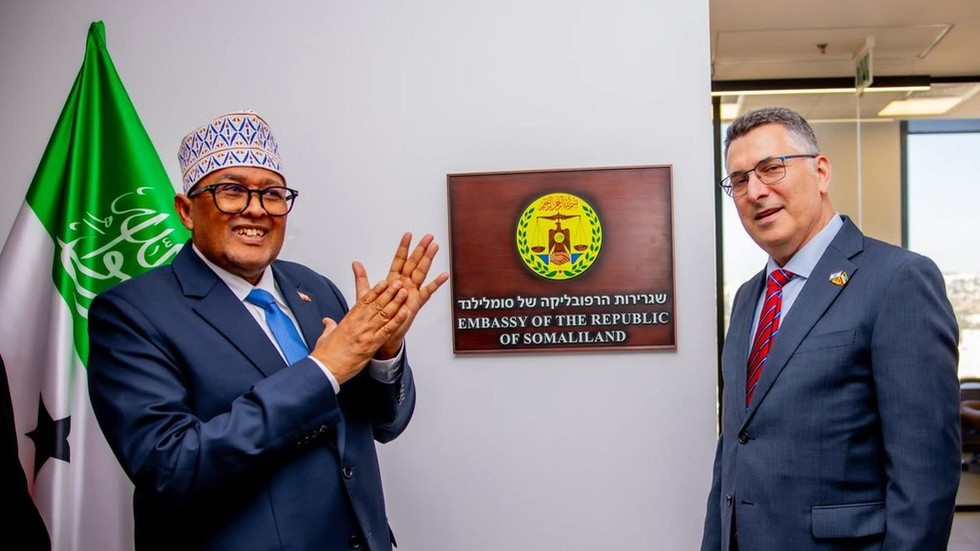
Somaliland officially inaugurated its first embassy in Jerusalem on Monday, marking a historic diplomatic breakthrough for the self-declared breakaway region that has spent over 35 years seeking international recognition. Israel remains the only state in the world to recognize Somaliland as a sovereign nation.
Somaliland President Abdirahman Mohamed Abdullahi and Israeli Foreign Minister Gideon Moshe Sa’ar attended the inauguration ceremony together. Abdullahi had arrived in Israel on Sunday, where he was received by President Isaac Herzog at the Presidential Residence — the first-ever state visit by a Somaliland leader to Israel.
“The opening of Somaliland’s first-ever embassy in Jerusalem — a historic and long-awaited moment the people of Somaliland have waited more than 35 years to witness,” Somaliland’s Foreign Ministry wrote on X.
Beyond the embassy opening, the two sides signed a Strategic Joint Declaration of Cooperation, signaling deeper political and economic ties. Abdullahi described the agreement as “a historic milestone in relations between our two nations,” built on “mutual respect, cooperation, and shared interests.”
Israel is also expected to open its own embassy in Hargeisa, Somaliland’s capital, following plans revealed by Somaliland Ambassador Mohamed Hagi during a visit to Israel in May.
The move has drawn sharp criticism from neighboring Somalia and the broader African continent. Somalia condemned the embassy opening as illegal and a direct violation of its sovereignty, while the African Union reaffirmed its support for Somalia’s territorial integrity and opposed Israel’s appointment of an envoy to Somaliland.
The tensions are rooted in a decades-long political dispute. Somalia’s central government collapsed in 1991, triggering the fragmentation of the country into competing administrations. Somaliland declared independence that same year and has since operated with its own government, currency, and institutions — yet without formal recognition from any United Nations member state, until now.
Somaliland’s diplomatic push comes at a time of intense geopolitical competition in the Horn of Africa, a region increasingly courted by global powers for its strategic location along key maritime trade routes.
For young Africans watching this story unfold, the Somaliland-Israel deal raises critical questions about sovereignty, self-determination, and who gets to decide which nations exist on the map.



