Physical Address
304 North Cardinal St.
Dorchester Center, MA 02124
Physical Address
304 North Cardinal St.
Dorchester Center, MA 02124

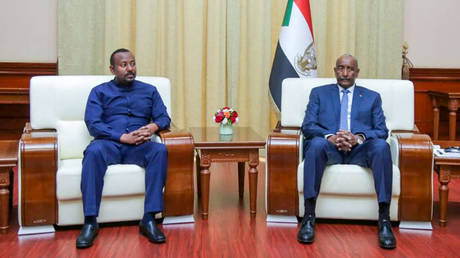
Two of Africa’s most populous nations have just slammed the door on each other. Sudan and Ethiopia have mutually closed consulates and expelled diplomatic staff, escalating a dispute rooted in accusations that each country is backing armed groups fighting the other’s government. The move signals a dangerous new chapter in an already volatile region.
Ethiopia ordered the closure of Sudan’s consulate in Assosa, a western border city, and gave six Sudanese diplomats 48 hours to pack up and leave. Sudan responded swiftly, shutting Ethiopia’s consulate in Gedaref, its eastern city, and ordering Ethiopian staff out. Neither foreign ministry issued a public explanation, leaving observers to read between the lines of a relationship that has been fraying for months.
Sudan’s grievance against Ethiopia is specific and serious. On the Sunday before the expulsions, Sudan’s Foreign Ministry lodged formal complaints with both the UN Security Council and the African Union’s Peace and Security Council, accusing Ethiopia of allowing the paramilitary Rapid Support Forces (RSF) to launch drone attacks from its territory. “The use of Ethiopian territory by the terrorist militia (RSF) to target Sudanese territory is considered a hostile act,” the ministry stated.
Sudan’s army-led Transitional Sovereignty Council released a report detailing the scale of the alleged strikes: 70 attacks between February 15 and October 27, involving 187 one-way attack drones launched from Ethiopian soil. Those strikes reportedly killed or wounded 484 civilians and killed 176 soldiers, hitting hospitals, residential areas, and electricity and fuel infrastructure.
Sudanese presidential adviser Amjad Farid sought to calibrate the response, telling Reuters that Khartoum remained committed to defending its territory while making “every possible effort to avoid an open war with Ethiopia.” The tension between those two positions captures the bind Sudan finds itself in.
Addis Ababa has denied everything. In a May 5 statement, Ethiopia’s Foreign Ministry dismissed the accusations as “baseless” and called instead for a humanitarian truce, a sustained ceasefire, and civilian-led dialogue to restore civilian rule in Sudan. The gap between the two governments’ narratives is wide enough to drive a crisis through.
To understand why the region is unravelling, you have to go back to April 2023, when Sudan collapsed into civil war. Fighting broke out between the national Sudanese Armed Forces (SAF), commanded by Abdel Fattah al-Burhan, and the paramilitary RSF, led by Mohamed Hamdan Dagalo, better known as Hemedti. The trigger was a power struggle over a planned transition to civilian rule, but the consequences have been catastrophic.
What started in Khartoum has since killed tens of thousands of people, displaced millions more, and pushed parts of the country into famine. The war has also carved Sudan into competing spheres of control. Burhan’s government returned to Khartoum in January 2026 after the army recaptured the capital, having previously operated out of Port Sudan. Meanwhile, in July 2025, the RSF-aligned TASIS coalition announced a rival government based in Nyala, in Darfur, with Dagalo heading its governing council. Both the UN Security Council and the African Union rejected that move outright.
For more on the hidden dimensions of this conflict, Sudan’s war has also involved chemical weapons allegations and a troubling accountability gap that the international community has largely failed to address.
International efforts to end the war have stumbled repeatedly. African Union mediation has gone nowhere. Saudi-US talks in Jeddah have repeatedly stalled. In September 2025, the Quad group, comprising the US, Saudi Arabia, Egypt, and the United Arab Emirates, proposed a three-month humanitarian truce intended to lead to a permanent ceasefire and a civilian-led political transition. Burhan rejected a subsequent US-led proposal that November, arguing it would dismantle state security institutions while leaving the RSF intact. The RSF, for its part, said it accepted the truce.
The UAE’s role has added another layer of suspicion. Sudan’s army-backed government severed diplomatic ties with Abu Dhabi in May 2025, accusing it of supplying and supporting the RSF. The UAE denies providing weapons to the paramilitaries. Relations with Washington deteriorated further in September 2026 after the US questioned the legitimacy of both factions. Sudan rejected those remarks and called for peace efforts free from foreign interference.
On the ground, the humanitarian situation is worsening. UN Resident and Humanitarian Coordinator Denise Brown warned on Tuesday that intensifying drone attacks are disrupting electricity, water, and fuel supplies across Sudan. A power outage halted dialysis treatment for 25 patients at a hospital outside Khartoum, and fuel shortages have stranded hundreds of aid trucks. These are not abstract statistics; they are the daily reality for millions of Sudanese civilians caught in a war they did not choose.
Ethiopia is not simply a bystander in Sudan’s conflict. It is managing its own deepening security crisis. On October 1, Addis Ababa expelled ten Eritrean diplomats and closed its embassy in Asmara, prompting Eritrea to sever diplomatic ties entirely. On the same day, Ethiopia expelled an Egyptian diplomat. Addis Ababa has accused Eritrea, Egypt, and Sudan of backing an armed alliance led by the Tigray People’s Liberation Front, which has joined forces with six other rebel groups seeking to overthrow Prime Minister Abiy Ahmed’s government. All three countries deny the allegations.
The pattern is striking: Ethiopia is now in diplomatic conflict with three of its neighbours simultaneously, while Sudan is fighting a civil war with regional dimensions that draw in the UAE, Egypt, and now Ethiopia. The Tigray crisis has long threatened to pull the entire Horn of Africa into a broader confrontation, and the latest expulsions suggest that threat is becoming harder to contain.
For the generation growing up in the Horn of Africa right now, this diplomatic breakdown is not a distant political story. It shapes access to food, safety, education, and opportunity. Wars fought by generals and politicians land hardest on young people, who make up the majority of those displaced, recruited into armed groups, or simply trying to survive in cities where the lights keep going out.
The failure of regional institutions to prevent this escalation, and the inability of international mediators to broker a lasting peace, raises urgent questions about who actually holds power in African conflicts and whose interests drive the decisions being made. The expulsions between Sudan and Ethiopia are a symptom of something larger: a region under enormous pressure, with no clear path to stability in sight.



