Physical Address
304 North Cardinal St.
Dorchester Center, MA 02124
Physical Address
304 North Cardinal St.
Dorchester Center, MA 02124

Picture a hall in Moscow, late October 2026, filled with delegates from across a continent of 1.4 billion people. Flags line the corridors, handshakes are exchanged, and communiqués are drafted. But beyond the ceremony, a harder question presses: after seven years of summits, declarations, and action plans, is the Russia-Africa relationship actually delivering something real? The answer, it turns out, is complicated — and the stakes for young Africans could not be higher.
The Russia-Africa Summit scheduled for Moscow on October 28–29 is the third of its kind, and it arrives at a moment when the relationship between Russia and African nations has moved well past diplomatic novelty. Since the first summit in Sochi in 2019, permanent institutional frameworks have been built, Russia’s diplomatic footprint on the continent has widened, and bilateral trade has climbed. The question now is not whether Russia wants to be a partner — it is whether the partnership is producing tangible results for ordinary people across Africa’s 54 nations.
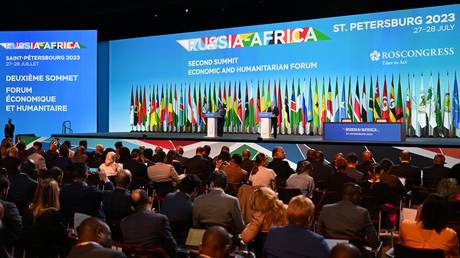
The first Russia-Africa Summit, held in Sochi in October 2019, was a statement of ambition. All 54 African nations attended, more than 40 heads of state among them, and the gathering established what analysts call a pan-African approach in Russian foreign policy — a commitment to treating the continent as a coherent bloc rather than a loose collection of bilateral relationships. It set the stage for regular summits and formalised cooperation with the African Union. Four years later, the second summit in St. Petersburg brought delegations from 49 African states, 17 led by heads of state, and produced a three-year Action Plan spanning 181 points — from financial settlements and banking ties to logistics, information technology, and transport. That plan is now up for evaluation in Moscow.
The institutional architecture has deepened considerably since St. Petersburg. In November 2024, the first Ministerial Conference of the Russia-Africa Partnership Forum convened in Sochi; a second followed in Cairo in December 2025. In July 2026, African Union Commission Chairperson Mahmoud Ali Youssouf and Russian Foreign Minister Sergey Lavrov held high-level consultations in Addis Ababa. Russia has also expanded its diplomatic network: 45 Russian embassies now operate physically across African nations, with new or reopened missions in Burkina Faso, Equatorial Guinea, Niger, Sierra Leone, and South Sudan. Openings in the Gambia, Liberia, Togo, and the Comoros are next. A dedicated Department for Partnership with Africa has been established within the Russian Ministry of Foreign Affairs — a bureaucratic signal that Africa is no longer an afterthought in Moscow’s foreign policy calculus.
Russia’s political presence in Africa has expanded faster than its economic footprint — and that gap matters enormously. Trade turnover between Russia and Africa grew from $16.8 billion in 2019 to $27.1 billion in 2025, which sounds impressive until you hold it next to China-Africa trade, which reached $348 billion in the same year. The numbers tell a story of ambition outpacing capacity. Russia’s exports to Africa totalled $22.7 billion in 2025, while imports from the continent amounted to just $4.4 billion — a lopsided relationship that raises real questions about the depth of economic integration.
Geography compounds the problem. Roughly 70% of all Russia-Africa trade is concentrated in North African countries, leaving sub-Saharan economies largely on the margins of this supposedly continental partnership. Food, fertilisers, fuel, and metals dominate the trade basket. For a continent whose youth population is the fastest-growing in the world, with millions entering the labour market every year, the absence of robust investment flows, manufacturing partnerships, and technology transfers is a serious gap. Moscow currently commands fewer financial resources than Beijing or Brussels, which forces it to be selective — focusing on sectors where it holds genuine expertise and where African demand is stable.
Russia’s most concrete contributions in recent years have come in food, energy, and education. Following the 2023 summit, Moscow fulfilled a pledge to deliver free wheat shipments to six African countries — 200,000 tons of grain, valued at approximately $60 million, went to Mali, Burkina Faso, Zimbabwe, Eritrea, Somalia, and the Central African Republic in 2024. Crucially, these deliveries bypassed international organisations entirely, which means Russia is building a direct, sovereign supply chain to African importers. The next phase could involve developing agricultural production capacities on the continent itself, including fertiliser manufacturing, grain storage, mechanisation, and seed production — priorities that align squarely with the African Union’s Agenda 2063 development blueprint.
In the energy sector, the construction of the El Dabaa Nuclear Power Plant in Egypt stands as Russia’s largest infrastructure project on the continent. It is not just a construction contract; it generates decades of demand for technical support, fuel supply, personnel training, and maintenance services — a long-term economic relationship baked into concrete and steel. Education plays a similarly long-term role: tens of thousands of African students are currently enrolled in Russian universities, building human capital that could, if linked deliberately to economic projects, create lasting professional networks between Russia and the continent. The potential is real. The execution, so far, is uneven.
One of the most important shifts of the past few years is that African governments are increasingly driving their own diplomatic agenda. The African Continental Free Trade Area (AfCFTA), which 50 of 54 signatory countries had ratified by 2026, represents a structural transformation of the continent’s economic architecture — a move toward a unified market, the phasing out of tariffs on 90% of product categories, and the gradual reduction of dependence on external suppliers. For any external partner, including Russia, engaging meaningfully with Africa now means engaging with this new framework, not just with individual governments.
African nations are also diversifying their foreign partnerships deliberately and confidently. China, the EU, the United States, India, Türkiye, the Gulf states, Japan, and South Korea all compete for influence on the continent. For several Sahel nations, Russia has become a high-priority partner — but even there, African governments are not surrendering their autonomy. The 2023 St. Petersburg summit made this visible: an African peace delegation had visited both Kyiv and St. Petersburg before the summit, presenting independent proposals for resolving the Russia-Ukraine conflict and raising concerns directly with Russian leadership about food security and the war’s economic impact on African economies. That kind of diplomatic confidence is not going away.
Russia’s most distinctive pitch to African governments centres on what analysts call “instruments of sovereignty” — technologies and systems that give nations greater practical control over their own affairs. In agriculture, this means food reserve systems, climate risk forecasting, and local processing infrastructure. In the digital sphere, it means data localisation, government information systems, satellite communications, and fibre-optic networks. In the extractive industries, it means geological exploration, personnel training, and regulatory tools that encourage raw material processing within the country rather than exporting unprocessed commodities. This framing resonates in a continent where memories of dependency — economic and political — remain sharp.
The approach gives practical weight to Russia’s rhetoric about sovereignty and multipolarity. But results, ultimately, must be measured in new productive capacities, trained specialists, reduced import dependence, and a broader tax base for African governments. Words and frameworks are not enough. The Moscow summit will need to show measurable progress — in the implementation of the 2023–2026 Action Plan, in the ambition of the incoming 2027–2029 plan, and in the financial infrastructure — export credit, risk insurance, banking support — that makes private business activity actually viable.
The 2026 Moscow summit is, in essence, a seven-year audit of Russia’s Africa policy. It is an opportunity to separate the projects that are genuinely functioning from those that exist mainly as talking points. For young Africans watching from Dakar to Dar es Salaam, the summit’s real significance lies not in the number of heads of state who attend, but in whether the next three years produce something concrete: infrastructure that works, food systems that are more resilient, digital networks that expand access, and educational pathways that connect to real jobs. Russia has demonstrated it wants a seat at Africa’s table. The question the continent is asking — with growing confidence and sophistication — is what Russia is actually bringing to it.