Physical Address
304 North Cardinal St.
Dorchester Center, MA 02124
Physical Address
304 North Cardinal St.
Dorchester Center, MA 02124

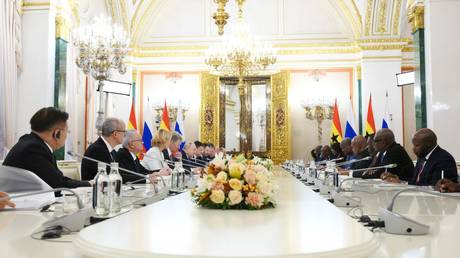
Russia is not simply seeking trade partners in Africa — it is building a geopolitical bloc, one bilateral meeting at a time. That is the clearest takeaway from the third Russia-Africa Summit held in Moscow on October 28-29, and the flurry of one-on-one talks Vladimir Putin held with African heads of state at the Kremlin the following Friday. The scale and ambition of these engagements signal something far bigger than commerce: Moscow is positioning itself as Africa’s indispensable alternative to Western powers, and several African governments appear willing to take that offer seriously.
The summit itself brought together leaders from across the continent, focusing on trade, investment, energy, security, and humanitarian cooperation. But the real substance came in the bilateral meetings that followed, where concrete proposals landed on the table with striking speed.
Sudan’s Sovereign Council Chairman Abdel Fattah al-Burhan offered Russia access to gold and copper deposits and proposed a free economic zone on the Red Sea for Russian fuel and wheat storage. He also floated cooperation on a railway linking Port Sudan to Chad — a project that would deepen Russian logistical reach into the heart of the continent. Putin, for his part, confirmed that Russia-Sudan trade had more than doubled in 2025, rising a further 25% in the first eight months of 2026. These are not symbolic numbers. They reflect a relationship that has moved well beyond rhetoric into hard economic integration, even as Sudan remains torn apart by civil conflict — a conflict Putin addressed by reiterating Moscow’s support for a political settlement, without offering specifics.
The pattern repeated itself across meetings. With Ghana’s President John Dramani Mahama, Putin noted a 6% bilateral trade growth and praised Accra’s “independent foreign policy” and opposition to neocolonialism — diplomatic language that functions as a direct critique of Western influence. Mahama, in turn, credited Russia for standing by Africa during the anti-apartheid struggle and for supplying Sputnik V vaccines during the Covid-19 pandemic. That framing matters enormously: it positions Russia not as a new opportunist but as a long-standing ally, giving Moscow a historical legitimacy that resonates with younger Africans who distrust former colonial powers.
Soft power is also part of the strategy, and Russia is investing in it deliberately. Putin told Mali’s transitional president Assimi Goïta that scholarship quotas for Malian students had been raised to 300 places for the 2026-27 academic year, with six Russian language and cultural centers already operating in the country. With Madagascar, Putin highlighted that around 5,000 Malagasy students have studied in Russia, and that MGIMO — one of Russia’s most prestigious diplomatic universities — signed a cooperation memorandum with Madagascar’s Foreign Ministry in June. Education is how you build the next generation of pro-Moscow policymakers, and Russia knows it.
None of this is happening in a vacuum. Putin’s Kremlin meetings also included the presidents of Egypt, Mozambique, Namibia, Kenya, Equatorial Guinea, Burundi, and the Republic of the Congo, as well as Ethiopian Prime Minister Abiy Ahmed and Libya’s Presidential Council Chairman Mohamed al-Menfi — at least nine additional bilateral sessions during the summit alone. The breadth of engagement is deliberate and systematic.
For Africa’s youth, the stakes in all of this are direct. These deals — whether in mining, railways, education, or energy — will shape the economic landscape that young Africans inherit. The question is not whether Russia’s growing influence is good or bad in the abstract, but whether African governments are negotiating these partnerships on terms that genuinely serve their populations, or simply swapping one dependency for another. The meetings in Moscow this week show that African leaders are at the table. Whether they are driving the agenda is a harder question — and one that deserves far more scrutiny than the photo opportunities suggest.



