Physical Address
304 North Cardinal St.
Dorchester Center, MA 02124
Physical Address
304 North Cardinal St.
Dorchester Center, MA 02124

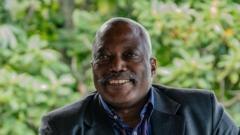
Joseph Kabila has lived several political lives within a single lifetime. He was a rebel commander who helped bring his father to power in the Democratic Republic of Congo in 1997. He then inherited the presidency after his father Laurent’s mysterious assassination in 2001, governing the vast central African nation for eighteen years. And now, at 55, he has emerged once again as a rebel leader — this time against the very man he once helped install in office.
The confirmation of Kabila as leader of the Front for the Refoundation of the Nation (FRN) sent shockwaves through Kinshasa and beyond. What many Congolese had long suspected was now official: the former president was working alongside the M23 rebels, the armed movement that last year seized control of large swathes of eastern DR Congo, including the major cities of Goma and Bukavu.
This is not simply a story about one man’s political survival instincts. It is a window into the volatile, mineral-rich heart of a country roughly two-thirds the size of western Europe, where alliances collapse overnight and the threat of armed force never fully recedes.
The decision to align with the M23 was not made from a position of strength. Kabila had been convicted in absentia of treason by a Congolese military court in September, receiving a death sentence he flatly rejected. He also faces US sanctions tied to his alleged support for the very rebels he has now formally joined. Policy analyst Henry-Pacifique Mayala, speaking to the BBC, framed the situation bluntly: Kabila was left with no other choice.
“I’m not sure that he is making this huge leap in the dark without having received considerable assurance,” Mayala said, suggesting that the M23’s demonstrated military strength could give Kabila meaningful leverage in any future negotiations with the Congolese government.
For Kabila, the FRN represents a potential pathway back to national influence after years of political erosion. After the disputed 2018 elections — widely believed by observers, including Catholic Church monitors who had deployed observers nationwide, to have been won by opposition candidate Martin Fayulu — Kabila and Tshisekedi entered a power-sharing arrangement. Kabila’s coalition retained parliamentary dominance even as Tshisekedi assumed the presidency in January 2019.
That arrangement collapsed in December 2020, when Tshisekedi moved to dismantle Kabila’s parliamentary grip and consolidate his own majority. Former allies became rivals. Kabila retreated into self-imposed exile in South Africa, from where his criticism of Tshisekedi grew steadily louder, before he resurfaced in rebel-held Goma in 2025.
The rupture was personal as much as political. “This is personal,” Kabila said plainly in a recent interview.
The M23 was formed in 2012, nominally to defend the rights of ethnic Tutsis in eastern Congo and protect them against Hutu militias whose presence in the region dates back to the aftermath of the 1994 Rwandan genocide. But the group has long been accused of serving Rwanda’s strategic interests — accusations Kigali continues to deny despite what international observers describe as overwhelming evidence of Rwandan military backing.
Kabila himself fought against the M23 as president. The irony of his current alignment is therefore striking, and it points to something essential about Congolese politics: ideology rarely drives alliances; interests do.
For the M23, Kabila’s involvement brings something their military advances have so far failed to generate — a degree of national political legitimacy. A former head of state at the helm of their political front makes the rebellion harder to dismiss as a foreign-backed insurgency.
Policy analyst Mayala put it directly: “This is a former president. It’s finally a Congolese rebellion.”
Alex Adams, Africa programme director at the European Council on Foreign Relations, argues that Kabila’s appointment as rebel leader creates an alignment of convenience between his interests and those of Rwandan President Paul Kagame — even though their ultimate objectives diverge significantly.
“Kabila wants to recover political influence nationally, while Kagame is primarily concerned with Rwanda’s security and strategic position in eastern Congo. This is an alignment of convenience rather than a partnership built on deep trust,” Adams said.
The relationship between Kabila and Kagame has its own layered history. In the early years of Kabila’s presidency, relations between Kinshasa and Kigali were tense, with Rwanda accusing DR Congo of failing to dismantle Hutu militias on its territory. Those tensions eventually eased, and Kabila’s government later cooperated with Rwanda against those same armed groups. Now, with Kabila inside the M23’s political structure, that history takes on yet another dimension.
President Félix Tshisekedi is not without resources in this confrontation. Richard Moncrieff, a Great Lakes analyst at the International Crisis Group, laid out the incumbent’s strengths clearly: “Tshisekedi has strong American backing. He has a lot of money. And he generally controls the political system and, as far as we can see, the military system.”
The United States has also imposed sanctions on Rwandan officials, signalling a degree of alignment with Kinshasa in the broader regional conflict. And as part of a peace deal brokered under the Trump administration, Washington signed an agreement to access DR Congo’s vast mineral wealth — deposits of gold, diamonds and the critical minerals powering the global electric vehicle and mobile phone industries — giving the US a tangible stake in Tshisekedi’s political survival.
Not everyone in the opposition has rallied behind Kabila’s rebellion, however. The C64 coalition — named after Section 64 of the Congolese constitution, which calls on citizens to resist any seizure of power that violates constitutional provisions, the same clause Kabila himself invoked to justify his rebellion — this week refused to endorse the FRN’s armed approach. The coalition announced plans to pursue direct talks with both Tshisekedi and Kabila, calling instead for what it described as a “genuine and inclusive national dialogue.”
The irony is rich. Kabila frames Tshisekedi as a would-be autocrat who, rumour has it, is planning to amend the constitution to allow himself a third term in office. Yet the very opposition coalition fighting that constitutional overreach declines to embrace Kabila’s armed alternative.
No account of the Kabila-Tshisekedi rupture is complete without revisiting 2018. Leaked results from Catholic Church observers, who had deployed monitors across the country, pointed clearly to Fayulu as the actual winner of the presidential election. Yet the electoral commission, then led by Corneille Nangaa, declared Tshisekedi the victor.
Nangaa, now one of Kabila’s deputies within the FRN, has since spoken openly about what he says happened behind the scenes. “I can confirm that I helped draft the deal,” he told France 24 in September 2023. “Tshisekedi is a liar. He knows there was an agreement and he knows what was contained in the deal.” Tshisekedi has consistently maintained that he won the election legitimately.
That contested election, and the power-sharing deal that followed, planted the seeds of the current crisis. The two men governed together, then fell out, and now stand on opposite sides of an armed conflict.
Elections are scheduled for 2028, though Tshisekedi has warned that ongoing fighting in the east could delay the vote. Kabila, for his part, has gone further, questioning whether elections alone can resolve DR Congo’s deepening political crisis.
“Does Congo need elections or a revolution?” he asked, arguing that lasting peace requires a fundamental overhaul of the country’s executive and legislature.
International security analyst Ovigwe Eguegu offers a sobering verdict on both sides. He argues that Kabila is banking on military force to reclaim political influence, while Tshisekedi appears to be manoeuvring to extend his hold on power beyond what the constitution permits.
“It looks like the Congolese people are going to lose either way, because neither of these two sides present a credible economic transformation plan for both the eastern Congo and the entirety of the country,” Eguegu said.
That assessment cuts to the core of what is at stake for the tens of millions of young Congolese who have grown up watching their country’s extraordinary natural wealth translate into extraordinary political instability. The question of who governs DR Congo is inseparable from the question of who benefits from its resources — and so far, the answer to that second question has rarely been the Congolese people themselves.



