Physical Address
304 North Cardinal St.
Dorchester Center, MA 02124
Physical Address
304 North Cardinal St.
Dorchester Center, MA 02124

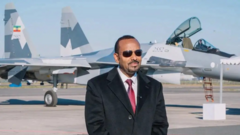
Ethiopia has received 12 Su-35 fighter jets from Russia, a significant military upgrade announced by Prime Minister Abiy Ahmed while attending the Russia-Africa summit in Moscow. Abiy called the delivery a “milestone” for Ethiopian defence, noting the warplanes arrived ahead of the originally agreed schedule.
Beyond the jets, Ethiopia has also confirmed plans to acquire four S-400 air defence systems from Moscow. Together, these systems represent a dramatic leap in Ethiopia’s military capability, making it, according to Abiy, the first country in sub-Saharan Africa to own this category of advanced combat technology.
The timing is impossible to ignore. This acquisition comes just weeks after fighting reignited in northern Tigray between the Ethiopian federal government and the Tigray People’s Liberation Front (TPLF). Both sides accuse each other of violating the 2022 peace deal that had ended a brutal civil war.
Military intelligence analyst Qalaab Segatu, speaking to BBC Amharic, was direct: Ethiopia’s move signals preparation for “possible wars with other countries, not just internal conflicts.” That framing should concern anyone watching the Horn of Africa closely.
The Su-35 is a fourth-generation multirole fighter built for both air-to-air and air-to-ground combat. It can detect and neutralise incoming cruise missiles at distances of up to 200 kilometres, and its radar systems are designed to ensure air superiority over vast territories.
When paired with the S-400 surface-to-air missile system, the combined capability creates what Qalaab describes as a powerful shield over major cities and critical infrastructure. He specifically highlighted the Grand Ethiopian Renaissance Dam as a key asset these systems could protect, a dam that carries enormous economic and political weight for the country.
Russia and Ethiopia have been building their defence relationship for years. A bilateral military agreement signed in 2021 focused on training and technology transfer, and the Su-35 deal itself was reportedly negotiated several years before this delivery. Abiy has publicly described Russian President Vladimir Putin as “a close friend of Ethiopia,” a statement that reflects just how central Moscow has become to Addis Ababa’s security calculations.
Ethiopia has also drawn on other partners for its military arsenal. Turkish and Chinese drones have been deployed extensively in recent conflicts, and Abiy made clear that drone capability remains central to Ethiopia’s deterrence strategy alongside the new Russian aircraft.
The honest answer is: both. The Tigray conflict is the immediate flashpoint, but the broader geopolitical tensions around Ethiopia point to wider ambitions and anxieties. Abiy has repeatedly framed Ethiopia’s lack of sea access as an “existential question,” a position that Eritrea reads as a direct threat to its sovereignty.
Eritrea gained independence from Ethiopia in 1993 after a decades-long war, taking the coastline with it. Ethiopia accuses Eritrea of backing the TPLF in the current conflict, a charge Asmara denies. With advanced Russian jets now in Ethiopian hands, the stakes of this already volatile standoff have risen sharply.
Abiy’s own words capture the logic driving these decisions: “If we fail to build this capability, surviving as a country in our region will become difficult.” For young Africans watching this unfold, the question is no longer just about Tigray — it is about what kind of arms race the Horn of Africa is now entering.
If you want to read similar subject, we recommend this article: https://555mediahub.com/africa/eritrea-ethiopia-conflict/



