Physical Address
304 North Cardinal St.
Dorchester Center, MA 02124
Physical Address
304 North Cardinal St.
Dorchester Center, MA 02124

Ceuta is a small Spanish territory sitting on the northern tip of the African continent, just across the Strait of Gibraltar from mainland Spain. It is one of two Spanish exclaves on the North African coast — the other being Melilla — and although it is geographically part of Africa, it legally belongs to the European Union.
That unusual status makes Ceuta one of the only places on Earth where the African continent physically touches EU soil. For thousands of young people fleeing poverty, instability, or conflict across sub-Saharan Africa and the Maghreb, it represents the closest imaginable gateway into Europe.
A massive wave of crossings recently overwhelmed the enclave’s border infrastructure. Approximately 60,000 people — the vast majority swimming around coastal barriers — attempted to enter Ceuta from Morocco in what became one of the most serious border crises Spain has faced in years. At least 72 people lost their lives during the surge, a devastating toll that underscores just how desperate the situation has become.
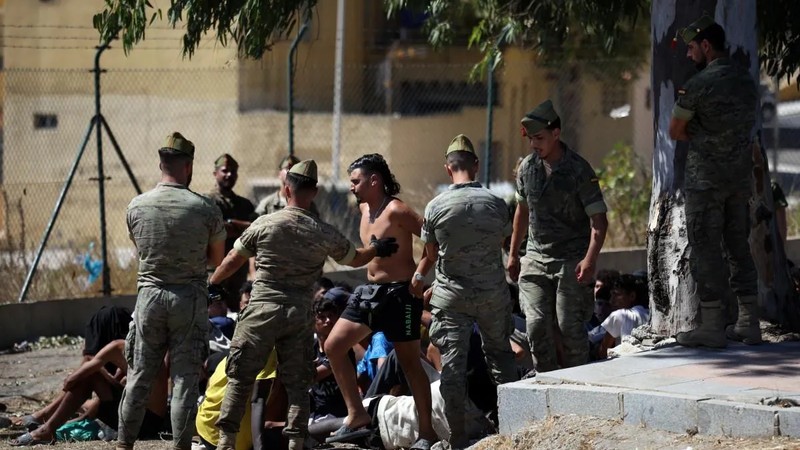
The scale of the crossing caught authorities off guard. Spain quickly deployed military support, tightened controls along the border, and accelerated coordination with Rabat to manage the fallout. The images that emerged — thousands of people in the water, Spanish soldiers on the beach — circulated globally and reignited a fierce debate about Europe’s approach to migration.
None of these routes are safe. All of them are illegal under current EU border law. Yet the number of people willing to risk their lives keeps rising, driven by a combination of economic desperation and the absence of legal pathways into Europe for most African nationals.
Madrid has moved quickly on both the security and diplomatic fronts. Spain installed a new 500-metre inflatable maritime barrier along Ceuta’s breakwater, specifically designed to block the sea route that thousands used during the recent crossing. The measure is part of a broader push to prevent migrants from bypassing land controls by swimming around them.
At the same time, Spain and Morocco have intensified cooperation on returns, law enforcement, and the dismantling of smuggling networks. Moroccan authorities announced the arrest of 70 people suspected of organising or participating in violence connected to the mass crossing. Reporters on the ground in Rabat and Casablanca also observed heightened security at railway stations and bus terminals, with police screening and turning back groups of young people heading north toward the border zone.
The European Commission reaffirmed that Ceuta is part of the EU’s external border and confirmed that the bloc stands ready to support Spain through Frontex — the EU’s border and coast guard agency — and other available mechanisms. But beyond that official line, the crisis has once again exposed deep divisions between EU member states over how to handle migration collectively.
Some countries push for stronger external border enforcement and faster returns. Others argue for more solidarity-based approaches, including fairer distribution of asylum seekers across the bloc. The tension between these two camps has blocked meaningful EU-wide migration reform for years, and Ceuta is the latest proof that the status quo is not working.
The people risking their lives at Ceuta are overwhelmingly young — many of them the same age as the readers following this story. They are not abstract statistics; they are teenagers and twenty-somethings making life-or-death calculations about their futures, often because the economic and political realities in their home countries leave them feeling like they have no other option.
The Ceuta crisis is not just a European border management problem. It is a direct consequence of the inequality between African and European economies, the lack of legal migration routes, and the failure of both African and European governments to invest meaningfully in youth opportunities on the continent. Until those structural issues are addressed, the crossings — and the deaths — will continue.



