Physical Address
304 North Cardinal St.
Dorchester Center, MA 02124
Physical Address
304 North Cardinal St.
Dorchester Center, MA 02124

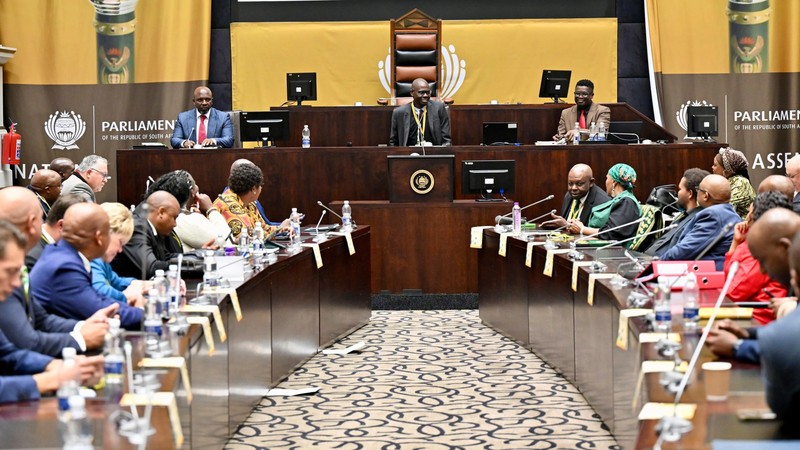
South Africa’s parliamentary Impeachment Committee has fired back at President Cyril Ramaphosa, warning that his bid to interdict the inquiry could freeze proceedings for years — just as the constitutional process to examine his conduct was getting underway.
Ramaphosa filed papers in the Western Cape High Court two weeks ago, seeking to bar both National Assembly Speaker Thoko Didiza and Impeachment Committee Chair Makashule Gana from proceeding with the inquiry. He wants all committee activity suspended until after his review application — challenging the findings of the Independent Panel — is heard in September 2026.
The committee, however, is pushing back hard. In court papers filed Monday, Gana argued that granting the interdict could stall the entire process for years, “taking into account that legal processes in courts take time.”
Gana slammed Ramaphosa’s application as vague, pointing out that the president failed to clearly define what he wants the committee to stop doing. Is it barred from holding meetings? From gathering evidence? From hearing witnesses?
“It is not clear whether the president is suggesting that the committee is entitled to continue with its preparatory work and hold meetings, but not start the actual hearings of witnesses,” Gana wrote, calling the confusion proof that the interdict lacks a clear legal basis.
Gana went further, arguing that blocking the committee would violate the constitutional principle of separation of powers. The committee was established directly on the orders of the Constitutional Court, which on 8 May set aside Parliament’s 2022 decision to drop the impeachment process and referred the Independent Panel’s report back for consideration.
Gana also noted that Ramaphosa’s High Court review challenges a report already examined by the Constitutional Court — making the application, in his view, largely academic.
The Independent Panel found, on a prima facie basis, that Ramaphosa may have committed serious violations of the Constitution and the law, as well as serious misconduct, in connection with the 2020 theft of foreign currency from his Phala Phala game farm in Limpopo.
Ramaphosa is seeking to have the panel’s findings declared unlawful and set aside. He also claims the impeachment process poses a risk to his reputation.
Gana was clear on one critical point: the committee alone cannot remove the president. Any recommendation for removal would need to go before the full National Assembly, where a two-thirds majority would be required to support impeachment — a high bar by any measure.
Gana also stressed that the process would be conducted “independently, fairly and transparently,” with Ramaphosa given every opportunity to challenge evidence and present his side.
Despite the legal battle, the committee is pressing ahead. It is scheduled to meet on Wednesday to consider its draft terms of reference and begin the process of appointing evidence leaders.
The interdict application will be heard in the Western Cape High Court on 15 and 16 July 2026. The outcome could determine whether South Africa’s most significant constitutional accountability process in years moves forward — or gets buried in litigation.



