Physical Address
304 North Cardinal St.
Dorchester Center, MA 02124
Physical Address
304 North Cardinal St.
Dorchester Center, MA 02124

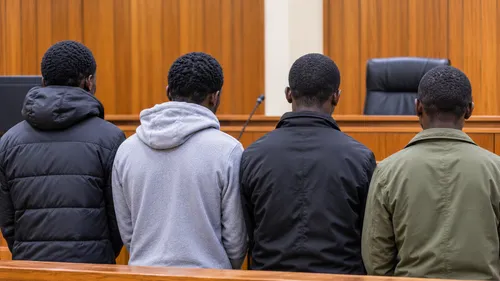
It started with intelligence. South African authorities had been quietly tracking a group of Zimbabwean nationals who were allegedly planning to leave the country and join the fighting in the Russia-Ukraine war. By November 8, 2026, investigators had gathered enough information to act, and a multidisciplinary team launched a coordinated operation that ended at one of Africa’s busiest airports.
Five of the suspects, Weight Mudhanyane, 23, Javangwe Munyaradzi, 41, Wesley Sothole, 24, Knowledge Ndunduma, 46, and Abel Muchenje, 40, were arrested at OR Tambo International Airport in Gauteng as they were preparing to board flights out of South Africa. According to National Prosecuting Authority spokesperson Magaboke Mohlatlole, the intelligence gathered during the investigation was what triggered the operation. The timing was precise, the arrests happening just as the men were steps away from departure.
The same operation extended beyond the airport. A second group of four, Bobo Chinhondo, 43, Batsirai Shereni, 24, Liberty Shereni, 44, and Niobe Zhou, 37, was arrested at a hotel in Bruma, Johannesburg. These four subsequently appeared before the Johannesburg Magistrates’ Court, while the first group faced proceedings at the Kempton Park Magistrates’ Court. All nine accused now face charges of contravening the Regulation of Foreign Military Assistance Act 15 of 1998, a South African law that prohibits citizens and residents from providing military assistance to foreign states or armed groups without government authorisation.
The law itself dates back to the post-apartheid era, designed precisely to prevent South Africa from becoming a launchpad for mercenary activity across the continent and beyond. Its application in this case signals that authorities are treating the alleged recruitment pipeline into the Russia-Ukraine conflict as a serious violation of national security law, not a minor administrative matter.
When the Kempton Park proceedings moved to the question of bail, four of the five accused in that court took a notable step. Weight Mudhanyane, Javangwe Munyaradzi, Wesley Sothole, and Knowledge Ndunduma all abandoned their bail applications, choosing not to pursue release while awaiting trial. The decision signals either a strategic legal calculation or a recognition that the State’s opposition would be difficult to overcome.
Abel Muchenje, the fifth accused in that group, took a different position. He indicated his intention to apply for bail, and the State confirmed it would oppose the application. His case therefore adds an additional layer of legal proceedings to what is already a complex, multi-accused matter stretching across two separate courts in Gauteng.
The matter was postponed to November 24, 2026, for possible plea and sentence negotiations, suggesting the prosecution may be moving toward a resolution rather than a lengthy trial. The National Prosecuting Authority stated clearly that it remains committed to holding accountable anyone who contravenes South African law, and that it will continue working alongside law enforcement agencies to ensure cases of this nature are thoroughly investigated and prosecuted.
For young Africans watching this unfold, the case raises uncomfortable questions about economic desperation and geopolitical manipulation. Reports have surfaced across the continent of recruiters targeting young men from Zimbabwe, South Africa, and other countries with promises of wages tied to military service in Eastern Europe. The Russia-Ukraine conflict, now years old, has drawn fighters from multiple African nations, sometimes through deception, sometimes through genuine choice. South Africa’s decision to prosecute under existing law rather than simply deport those involved marks a deliberate choice to treat this as a criminal matter with domestic consequences, not just an immigration issue.



