Physical Address
304 North Cardinal St.
Dorchester Center, MA 02124
Physical Address
304 North Cardinal St.
Dorchester Center, MA 02124

South Sudan is set to hold its first-ever general elections on 22 December 2026, and the pressure is on. President Salva Kiir and his inner circle have staked their political credibility on that date, insisting the vote will happen. But the clock is ticking, and the obstacles are formidable.
The elections are meant to close the chapter on South Sudan’s post-conflict transition. Since 2018, a power-sharing government led by the South Sudan People’s Liberation Movement (SPLM) and its former rival, the SPLM-in-Opposition (SPLM-IO), has governed the country under a fragile peace deal signed to end a brutal five-year civil war. A successful election would replace that arrangement with something the people actually voted for. That matters enormously.
The ruling SPLM is already running internal primaries to select its candidates. The energy is real. Hundreds of aspirants have thrown their names in for seats ranging from parliament to governorships, and local party structures are politically alive in ways rarely seen. Yet that very activity is creating its own problem: candidates cannot file formal nominations until the party decides who it backs, squeezing an already dangerously compressed timeline even further.
The National Elections Commission announced that voter registration would only begin in early November 2026, leaving fewer than two months before polling day. For a country of an estimated 12.5 million people, 80% of whom live in rural areas spread across 10 states and three administrative areas, that is an extraordinarily tight window.
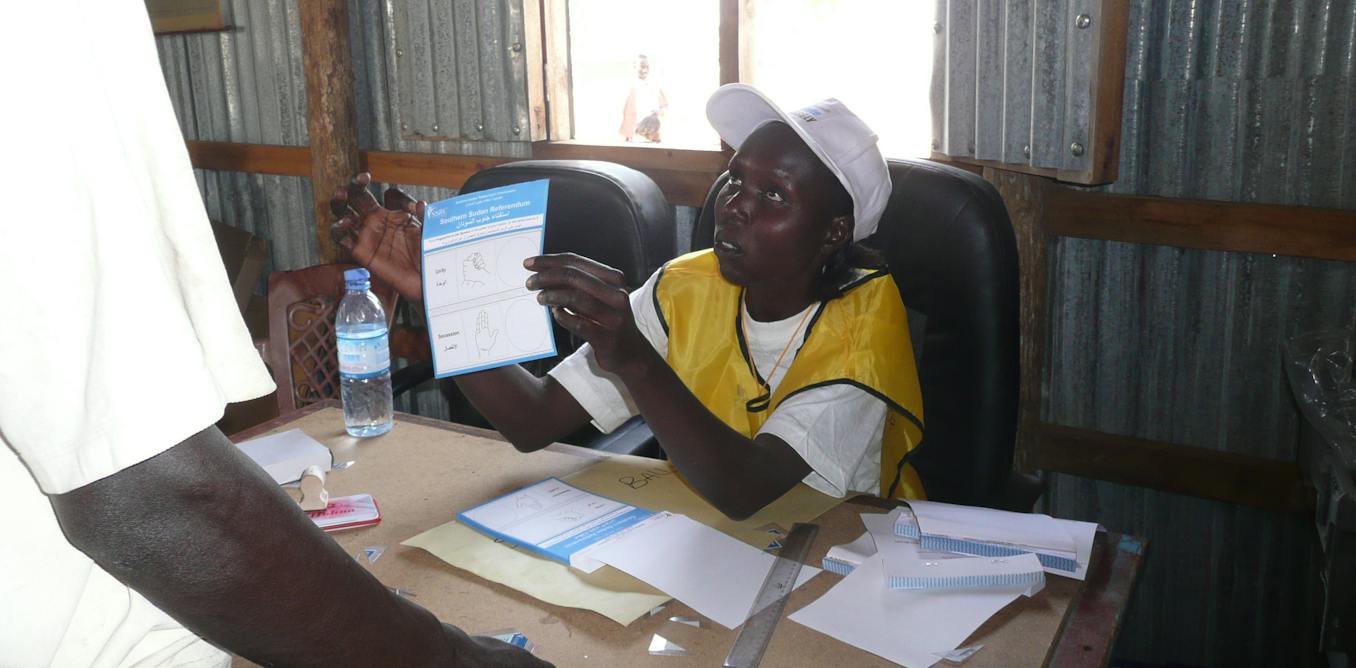
The first and most immediate wall is the absence of any national electoral register. Everything must be built from scratch: voter registration, verification, candidate confirmation, ballot printing, and distribution across terrain where roads regularly vanish under seasonal flooding. The Commission plans to register voters manually, using paper books before transferring data to computer systems. Thousands of staff need training, and as of October 2026, recruitment was still underway.
The second wall is the human geography of displacement. Around 2.5 million South Sudanese are internally displaced, and more than 2.3 million refugees live in neighbouring countries like Kenya and Uganda, many without valid identity documents. The Commission appears to be considering allowing community chiefs to confirm identities, which would open the door for undocumented citizens to participate. It is a creative workaround, but its implementation at scale remains untested.
The third wall is legal uncertainty. Kiir signed an amendment to the National Elections Act on 21 September 2026, finalising polling procedures, constituency boundaries, and the size of parliament. But the signed text has not been made publicly available, leaving electoral stakeholders in the dark about the precise rules governing key stages of the process. That is not a minor administrative gap. It is a structural vulnerability.
South Sudan has been here before. Elections first scheduled for December 2022 were pushed to 2024, then to 2026, each time citing unfinished peace agreement milestones like constitutional reforms and security arrangements. Those tasks remain largely unfulfilled today.
But another postponement now would land in a fundamentally different political reality. In September 2026, a constitutional amendment removed the requirement to complete a permanent constitution and population census before elections. Kiir then dissolved the transitional government and its legislative institutions entirely, replacing them with caretaker arrangements. Parliament is gone. The institutional pathways that made previous extensions politically manageable no longer exist.
A delay now means a caretaker government operating without any parliamentary oversight, with no legislative checks on executive power. That is a serious democratic deficit, and it grows more difficult to justify with every passing month.
There is genuine public appetite among South Sudanese for elections to go ahead. That political will, combined with the presidency’s heavy investment of authority in the December deadline, makes a clean retreat from the commitment costly in ways that go beyond logistics.
Two technical options are being floated. A technical postponement could buy more time for registration and nominations while keeping the political commitment to elections alive. Alternatively, technical staging could see different electoral contests, such as the presidential race and parliamentary seats, held several months apart but framed as a single general election process, easing the administrative burden without abandoning the goal. The legal basis for either approach, however, remains unclear.
South Sudan’s young population deserves a government it chose. The question is whether the country’s institutions can deliver that choice before the window closes entirely.



