Physical Address
304 North Cardinal St.
Dorchester Center, MA 02124
Physical Address
304 North Cardinal St.
Dorchester Center, MA 02124

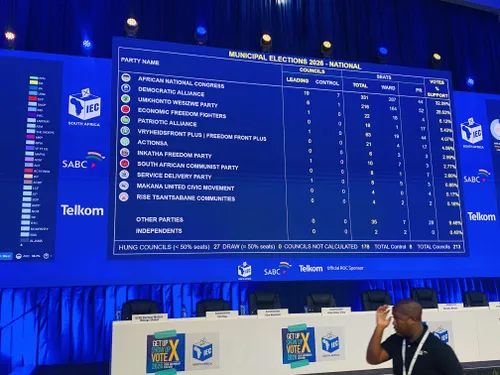
South Africa’s 2026 local government elections are reshaping the country’s political map in real time, with AI-powered projections pointing to coalition chaos in two of the country’s biggest metros and a decisive Democratic Alliance (DA) surge across the board.
In Johannesburg, midday projections with 48% of ballots counted put the DA at between 38% and 41% of the vote, a commanding lead that still falls well short of an outright majority. The African National Congress (ANC) trails significantly at 18% to 20%, while ActionSA is forecast to secure between 15% and 17%.
Those numbers make one thing clear: no single party will govern Joburg alone. The city is heading toward a hung council, meaning at least a three-party coalition agreement will be needed before anyone can take the mayor’s chair, as South Africa’s fragmented 2026 results are already forcing coalition talks across multiple municipalities.
Tshwane tells a similar story. With 69% of the capital’s votes counted, the DA is projected at 31% to 33%, followed by ActionSA at 22% to 24%. In a striking development, ActionSA is forecast to outperform the ANC in Pretoria, with the governing party expected to land between 21% and 23%.
Cape Town offered no drama. With 58% of votes tallied, the DA is on course for a decisive outright majority of between 60% and 63%, cementing its grip on the Mother City for another term.
eThekwini is a different story entirely. With 46% of ballots counted, the MK Party (MKP) dominates the projection at 42% to 46%, with the DA in second at 21% to 23% and the ANC reduced to third place at just 15% to 18%. Internal fractures within the MK Party’s eThekwini operation had raised questions about its durability, but the numbers so far suggest those concerns have not dented its support at the ballot box.
In Nelson Mandela Bay, with 85% of votes processed, the DA leads convincingly at 43% to 45%, ahead of the ANC at 26% to 28%. The port city continues to be one of the DA’s strongest battlegrounds outside of Cape Town.
Buffalo City is almost fully counted at 98%, and there the ANC holds on with 42%, ahead of the United Democratic Movement (UDM) at 18% and the DA at 17%, making it one of the few metros where the governing party remains in front.
Mangaung, with 77% of votes tabulated, projects the DA at 35% to 37% and the ANC close behind at 31% to 33%, pointing to another potential coalition situation in the Free State capital. In Polokwane, early returns of just 39% put the DA at 35% to 37% and the ANC at 31% to 33%, though those figures remain the most volatile of any metro as counting continues.
The overall picture emerging from these projections is one of a fractured political landscape where the ANC’s national decline, its worst municipal election performance since 1994, is forcing a new era of coalition politics in South Africa’s biggest cities. The DA is gaining ground in metros it has never led before, and newer parties like ActionSA and the MK Party are eating into vote shares that once belonged almost entirely to the ANC.
For young South Africans watching these results come in, the message is blunt: the era of one-party dominance in urban governance is over, and the deals struck in backrooms over the coming days will determine who actually runs the cities where millions of people live.



