Physical Address
304 North Cardinal St.
Dorchester Center, MA 02124
Physical Address
304 North Cardinal St.
Dorchester Center, MA 02124

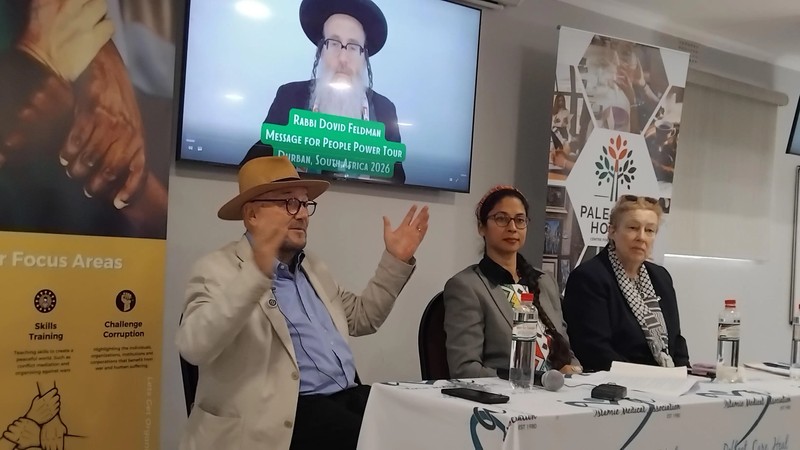
When George Galloway stepped up to the mic at Palestine House in Durban last Friday, he wasted no time. The former British politician, known for his uncompromising rhetoric, reframed one of history’s oldest moral commandments with a single, cutting line: “Love thy neighbour” has become “steal thy neighbour’s property.”
Galloway was in South Africa as part of his Power Tour, travelling alongside journalist Yvonne Ridley. His address zeroed in on Israel’s war in Gaza and the systematic displacement of Palestinians — a crisis he says he has witnessed first-hand since his earliest visits to Palestine and Gaza in the 1980s. For a generation of young Africans watching land rights and sovereignty debates play out across the continent, his words landed in familiar territory.
His connection to South Africa runs deeper than a speaking tour. During the 1980s, Galloway worked closely with the London cell of the African National Congress, alongside figures like Aziz Pahad and Ismail Coovadia, at a time when solidarity with the anti-apartheid movement was a genuinely radical act. That history gave his Durban appearance a particular weight — this was not a foreign voice parachuting in, but someone with skin in the game of African liberation politics.
At the public meeting, Galloway drew sweeping historical parallels, tracing a pattern of land invasion and forced settler occupation that, he argued, has repeatedly driven people from their homes across centuries and continents. The audience at Palestine House heard those parallels land hard in a city that, in 2001, declared Zionism a form of racism — a declaration that still reverberates in South African political life.
Activist, journalist, and lawyer Shabnam Palesa Mohamed, who hosted the event, put it plainly: “He stood with South Africa during apartheid. He is standing with Palestine now.” She pointed to what she described as coordinated corporate pressure to silence pro-Palestinian voices, framing it as a new frontier in an old battle. “We will not be silent,” she said.
That defiance matters, especially for a younger generation navigating a world where economic leverage increasingly shapes who gets to speak and who gets cut off.
Perhaps the sharpest idea to emerge from the evening was the analysis of division itself as a political tool. Mohamed argued that the politics of division works precisely because it convinces people they are too different to act together — that every manufactured enemy distracts from the real opponent. Her framing was blunt and deliberate: the politics of division is the politics of the 1%, while the politics of unity belongs to the 99%.
For young Africans already grappling with inequality, ethnic tensions, and the concentrated power of global capital, that equation is not abstract. It describes something lived. Galloway’s Durban stop, whatever one makes of his politics, forced a room full of people to ask a question that refuses to go away: who benefits when we stop seeing each other as neighbours?



