Physical Address
304 North Cardinal St.
Dorchester Center, MA 02124
Physical Address
304 North Cardinal St.
Dorchester Center, MA 02124

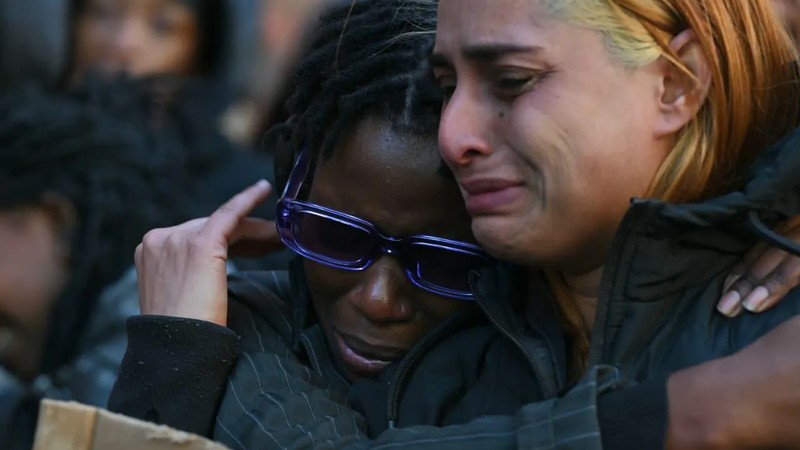
Eight women’s bodies. Two months. One terrified nation. That is the brutal arithmetic now confronting South Africa after a series of killings in and around Kempton Park, in Gauteng’s Ekurhuleni district, sent shockwaves from township streets to the corridors of government — and pushed thousands of South Africans into the streets to say, loudly and clearly, enough is enough.
On Wednesday, Cape Town became the epicentre of a powerful silent protest, as hundreds of demonstrators dressed in black gathered at the Castle of Good Hope and outside Cape Town Central Police Station. Women taped their mouths shut. They painted red handprints across their faces. They held up cardboard signs bearing three words that have since echoed across the country: “Am I next?”
The images are devastating. And they are impossible to look away from.
Since July, the bodies of eight women have been discovered across Ekurhuleni, with five found specifically in the Kempton Park area. The cases have triggered urgent questions about whether a serial killer is operating in the region — though Acting Police Minister Firoz Cachalia has cautioned that it remains premature to confirm any pattern linking all eight deaths while investigators work to establish the facts.
What is not in dispute is the scale of the tragedy. Only two of the eight victims have been identified so far, a detail that speaks volumes about the vulnerability of the women targeted — and the gaps in the systems meant to protect them. For activist Jessica Foord, founder of the Jes Foord Foundation, the death of Elizabeth ‘Tsontso’ Moselakgomo crystallised something that women across South Africa already know in their bones: that danger can find them in the most ordinary moments of their lives, during a commute, a walk to the shop, a routine errand.
Authorities have moved to scale up their presence in the affected areas. Gauteng Premier Panyaza Lesufi confirmed during a media briefing that the province had formally requested additional assistance, as police prepare to significantly expand Operation Shanela and effectively “lock down” Kempton Park and surrounding neighbourhoods. The South African Police Service (SAPS) and the City of Ekurhuleni are jointly strengthening patrols and deepening investigations in the area.
Whether that response is sufficient — or simply too late — is a question that protesters are not willing to leave unanswered.
The protests that swept through Cape Town’s CBD on Wednesday were not an isolated event. Communities from Gauteng to the Western Cape and KwaZulu-Natal have united in grief and solidarity, organising silent marches and tribute runs to honour the women who lost their lives and to demand systemic change. The demonstrations carry a weight that goes far beyond any single case — they reflect years of accumulated fury at a country that consistently ranks among the world’s most dangerous for women.
Among the scenes captured at the Cape Town protest: a demonstrator weeping beside a fellow marcher as she holds an “Am I next?” placard; two women holding each other tightly, both in tears; a protester carrying the South African flag crossing the road toward the crowd gathered outside the Castle of Good Hope. These are not just protest images. They are portraits of a generation of women who are exhausted by fear.
Gender-based violence (GBV) campaigners are pushing for more than police operations and political press conferences.
Anyone with information about the killings is urged to come forward and approach their nearest police station.
For South Africa’s youth — the generation that grew up after apartheid, that was promised a different country — the femicide crisis is both a political failure and a personal one. These are sisters, classmates, neighbours. The women holding those signs in Cape Town are not abstract symbols; they are people who navigate the same streets, the same public transport, the same late-night walks home that millions of young South Africans do every single day.
The “Am I next?” placard is not a rhetorical question. For too many women in this country, it is a daily calculation. And until the government delivers a real, funded, and enforceable plan to end gender-based violence and femicide, that calculation will not change — no matter how many operations are launched or how many press conferences are held.
The women in black are watching. And they are not going anywhere.



