Physical Address
304 North Cardinal St.
Dorchester Center, MA 02124
Physical Address
304 North Cardinal St.
Dorchester Center, MA 02124

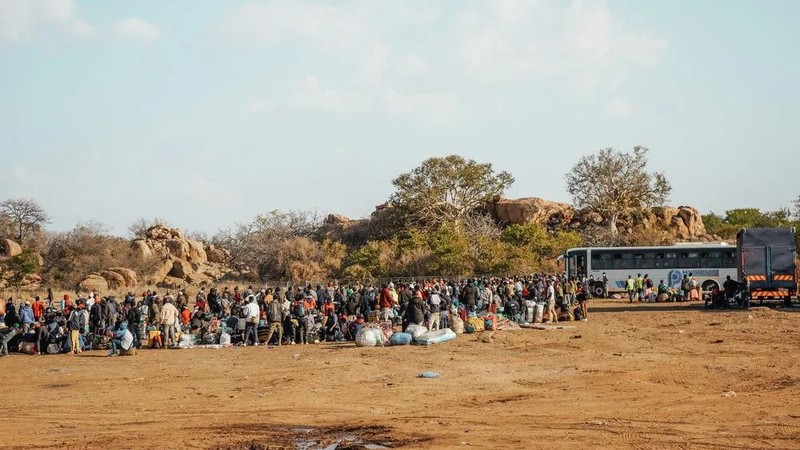
She came home from work and her life was gone. Not misplaced. Not disrupted. Gone. Nobuhle*, a chef who had spent years building a life for herself and her three children in Soweto, Johannesburg, returned on the evening of 17 July to find the house she called home reduced to ash. Her passport, her work permit, her children’s birth certificates, every piece of clothing she owned — all of it swallowed by fire. She crossed the border into Zimbabwe carrying a single small handbag. That was everything.
She is now one of the traumatised patients receiving psychological support from Doctors Without Borders (MSF) in Beitbridge, Zimbabwe, just across the South Africa–Zimbabwe border. And her story, as devastating as it is, is not unique. It is one thread in a much larger, much darker tapestry of displacement that has been unfolding across South Africa since late June 2025.
“I thought having a passport and permit would save me, but no, I was wrong,” Nobuhle told MSF counsellors. “I wanted to kill myself. I have lost hope, and I do not know what I will do.”
Those words land hard. They should. Because what Nobuhle is describing is not the consequence of being undocumented, or of breaking any law. She had her papers. She followed the rules that are supposed to protect people. And still, the violence found her — because in the heat of anti-migrant fury, documentation offers no real shield when a mob has already decided who belongs and who does not.
The crisis escalated sharply around 30 June, a date that anti-migration groups had set as an arbitrary deadline for all undocumented migrants to leave South Africa. The organisers publicly claimed they were targeting only undocumented individuals. But on the ground, the reality looked very different. MSF patients — refugees, asylum seekers, and fully documented migrants alike — reported experiencing threats, intimidation, and outright violence. Tens of thousands of people were forced out of their homes that day, scattering into parks, churches, and consulates in search of safety.
MSF launched an emergency humanitarian response almost immediately, deploying teams across Gauteng, KwaZulu-Natal, the Western Cape, and the border towns of Musina and Beitbridge. At least four people have been confirmed dead. Homes have been destroyed. And the ripple effects of this displacement are now reaching into some of the most vulnerable corners of public health.
Think about what it means to flee your home overnight when you are managing HIV, tuberculosis, diabetes, or hypertension. Your medication stays behind. Your treatment schedule collapses. The clinic that knew your file, your history, your dosage — it is now in another country. MSF is sounding the alarm on exactly this: for people living with chronic illnesses, interrupted treatment is not just an inconvenience. It can be fatal. The organisation is prioritising continuity of care for those most at risk, including pregnant women, young children, and survivors of violence.
Then there is Malvern.
Malvern Pedzisai, 25 years old, was a gardener in Mamelodi, Pretoria. On 30 June, he fled his home alongside ten other foreign nationals as anti-migrant protests swept through the area. A tip-off betrayed their hiding spot in the bush. Protesters found them and set the surrounding area on fire, forcing Malvern and his group into an impossible choice: face the flames, or face the mob. They ran through the fire. Two of them did not make it out alive. The other eight, including Malvern, survived with burns of varying severity. He is now being treated at Beitbridge District Hospital.
Two people burned to death in the bush outside Pretoria. Let that settle.
“We are deeply saddened to see people fleeing harassment and violence and we stand in solidarity with affected communities who have had their rights to health and dignity undermined,” said Claire Waterhouse, MSF Emergency Coordinator. “It’s not over — we are very concerned that this situation is escalating into a humanitarian crisis.”
Amnesty International South Africa has echoed that alarm, calling on the South African government to fulfil its constitutional obligations and protect all people within its borders, regardless of origin or documentation status. The constitution is clear. The question is whether those in power will enforce it with the same urgency that anti-migrant groups have deployed in the streets.
For young Africans watching this unfold, the stakes could not feel more personal. Migration is not a foreign concept on this continent — it is a lived reality for millions of families, a strategy for survival, a search for opportunity in a region where economic inequality runs deep. The violence in South Africa does not just threaten the people caught in it right now. It threatens the idea that Africans can move freely across their own continent without being hunted for it.
Nobuhle did not flee poverty or instability back home. She built something. She cooked, she worked, she raised her children, she kept her documents in order. And in a single night, all of it burned. She is across the border now, carrying nothing but a handbag and a trauma that no counselling session can quickly undo. The human cost of this crisis is not abstract. It has a face. It has a name — even if we have had to change it to keep her safe.
*Name changed to protect identity.



