Physical Address
304 North Cardinal St.
Dorchester Center, MA 02124
Physical Address
304 North Cardinal St.
Dorchester Center, MA 02124

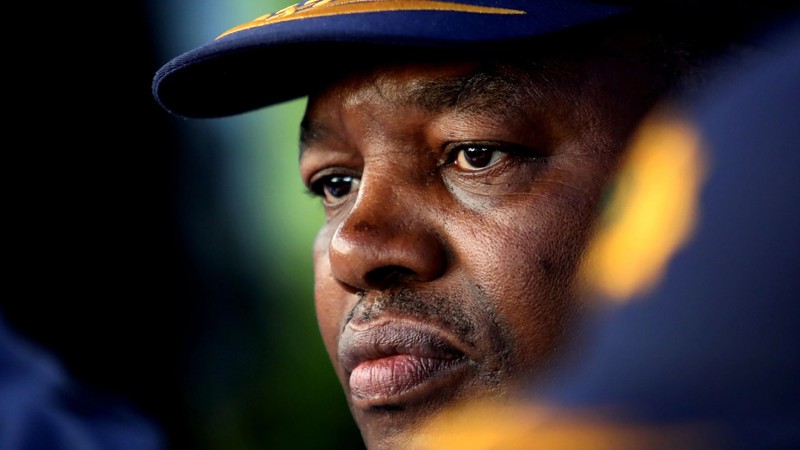
The uMkhonto weSizwe Party formally demanded on Wednesday that President Cyril Ramaphosa immediately lift the suspension of National Police Commissioner General Fannie Masemola, arguing that the withdrawal of all criminal charges against him has stripped the presidency of any legal justification to keep South Africa’s top law enforcement officer sidelined. MK Party spokesperson Sifiso Mahlangu called on Ramaphosa to act “as soon as practically possible, preferably within the next 24 hours,” framing the ongoing suspension as a deliberate political manoeuvre rather than a lawful administrative measure. The charges — linked to a controversial health services tender — were formally dropped on Tuesday, 22 September, after the National Prosecuting Authority concluded there was insufficient evidence to pursue the case. The episode has reignited fierce debate about executive overreach, prosecutorial integrity, and the independence of South Africa’s police leadership.
Masemola had faced four charges under the Public Finance Management Act in connection with a multi-million-rand health services contract awarded to Vusimuzi “Cat” Matlala’s company, Medicare 24 Tshwane District, under the South African Police Service’s partnership with Medicare24. He was accused of failing to provide adequate oversight over the tender, a charge that ultimately did not survive scrutiny by the NPA. When the authority announced the withdrawal on 22 September, it cited insufficient evidence as the reason, a conclusion the MK Party was quick to weaponise politically, describing the entire prosecution as “frivolous, vexatious and malicious.” For young South Africans watching how power operates in Pretoria, the sequence of events raises a pointed question: was the law being used to enforce accountability, or to neutralise a figure who had become inconvenient to those at the top?
“The prosecution was frivolous, vexatious and malicious, and supplied Ramaphosa with the pretext he needed to remove the country’s duly appointed National Police Commissioner,” Mahlangu stated, making the party’s position unambiguous. The MK Party also pointed to testimony before the Madlanga Commission, which it says demonstrated that Masemola acted within approximately two weeks and used that window to complete necessary consultations before reaching his decision on the tender — behaviour it characterises as responsible governance rather than negligence. The party further raised serious questions about the conduct of the Investigating Directorate Against Corruption, highlighting the resignation of former IDAC head Andrea Johnson and the suspension of IDAC investigators as evidence that the prosecutorial process itself was compromised, with those circumstances now reportedly referred for judicial scrutiny.
The MK Party also turned its fire on what it described as a glaring inconsistency in Ramaphosa’s own conduct during the period of Masemola’s suspension. The Presidency had announced on 16 September that Ramaphosa had been booked off public engagements and instructed to rest, yet he appeared publicly at the ANC Veterans’ League Presidential Fundraising Golf Day at Country Club Johannesburg just five days later, on 21 September. The party used this detail to question why the president had found no time to address Masemola’s status while apparently well enough to attend a high-profile social event, a contrast that carries real political sting in a country where millions of young people scrutinise every sign of elite double standards. Mahlangu described the continued suspension as a “national disgrace,” a phrase calibrated to land hard in a public discourse already deeply sceptical of institutional integrity.
With the charges formally withdrawn, Masemola was released and now stands on the threshold of a potential return to the office of National Police Commissioner, a position whose vacancy at the top has left South Africa’s law enforcement architecture without its elected leader at a time of persistent crime pressures. Reports indicate that a meeting between Masemola and President Ramaphosa is being considered, though no date has been confirmed, leaving the political tension unresolved for now. The MK Party’s intervention, aggressive in tone and precise in its legal framing, signals that the opposition intends to hold Ramaphosa publicly accountable for every hour Masemola remains suspended without a lawful basis. For the youth of southern Africa watching how democratic institutions bend — or break — under political pressure, this standoff is far more than a bureaucratic dispute; it is a live test of whether the rule of law actually governs those who govern.



