Physical Address
304 North Cardinal St.
Dorchester Center, MA 02124
Physical Address
304 North Cardinal St.
Dorchester Center, MA 02124

When taxi mogul Joe “Ferrari” Sibanyoni stood before President Cyril Ramaphosa at an ANC campaign rally in KwaNdebele in 2024, his words were direct, almost theatrical in their boldness. With ANC chairperson Gwede Mantashe also present in the crowd, Sibanyoni issued what many would later describe as an open threat dressed up as a community grievance: if anyone interfered with PUTCO’s operations, he said, you should know it was his group behind it. Fast-forward to January 2025, and four PUTCO bus depots — Moloto, Wolwekraal, Siyabuswa and Vaalbank — were stormed by armed men who tied up security personnel, assaulted employees, shot one worker in the leg, and set 51 buses ablaze using flammable liquids. The question hanging over the Madlanga Commission of Inquiry is whether those two moments are connected by more than coincidence.
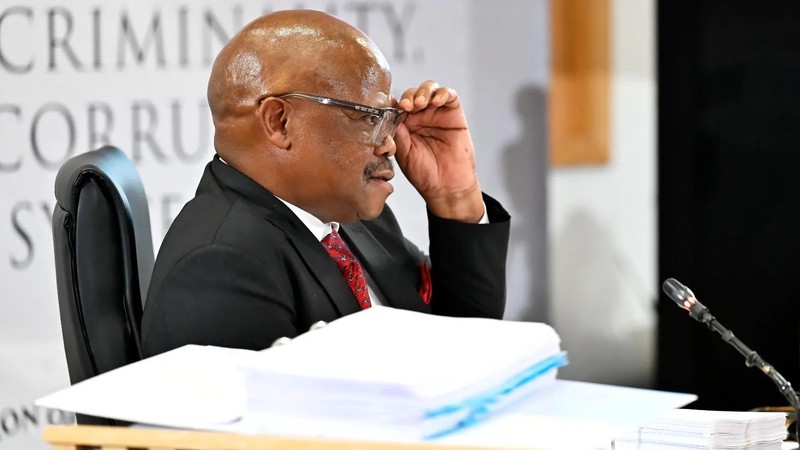
Sibanyoni appeared before the commission on 29 September 2026, and the footage of his address to Ramaphosa was played in the hearing room for all to see. His exact words, captured on video, left little room for ambiguity: “When you find someone wanting to interfere with the Putco business, you must know it’s us.” He had also warned that local groups would “fight for themselves” if their demand for a 30% operational stake in PUTCO went unaddressed, pointing to the company’s four decades of presence in the KwaNdebele area as justification. The commission, led by Justice Mbuyiseli Madlanga, is now tasked with determining whether those words were political theatre or something far more sinister.
Evidence leader Advocate Matthew Chaskalson SC has been methodical in his questioning of Sibanyoni, constructing a narrative that links the fiery rhetoric, the physical attacks, and a subsequent business manoeuvre into what he describes as a single coordinated pressure campaign. Chaskalson pressed Sibanyoni on why the commission should not reasonably conclude that the taxis filmed blocking PUTCO buses were connected to his network, given the explicit warning he had delivered to the country’s president. Sibanyoni’s defence has been consistent if somewhat strained: he insists he was speaking on behalf of the broader community, not in any personal or organisational capacity, and that he bears no responsibility for the violence that followed.
The evidence leader also confronted Sibanyoni with a striking piece of information that many young South Africans following this case will find difficult to ignore: approximately one month after the buses were reduced to ash, Taxi Choice — the business wing of the South African National Taxi Council, chaired by Sibanyoni himself — made an unsolicited offer to purchase PUTCO’s entire business operation in KwaNdebele. Chaskalson argued that the “interfere” speech and this acquisition bid pointed unmistakably to a single process, one in which PUTCO was being systematically pressured into a sale. Sibanyoni rejected this characterisation entirely, telling the commission he differed “100%” with its findings.
Among the most revealing moments of the hearing was the examination of WhatsApp messages sent roughly 36 hours after the 51 PUTCO buses were torched. In those messages, Sibanyoni had instructed his co-accused, Bafana Sindane, to approach Taxi Choice about acquiring 15 old buses. When pressed on the timing and purpose of this communication, Sibanyoni offered an explanation that raised more eyebrows than it lowered: he said he intended to donate the buses to his personal foundation. The proximity of this request to the arson attacks, and the fact that it was directed at the very organisation he chairs, gave Chaskalson ample material to work with, even if Sibanyoni refused to accept the implied connection.
Sibanyoni also introduced a remarkable counter-narrative during his testimony, suggesting that PUTCO had in fact burned its own buses as part of an internal labour dispute. This claim, offered without supporting evidence, drew sharp attention in the hearing room and illustrated the lengths to which the taxi boss appeared willing to go in distancing himself from the attacks. His testimony was further complicated by contradictions around the number of taxi associations operating along the relevant route: he had initially told the commission that a single association was involved, but later references to five additional associations forced the evidence leader to call out the inconsistency directly.
To understand why this case matters so deeply — particularly for young people in Mpumalanga and the broader region — it is essential to grasp what is actually at stake in the PUTCO dispute. PUTCO is not a small operator. It is one of South Africa’s oldest and largest bus companies, with a 40-year footprint in KwaNdebele, providing daily transport to thousands of commuters who depend on it to get to work, school, and essential services. When 51 of its buses burned in a single night, those commuters were left stranded, and the economic ripple effects were immediate and severe. The demand for a 30% operational stake, framed by Sibanyoni as a matter of community entitlement, sits at the intersection of legitimate economic transformation aspirations and alleged criminal coercion — a tension that defines much of post-apartheid South Africa’s economic landscape.
The taxi industry in South Africa has long occupied a complex and often violent space in the national economy, simultaneously providing an essential service to millions of working-class and poor commuters while operating in an environment where disputes over routes and market share have historically been settled through intimidation and bloodshed. Sibanyoni’s position at the head of Taxi Choice, the commercial arm of the country’s most powerful taxi body, places him at the very apex of this ecosystem. The Madlanga Commission’s investigation into his alleged links to organised crime therefore carries implications that stretch far beyond one man’s testimony — it speaks to how economic power is contested and captured in sectors that the state has long struggled to regulate.
The atmosphere at the commission took a charged turn when Sibanyoni began questioning Chaskalson’s impartiality, suggesting that the evidence leader was making the matter personal through his engagement with PUTCO. Justice Madlanga intervened swiftly and firmly, clarifying that there was nothing improper about the evidence leaders consulting with PUTCO as part of their work at the commission. The exchange revealed the degree of frustration building on Sibanyoni’s side of the proceedings, and it underscored the difficulty of his position: a man whose own recorded words, sent messages, and business decisions appear to form a coherent chain of evidence that he is now publicly and strenuously trying to break apart.
The commission continues its work, with investigators still examining the full scope of Sibanyoni’s business interests, his relationships within the taxi industry, and his alleged connections to organised criminal networks. For the youth of South Africa — a generation that has grown up watching economic opportunity remain stubbornly out of reach while powerful figures manoeuvre for control of key industries — this case is more than a legal proceeding. It is a live demonstration of how transport, politics, and money intersect in ways that shape everyday life, and why accountability at the highest levels of the informal economy is not just a legal question, but a generational one.



