Physical Address
304 North Cardinal St.
Dorchester Center, MA 02124
Physical Address
304 North Cardinal St.
Dorchester Center, MA 02124

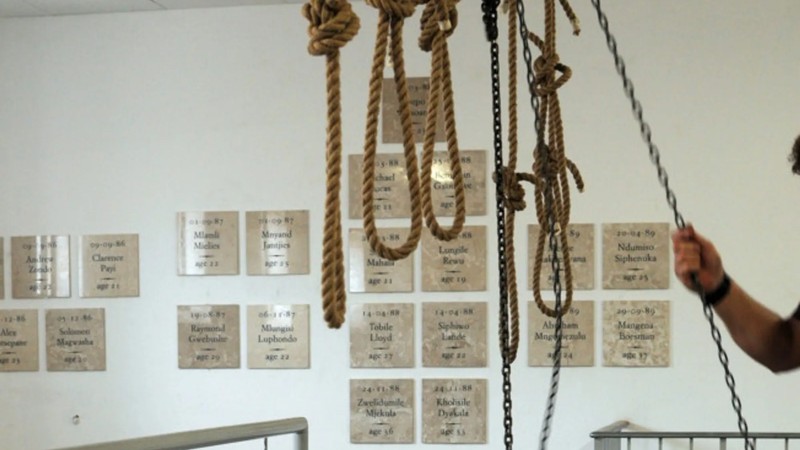
Thirty years after the Constitution was born, South Africa is still reckoning with the ghosts of its past.
Justice Minister Mmamoloko Kubayi stood before an audience in Gqeberha last weekend to deliver the Gallows Lecture — a powerful annual event that honours activists executed under apartheid and forces a nation to remember what it promised never to repeat. Her message was unambiguous: the death penalty has no place in South Africa’s constitutional democracy, and the country must never slide back into what she called barbarism.
This was not just a speech. It was a reckoning. Kubayi spoke at a moment when calls to reinstate capital punishment resurface every time violent crime dominates the headlines — and in a country where gender-based violence, murder rates, and public frustration with the justice system are very real, those calls can sound seductive. But the minister pushed back hard, grounding her argument not in sentiment, but in history and constitutional principle.
The people who died fighting apartheid, she reminded her audience, did not sacrifice their lives so that the state could keep the power to kill. They died believing their struggle would build something better — a society defined by dignity, not by the gallows. “Those who lost their lives during the dark days of the struggle died convinced that their contribution would one day help build a foundation for a new society,” Kubayi said. They were convinced, she added, that capital punishment had no role in the Africa they were fighting to create.
The numbers Kubayi cited from the Truth and Reconciliation Commission are impossible to ignore. Under apartheid, 95% of those sentenced to death were Black. Every single person who handed down those sentences was white. The death penalty was never just a tool of criminal justice — it was an instrument of racial terror, a mechanism to silence dissent and protect the privileges of the few. Understanding that history is not optional. It is essential context for any honest conversation about capital punishment in South Africa today.
The turning point came in 1995, when the Constitutional Court outlawed the death penalty in a landmark judgment penned by former Chief Justice Arthur Chaskalson. Kubayi quoted the ruling directly: the death penalty not only destroys lives, it is a cruel and inhumane punishment. That decision, she argued, did more than save lives — it opened an entirely new chapter in South African jurisprudence and gave birth to what she described as “a new humane and civilised society.” In her own words, that court decision “marked the end of a system that killed good people and at the same time played midwife to the birth of a new system that saved.”
Kubayi also drew attention to Paula McBride, wife of Robert McBride — a man who spent five years on death row. Paula described the death penalty as a gross human rights violation that brutalises not only those sentenced to die, but those who sentence them. That point cuts deep. State-sanctioned killing does not exist in a moral vacuum. It shapes institutions, it shapes people, and it shapes the kind of society a nation becomes.
There is something equally important in the details Kubayi shared about the Gallows Exhumation Project. This initiative worked to locate and recover the graves of political prisoners executed on death row whose bodies had remained the property of the state — even in death, denied to their families. The project concluded last year after the exhumation of 81 remains. Eighty-one people. Their bodies were finally returned to their loved ones. That fact alone tells you everything about what the apartheid death penalty really was.
And yet, even after Nelson Mandela walked free in 1990, over 70 political prisoners remained on death row. Many were only released after sustained pressure from activists inside and outside South Africa. Freedom did not arrive all at once. It was fought for, inch by inch, right up until the very end.
For young South Africans — the generation that inherited the Constitution without living through what it replaced — the Gallows Lecture is a reminder that rights are not decorative. They were paid for. The constitutional abolition of the death penalty is not a weakness in the system; it is one of the system’s most deliberate and hard-won achievements. Kubayi’s message, delivered thirty years on, is that progress is fragile, memory is political, and the price of forgetting is higher than most people realise.



