Physical Address
304 North Cardinal St.
Dorchester Center, MA 02124
Physical Address
304 North Cardinal St.
Dorchester Center, MA 02124

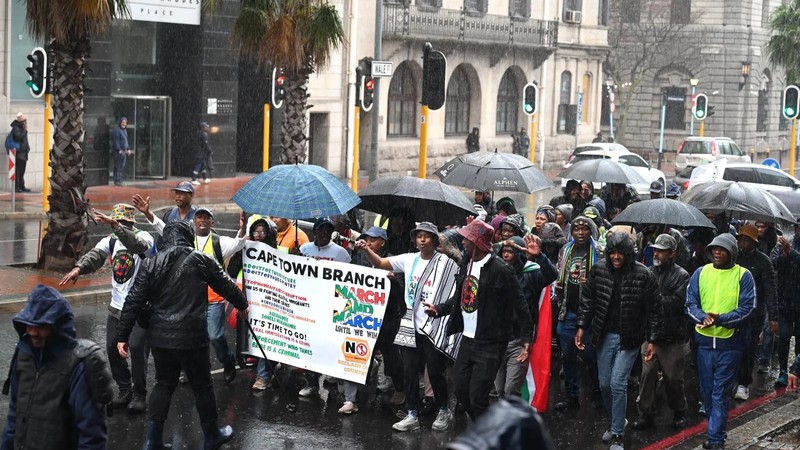
On a cold and wet Thursday morning, anti-undocumented immigration groups took to Cape Town’s streets, cutting through the city’s central business district in a demonstration that was smaller in numbers but loud in ambition. Members of March and March, the Labour and Civic Organisation (LACO), and Operation Dudula marched along Long Street before stopping at both the Department of Home Affairs and Parliament, where they delivered formal memoranda outlining their demands. Despite the rain dampening attendance, organisers were quick to insist that turnout figures do not capture the depth of public sentiment behind their campaign.
The march forms part of a growing wave of civic mobilisation around immigration enforcement in South Africa — a movement that has sparked fierce national debate about belonging, economic anxiety, and the boundaries of lawful protest. For young South Africans watching from the sidelines, understanding what these groups are actually demanding, and what the broader stakes are, matters more than ever.
Charlie Roux, the Cape Town leader of March and March, used the demonstration to push back against what she called a widespread misconception about the movement’s targets. “A misconception that we want to clear as a group is that we are only coming for black African nationals from countries like Zimbabwe and Nigeria who are undocumented and in the country illegally,” Roux told the crowd. “We are coming for every undocumented foreign national, no matter the race.” That framing is significant — it positions the campaign as a legal and civic matter rather than a racially motivated one, though critics remain unconvinced by that distinction.
Beyond the rhetoric, the groups presented concrete demands at Parliament. They called for urgent reform of the asylum and refugee processing system, arguing that systemic backlogs have created loopholes that “undermine the credibility of the refugee protection system.” They also pushed for intensified immigration enforcement operations — but stressed these must remain constitutionally lawful. “Individuals found to be in the country illegally should be processed in accordance with the law,” a spokesperson told the crowd assembled outside Parliament. The emphasis on legality appears designed to distance the movement from accusations of vigilantism.
Roux’s decision to march through Long Street was deliberate and symbolic. “We are marching through Long Street because it is one of the many streets in the city that are taken over by foreign nationals. Businesses and business owners are being pushed out,” she explained. The street, known for its vibrant mix of bars, restaurants, and small traders, has become a flashpoint in a broader narrative that these groups have been building for months — one that links undocumented immigration to unemployment, rising crime, and pressure on public services.
Those claims, however, remain heavily contested. Economists and civil society organisations have repeatedly challenged the assertion that undocumented migrants are primary drivers of South Africa’s unemployment crisis, pointing instead to structural issues including skills mismatches, energy shortages, and slow economic growth. The South African government has also consistently maintained that immigration enforcement must operate within the law, and has issued warnings against vigilantism and any form of xenophobic intimidation.
March and March did not begin in Cape Town. The organisation, led nationally by Jacinta Ngobese-Zuma, first built its profile as a grassroots movement in Durban before expanding its reach across the country. The group describes itself as a civic organisation focused exclusively on illegal immigration — a framing that attempts to separate its mission from the xenophobic violence that has periodically erupted in South Africa over the past two decades.
The movement first captured national attention in May, when Ngobese-Zuma led a march in Bellville that drew significant crowds and controversy in equal measure. Her words that day were blunt and widely shared: “Ubuntu is suspended until further notice! We don’t want a situation where foreign nationals are always painted as the victims and we are the villains. It’s our country, and we’re tired of explaining there is no xenophobia in the country.” That speech crystallised the movement’s tone — defiant, emotionally charged, and deeply rooted in a sense of national dispossession felt by many working-class South Africans.
March and March has set 30 June as a hard deadline for undocumented foreign nationals to leave South Africa voluntarily. The ultimatum carries no legal weight — the government, not a civic organisation, holds enforcement authority — but its symbolic power is undeniable. It has kept the movement in the headlines, forced political responses, and amplified pressure on the Department of Home Affairs to demonstrate visible action on immigration enforcement.
The South African Police Service confirmed it deployed officers at marches across the country, stating it was operationally prepared to manage planned demonstrations. The government’s broader position has remained consistent: immigration enforcement is a state function, it must respect constitutional rights, and no group has the authority to take the law into its own hands. That message, while legally sound, has done little to defuse the political energy driving these marches.
For South Africa’s youth — a generation facing unemployment rates that hover above 60 percent among those under 35 — the frustrations that fuel these marches are real, even if the proposed solutions are fiercely debated. The question of how a democratic, constitutional state manages migration while addressing genuine economic grievances is not unique to South Africa. Across the African continent and beyond, governments are wrestling with the same tension between open borders, regional solidarity, and domestic pressure. What makes South Africa’s moment distinctive is the urgency, the volume, and the speed with which civic groups have moved from the streets to the steps of Parliament.



