Physical Address
304 North Cardinal St.
Dorchester Center, MA 02124
Physical Address
304 North Cardinal St.
Dorchester Center, MA 02124

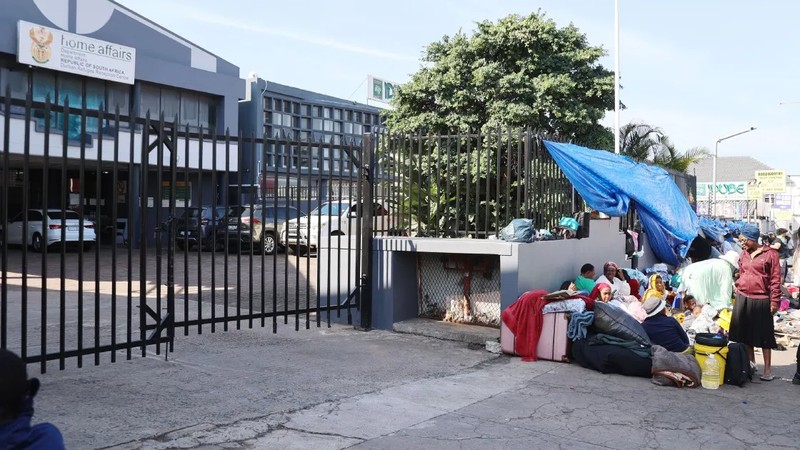
For nearly two months, hundreds of refugees have been sleeping rough on the pavements outside the Home Affairs Refugees Reception Centre on Che Guevara Road in Durban, South Africa. They are documented, they are legal, and they are being ignored. This is not a story happening far away — it is a live human rights emergency, and young Africans everywhere need to pay attention.
The displaced come from across the continent: the Democratic Republic of Congo, Burundi, Ghana, Sudan, Tanzania and Uganda. They were not crossing borders illegally. Verification by Home Affairs confirmed that only 2 out of 457 people were undocumented. The rest hold valid papers — yet they remain on the street, exposed to cold, violence and uncertainty.
These families did not choose the pavement. They were pushed onto it. Xenophobic groups have been operating across South African communities with what observers describe as near-total impunity — illegally demanding identity documents, assaulting residents, looting businesses, and ordering migrants to leave the country by 30 June. The threats were not empty. People were attacked at home and at work, their livelihoods destroyed overnight.
When the displaced sought safety at a Durban police station, they were met with rubber bullets. Two days at the Diakonia Centre brought no resolution. They were then directed to the Home Affairs office on Che Guevara Road, where they have remained ever since, building makeshift shelters from blankets and whatever they could carry.
Princess Adjei, 33, originally from Ghana, came to South Africa as a baby and grew up here. She lost most of her family in the chaos. Her story is not an exception — it is the rule for the more than 400 documented refugees camped on that pavement, and the estimated 1,000 displaced people living in similarly dire conditions in Sherwood Park.
That last point is critical. The government’s response has effectively placed the burden back on the victims, offering reintegration into unsafe communities or detention as the only two options on the table.
South Africa’s government has formally condemned xenophobic violence. But condemnation without consequence is just noise. While officials issue statements, xenophobic groups continue to operate freely, and a parallel programme of mass deportations signals that the state views migration primarily as a security problem rather than a human rights issue.
eThekwini Mayor Cyril Xaba accompanied Minister Kubayi during her visit and indicated the city would facilitate repatriation for those wishing to return home. No formal relocation plan for those who cannot safely return has been announced.
For a generation of young Africans who grew up believing in continental solidarity and the promise of pan-African belonging, watching documented refugees sleep on pavements while officials talk about repatriation should feel like a provocation. These are people who built lives, raised children and contributed to South African society — and they are being treated as a problem to be processed, not people deserving of protection.
The refugees themselves have made their demand clear: relocation to a safe space with access to basic services while their asylum claims are processed. It is a reasonable ask. It is also, under international refugee law, an obligation — not a favour.
The Che Guevara Road camp is both a symptom and a symbol: a symptom of a broken asylum system under severe pressure, and a symbol of what happens when political rhetoric about sovereignty drowns out the basic duty of care. Until the South African state acts decisively — prosecuting those responsible for xenophobic violence, providing emergency shelter, and guaranteeing access to services — the pavement outside Home Affairs will remain the most honest reflection of where its priorities actually lie.



