Physical Address
304 North Cardinal St.
Dorchester Center, MA 02124
Physical Address
304 North Cardinal St.
Dorchester Center, MA 02124

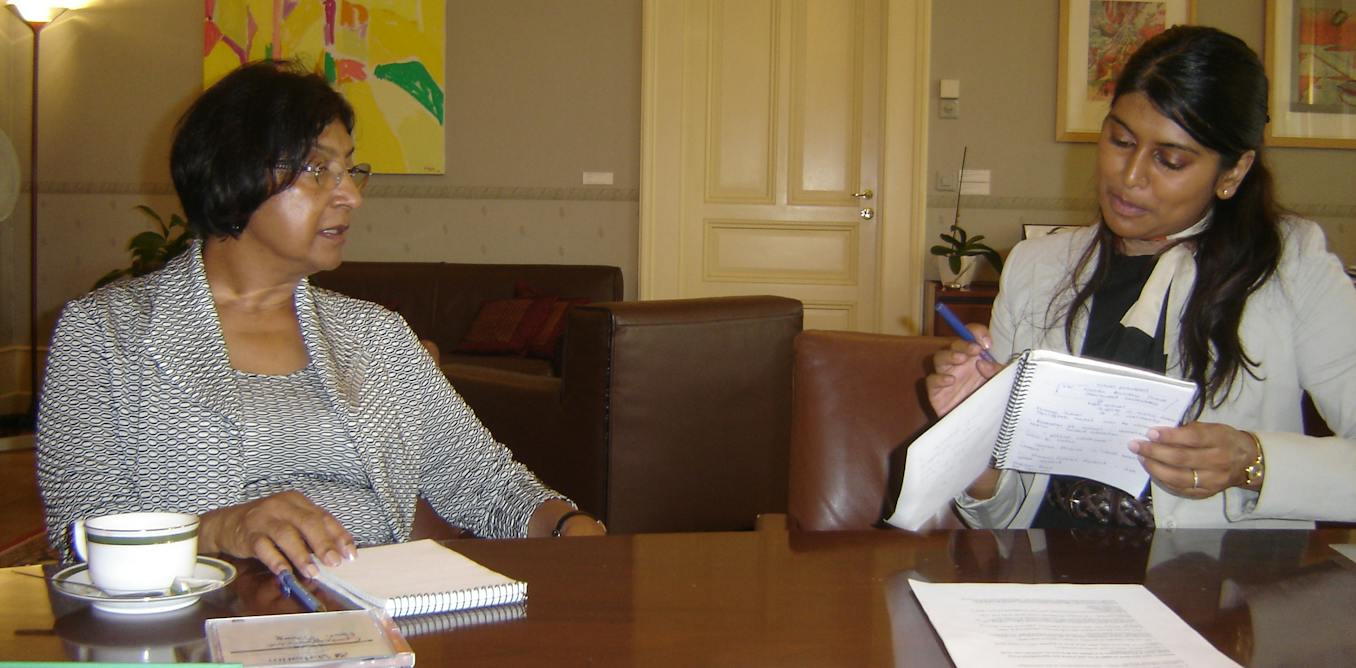
She is 85 years old, and she has never stopped asking where justice is. Navi Pillay, the South African international human rights judge, has been awarded the 2026 Nobel Peace Prize in recognition of her lifelong dedication to international law and global justice — a career that spans decades, continents and some of the most consequential legal battles of our time. To understand who she really is, 555MediaHub spoke with Sam Naidu, a feminist and literary scholar who authored a biography of Pillay.
Naidu, who interviewed Pillay in Geneva in 2009, describes her as “a down-to-earth, no-nonsense kind of person with a wicked sense of humour.” Behind the warmth, Naidu says, lies something harder and more enduring — a steely grit that no obstacle to human rights has ever managed to quell. And if Pillay’s recent stances against Donald Trump and Benjamin Netanyahu are anything to go by, that grit has only sharpened with age.
The story begins far from Geneva. Navanethem Pillay was born in 1941 in Clairwood, a working-class suburb of Durban, the fifth of eight children. Her Tamil grandparents had arrived in South Africa as indentured labourers from India in the late 19th century, brought to what is now KwaZulu-Natal to work the sugarcane fields under British colonial rule. Her father drove buses and fished on the side to make ends meet.
Apartheid was formally written into law in 1948, when Pillay was just seven years old. Black South Africans were systematically denied educational opportunities. But her school principal saw her academic brilliance, and her community pooled resources to send her to university to study law. She went further — completing a master’s degree and then a doctorate in juridical science at Harvard University. In 1967, she became the first black woman in South Africa to establish her own law practice. She was not yet 30.
Her earliest cases as an independent lawyer included defending Phyllis Naidoo, an African National Congress member placed under banning orders. In 1973, she secured legal representation for political prisoners held at Robben Island. In 1986, she co-founded the Advice Desk for Abused Women. Every step was a fight — and she took every one of them.
When apartheid formally ended with South Africa’s first democratic elections in 1994, Pillay’s career shifted gears rather than slowing down. In 1995, Nelson Mandela recommended her as the first black female judge in the country’s Supreme Court. That same year, she joined the International Criminal Tribunal for Rwanda, and by 1999 she had risen to become the tribunal’s judge president. She then moved to the International Criminal Court in The Hague, before being appointed UN High Commissioner for Human Rights in 2008.
In August 2009, Forbes Magazine placed her 64th on its list of the world’s 100 most powerful women — making her only the second African ever to appear on that list. The Nobel Peace Prize, Naidu argues, is simply the most fitting acknowledgment of a career that has always been bigger than any single title.
Among Pillay’s most consequential contributions is one that permanently changed how the world understands rape in conflict. At the International Criminal Tribunal for Rwanda, she sat on the bench that presided over the landmark case of Jean-Paul Akayesu, the former mayor of Taba, brought before Trial Chamber I on 30 May 1996 on fifteen charges including genocide and crimes against humanity.
During the trial, victim-witnesses recounted acts of sexual violence — but Akayesu faced no charges related to sexual violence. Pillay refused to let that pass. She posed a direct question to the office of the prosecutor: what were judges expected to do with evidence of sexual violence in a trial where no such charges existed and the main charge was genocide? The question forced action. The prosecution filed a new indictment, and the tribunal ultimately ruled that rape can, under certain circumstances, constitute genocide — a first in the history of international law.
That ruling was later incorporated into the leading instruments of modern international criminal law. As Pillay herself said, “From time immemorial, rape has been regarded as spoils of war. Now it will be considered a war crime.” Naidu calls it a feminist victory with rare, real, material impact — and she is right to do so.
Naidu traces Pillay’s relentless pursuit of justice back to a moment in childhood. At six years old, she stood in a Durban court and gave evidence after her father was robbed by a colleague. The robber was convicted, but the money was never returned. Young Navanethem asked, “Where is my father’s money? Is this justice?” She never stopped asking. The question simply grew larger. Today, at 85, it has a global focus: “Where is justice for each and every one of us?”
Her career has won her enemies — those who dismiss her methods or challenge her conclusions. But her ideals, Naidu notes, are considerably harder to fault. History has a way of vindicating the stubborn. Nobody predicted that Nelson Mandela would become president of South Africa. And very few would have guessed that a six-year-old girl questioning a Durban courtroom would one day hold a Nobel Peace Prize. Now she does.



