Physical Address
304 North Cardinal St.
Dorchester Center, MA 02124
Physical Address
304 North Cardinal St.
Dorchester Center, MA 02124

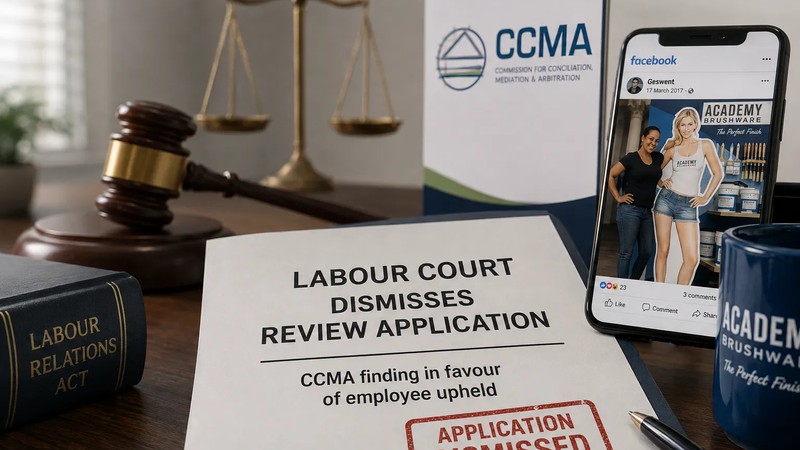
A single post. A few photographs. A dismissal that a court just declared unlawful.
South Africa’s Labour Court has upheld a ruling by the Commission for Conciliation, Mediation and Arbitration — the CCMA — in favour of an employee who lost their job after posting social media pictures that imitated a campaign model. The employer framed it as gross insubordination, a charge serious enough to justify immediate dismissal. The court disagreed, finding the termination substantively unfair and siding firmly with the worker.
The case lands at a moment when millions of young Africans are navigating the blurry, often treacherous line between personal expression online and professional accountability. For a generation that grew up posting, sharing and performing identity on social media, the idea that a photograph — not a threat, not a slur, not a leak of confidential data — could cost you your livelihood is both alarming and, for many, deeply familiar.
What the court’s decision signals is significant. Employers across the continent have increasingly reached for disciplinary codes to police employee behaviour on personal social media accounts, sometimes stretching the definition of misconduct far beyond what the law was ever designed to cover. The CCMA’s original finding, now backed by the Labour Court, draws a clearer boundary: mimicking a campaign model in photographs does not automatically rise to the level of gross insubordination, and companies cannot simply attach a weighty label to conduct they dislike and expect dismissal to stand.
Labour law in South Africa requires that a dismissal be both procedurally and substantively fair — meaning the employer must follow due process and must have a valid, proportionate reason. When those bars are not cleared, the courts intervene, and workers get reinstated or compensated. That framework, built through decades of post-apartheid labour reform, remains one of the more progressive in the region, even as enforcement is uneven and access to legal recourse is still a privilege many cannot afford.
For the employee at the centre of this case, the ruling represents more than a legal technicality. It is the difference between a career derailed and one that continues. It is also a reminder that the fight for workplace dignity — the right not to be punished arbitrarily, not to have your personal life weaponised against you — is still very much alive, and still very much worth waging.



