Physical Address
304 North Cardinal St.
Dorchester Center, MA 02124
Physical Address
304 North Cardinal St.
Dorchester Center, MA 02124

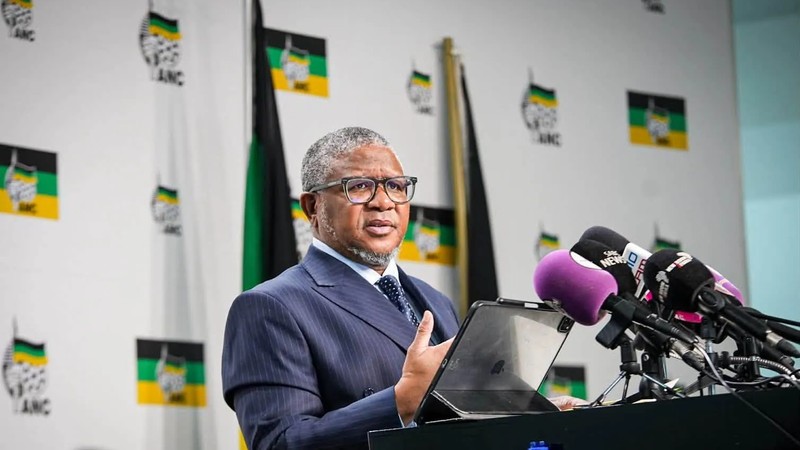
It started with a single sentence at a press briefing — and now it threatens to spill into a courtroom.
On 2 July, African National Congress Secretary-General Fikile Mbalula stood before journalists and accused the Economic Freedom Fighters (EFF) of going door-to-door, telling foreign nationals to leave South Africa. For a country already on edge over xenophobic tensions, the allegation landed like a grenade. The EFF’s lawyers responded within days, demanding a retraction, a public video apology, and the removal of all related statements from Mbalula’s social media platforms — or face a defamation lawsuit. Mbalula’s answer was swift, unapologetic, and delivered in a now-viral post on X: “I see the boys want me to retract the truth jonganapha makwedini andingo Kenny ke mna. Oright!” Translation: he was not backing down.
At the heart of this dispute is a statement Mbalula made during an ANC media briefing, where he declared that “lawlessness cannot be a norm and be tolerated, nor can violence,” before directly implicating the EFF in anti-immigrant vigilantism. He claimed the red berets were “knocking on people’s doors, telling foreigners to go, outside the law.” For a party that brands itself as the voice of the African working class and the dispossessed, being publicly tied to xenophobic activity is not just politically inconvenient — it is potentially devastating to the EFF’s brand.
The EFF’s elections spokesperson, Thembi Msane, pushed back firmly, insisting the party has never organised, endorsed, or participated in any door-to-door campaign to intimidate or forcibly remove foreign nationals. The party’s legal team gave Mbalula 48 hours to comply with their demands, warning they would sue for damages if he refused. He refused.
In a letter dated 7 July, Mbalula’s lawyers at LS Mashifane Incorporated fired back with a comprehensive rejection of every demand. The letter states plainly that their client “will not retract his remarks,” “will not issue the public apology demanded,” and “does not accept that his remarks were unlawful or defamatory.” The legal team went further, arguing that the EFF’s interpretation of Mbalula’s words reflects “a fundamental misunderstanding of the law of defamation” and that the statement constitutes protected political speech under the South African Constitution, delivered during a public briefing on matters of national concern.
This is not a trivial legal point. South Africa’s constitutional framework provides robust protections for political expression, particularly on issues of public interest. Whether Mbalula’s remarks cross the legal threshold into defamation will depend on whether the courts view his words as a factual claim or as political commentary — a distinction that, in practice, can be razor-thin.
Perhaps the sharpest blow in Mbalula’s legal response was not a legal argument at all — it was a political one. His lawyers pointed directly to a January 2022 EFF campaign in which party leader Julius Malema personally visited restaurants at the Mall of Africa to inspect the ratio of South African to foreign employees. The implication is clear: a party that dispatched its Commander-in-Chief to scrutinise the nationality of restaurant workers cannot, with a straight face, claim to be entirely untouched by anti-foreigner sentiment.
The EFF has consistently maintained that those 2022 visits were acts of parliamentary oversight aimed at checking compliance with South African labour law, not a campaign targeting foreign nationals. That distinction matters — but so does the optics, especially when you are simultaneously threatening to sue someone for linking you to anti-immigrant activity. Mbalula’s lawyers also pointed to Malema’s public accusations that judicial officers acted out of racial prejudice, and the EFF’s long history of advocating for land occupations that have drawn judicial intervention, as further evidence that the party’s “indignation” sits awkwardly alongside its own political conduct.
The stakes are real. Julius Malema has proven himself a formidable opponent in defamation litigation, having recently secured a victory against Eastern Cape Premier Oscar Mabuyane in a high-profile defamation case. That winning streak means the EFF is no stranger to the courtroom — and no pushover in it either. If this dispute escalates to a full legal confrontation, Mbalula will need more than political bravado to come out on top.
What makes this moment particularly significant for young South Africans watching from the sidelines is what it reveals about the political landscape they are inheriting. Two of the country’s most prominent political forces are locked in a battle that touches on xenophobia, free speech, constitutional rights, and political accountability — all at once. These are not abstract issues. They shape who gets to live safely in South Africa, who gets to speak freely, and who gets to hold power accountable without facing legal intimidation.
Strip away the legal jargon and the social media bravado, and what you are left with is a confrontation that exposes the fault lines running through South African politics in 2025. The ANC, still struggling to maintain its grip on moral authority after years of governance failures, is using the EFF’s association with xenophobia as a weapon. The EFF, for its part, is deploying legal muscle to protect a brand identity that depends on being seen as the champion of the marginalised — including, theoretically, migrants and foreign nationals.
Neither side is entirely clean here. And that, perhaps, is the most important thing a young South African can take away from this saga: political parties will always fight to control the narrative, but the truth — and the law — tend to be far more complicated than any press briefing or X post would suggest. Watch this space. The courtroom chapter of this story is almost certainly still to come.



