Physical Address
304 North Cardinal St.
Dorchester Center, MA 02124
Physical Address
304 North Cardinal St.
Dorchester Center, MA 02124

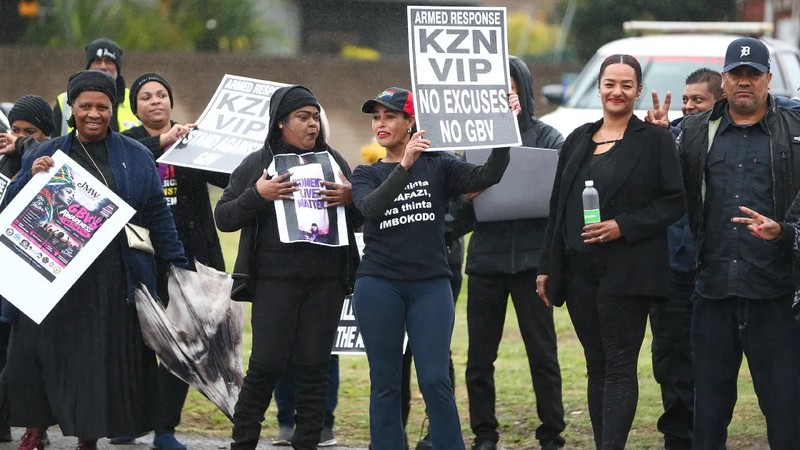
Since July, the bodies of nine women have been recovered across Ekurhuleni, a metropolitan area east of Johannesburg in Gauteng province. Most of the victims were in their twenties and thirties — young women, with their whole lives ahead of them. Several were found stripped of their clothing, with signs of sexual assault, details that have horrified communities and reignited a national conversation about the safety of women in South Africa.
Police are still investigating whether the killings are connected, and Acting Police Minister Firoz Cachalia has stated it is too early to confirm a pattern. What is already clear, however, is that the discovery of each new body has deepened public outrage, and that outrage has now spilled onto the streets.
The “South Africa Wear Black” campaign began circulating on social media earlier this week, calling on South Africans to dress in black for nine consecutive days — one day for each woman whose life was lost in the same area. The symbolism is deliberate and powerful: a collective mourning that refuses to be quiet.
By Friday, the campaign had moved from timelines to the streets. In KwaZulu-Natal, communities marched, blew whistles, and held silent protests. Runners took to the roads at 5am from Florida Road, dressed in black, in memory of Elizabeth “Tsontso” Moselakgomo, a runner who disappeared during a jog and was found dead days later. A memorial run in Johannesburg on Saturday morning lit candles and carried a banner that read: “Enough. Stop Femicide.”
In Cape Town, a 30-minute silent protest gathered at the Castle of Good Hope and in front of the city’s police station, with participants standing in silence to honour women taken by violence and to stand with those still living in fear.
The voices rising from this crisis are many, and they are urgent. Lerato Lentsela, who joined the memorial run in black, captured the exhaustion felt by countless women: “We are not safe running, we are not safe at a post office, we are not safe on a date, we are not safe in our own homes, we are not safe in an Uber.” That sentence — blunt, rhythmic, devastating — says everything about what it means to be a woman in South Africa right now.
Residents near the crime scenes in Ekurhuleni are equally shaken. “This is very scary… because you can say us as women and children are no longer safe,” said Patience Masa. Another resident, Zanele Vilakazi, added: “I don’t feel safe — for this to happen in the morning, so we are not safe.”
The council also flagged a critical humanitarian concern: some of the victims remain unidentified, and it has appealed to families with missing loved ones in Gauteng to contact the SAPS and the Gauteng Department of Health so that DNA identification can proceed.
Gender-based violence and femicide was declared a national disaster in South Africa in 2025 — a recognition that this is not a series of isolated incidents but a systemic, structural emergency. The Ekurhuleni killings are a brutal reminder of a crisis that has persisted for years, cutting across provinces, income levels, and communities.
The numbers behind the crisis are stark. South African police statistics show that authorities solve approximately one in ten murder cases nationwide — a conviction rate that signals deep institutional failure. The criminal justice system, underfunded and overstretched, struggles to deliver the accountability that survivors and families deserve.
Police have offered a R400,000 reward for information leading to the arrest of the killer or killers in the Ekurhuleni case, and Deputy Police Chief Tebello Mosikili told journalists at the scene in Dawn Park: “We cannot continue picking up bodies.” It is a statement that should not need to be made in 2025.
President Cyril Ramaphosa has promised that law enforcement agencies will prioritise the Ekurhuleni murder investigations, a pledge that activists are watching closely but cautiously. Promises have been made before. The question is whether this moment translates into lasting structural change or fades once the news cycle moves on.
On the ground, activists in Cape Town and Johannesburg have made clear they are not going anywhere. They plan to maintain street demonstrations until the government allocates additional investigative resources to rural and township precincts — the areas that are consistently underserved and where violence against women is most acute.
The ‘Wear Black’ movement is more than a social media trend. It is a generation refusing to accept that femicide is inevitable, demanding that institutions built to protect citizens actually do so. For the young people marching, running, and standing in silence across South Africa, the message is simple: nine women are dead, their names deserve justice, and this cannot keep happening.



