Physical Address
304 North Cardinal St.
Dorchester Center, MA 02124
Physical Address
304 North Cardinal St.
Dorchester Center, MA 02124

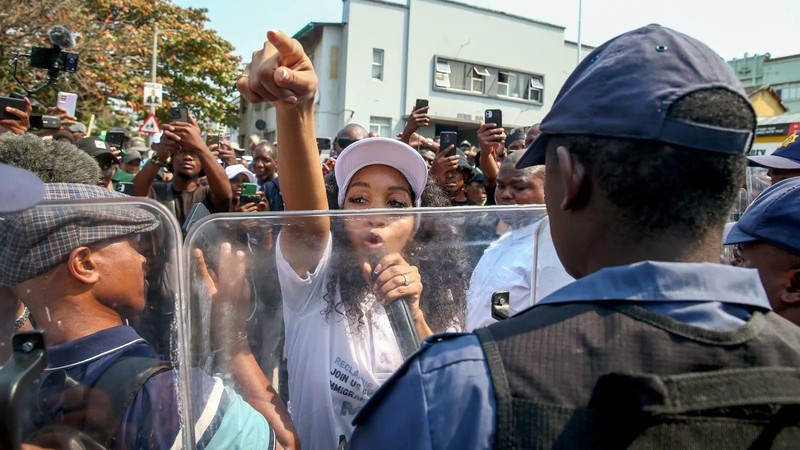
On a busy road in Durban, about 400 human beings — documented refugees and asylum seekers — have been sleeping on tarmac for over fifteen weeks. They are not criminals. They are not illegal. They hold papers. And yet, on Thursday, rocks flew at them. Their furniture was seized and thrown into the road. Their clothes were treated as rubbish. This is not just a local incident. It is a symptom of a political and institutional failure that should concern every young African watching from across the continent.
The thesis is simple: the violence outside the Durban Home Affairs office on Che Guevara Road is not a spontaneous outburst of community frustration — it is the predictable result of organised anti-migrant politics operating in a vacuum of state protection, and it exposes how South African institutions are failing both their constitutional obligations and their neighbours.
The group behind Thursday’s march calls itself March and March. It describes its activities as a “clean-up operation.” Let that framing sink in. Human beings — families from the Democratic Republic of the Congo, Burundi and Rwanda — are being described as waste to be cleared. The march began at King Dinuzulu Park and moved toward the refugee camp accompanied by more than twenty police officers, a detail the refugees’ own leaders have highlighted as deeply troubling.
The group’s leader, Jacinta Ngobese-Zuma, set a combative tone from the start. She warned her supporters away from police by claiming officers were armed with tear gas and were “scared of their friends, the NGOs.” She blamed President Cyril Ramaphosa for the Marikana massacre in the same breath as questioning whether refugee families were complying with municipal bylaws. She called on men who had allegedly threatened her to “come forward.” This is not civic leadership. It is escalation.
And it worked. When the chaos peaked, anti-migrant protesters grabbed furniture and clothes belonging to refugees off the pavement and hurled them into the road. They sang. They beat the items. At least three people needed medical attention. Police fired rubber bullets and tear gas — at the marchers, eventually — and arrested one person. A foreign national was also arrested, accused of throwing a rock at a police officer.
Here is what gets lost in the noise: these refugees are documented. They are not undocumented migrants. They fled violence, evictions and intimidation in the lead-up to anti-migrant protests, and they have been living on Che Guevara Road since 22 May — outside the very Home Affairs office that is supposed to process and protect them. They have access to only a few mobile toilets. They have been there for four months.
Refugee leaders Bishop Raphael Bahebwa and Kafuti Muyumba allege that two people have already died while living on that road. They allege that when they sought protection at Durban Central Police Station after last Thursday’s confrontation, they were attacked there too. If those allegations are accurate, the situation has moved beyond neglect into something far more serious.
South Africa’s constitution is explicit on the rights of asylum seekers and refugees. The country is also a signatory to the 1951 Refugee Convention. None of that means much when you are sleeping on a pavement while a mob throws your belongings into traffic.
The government’s answer to this crisis has been to announce the relocation of the Che Guevara Road refugees to the Lindela Repatriation Centre in Gauteng. Lindela is not a refugee shelter. It is a detention facility. Sending documented asylum seekers there does not resolve their situation — it warehouses them, removes them from public sight, and does nothing to address the violence or the housing crisis that put them on the street in the first place.
Meanwhile, the eThekwini Municipality mayor, Cyril Xaba, was chased away from the scene by March and March members. The state’s visible representatives either fled or stood by. That image — a mayor driven off by an anti-migrant crowd — tells you everything about where institutional authority currently stands in this standoff.
The deeper implication is this: when governments respond to organised xenophobia by moving its targets rather than confronting the perpetrators, they validate the tactic. They teach the lesson that violence and intimidation work. And for a generation of young Africans growing up on a continent where cross-border movement is both a reality and a right, that lesson is dangerous.
What happened on Che Guevara Road was not a “clean-up.” It was a warning — and the institutions that should have stopped it were either absent, complicit, or looking the other way.



