Physical Address
304 North Cardinal St.
Dorchester Center, MA 02124
Physical Address
304 North Cardinal St.
Dorchester Center, MA 02124

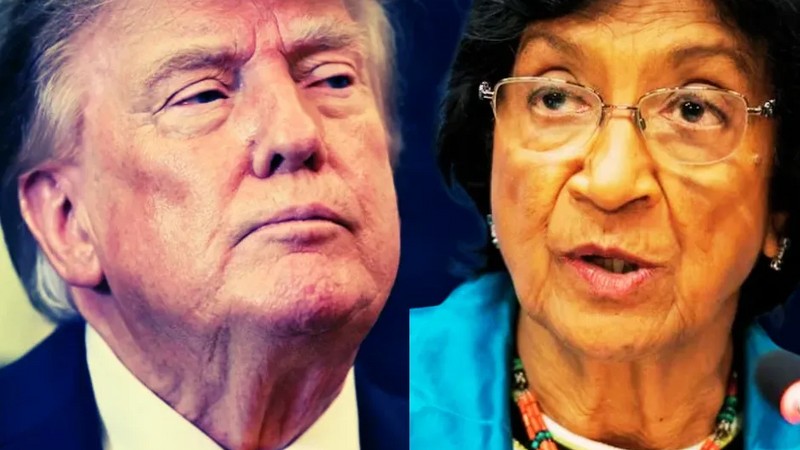
US President Donald Trump launched a fierce public attack on the Norwegian Nobel Committee after South African jurist Navi Pillay was awarded the 2026 Nobel Peace Prize “for her efforts to promote peace and international law.” Trump, who has openly coveted the prize since returning to the White House in January 2025, made clear he believed the honour belonged to him.
Taking to his Truth Social platform, Trump wrote: “This is the woman who received the Nobel Peace Prize over the Great United States of America, whose Representative, ME, settled eight Wars, and many other things.” He added that he had “never heard of her” and accused her of “very obviously” hating Israel — a charge that drew immediate attention given Pillay’s recent role chairing a UN commission that concluded Israel had committed genocide in Gaza.
Speaking at a rally in Syracuse, New York, Trump called Pillay a “mystery person” and issued a pointed warning to Oslo: “We will not forget, Norway, that you didn’t give this prize.” On Truth Social, he escalated further, declaring the Nobel Peace Prize “forever discredited by a handful of radical ideologues who are anti-democracy, and enemies of civilization.”
Trump also claimed the committee had “shamed itself beyond repair” by selecting someone he described as an “unabashed hater of America and Israel.” He argued he should have won the award eight times over — once for each war he claims to have settled — and said that heads of state from countries he helped had personally lobbied the Norwegian Nobel Committee on his behalf.
The backlash did not stop at words. Shortly after Trump’s public outburst, his administration announced further sanctions against the International Criminal Court — the very institution where Pillay served as a judge until 2008. The move signals a broader pattern of the Trump administration using economic and diplomatic pressure against international legal bodies it views as hostile.
So who exactly is Navi Pillay? Born in South Africa during the apartheid era, she became the first non-white woman in the country to establish her own law practice — a milestone that speaks volumes about the barriers she broke through long before the international stage ever knew her name. She later served as a judge at the International Criminal Court and as UN High Commissioner for Human Rights, building a decades-long record in international law and human rights advocacy.
In a video capturing the moment she learned of the prize, Pillay responded with sharp wit, joking that she “may share this prize with Trump.” The remark landed as both gracious and pointed — a reminder that the woman Trump claims “nobody has ever heard of” carries a global reputation built over half a century of legal work.
For young Africans watching this episode unfold, Pillay’s recognition carries a weight that goes beyond diplomacy. Her story — from apartheid South Africa to the Nobel stage — is a direct challenge to the idea that power and prestige belong only to those who already hold them. Trump’s reaction, in contrast, lays bare a worldview in which international institutions only have value when they validate American — and specifically his own — dominance.
The confrontation also raises harder questions about the future of multilateralism. With the Trump administration openly threatening Norway and sanctioning the ICC, the pressure on international legal and humanitarian frameworks is intensifying. For a generation of young Africans who rely on those frameworks to hold powerful states accountable, the stakes in this seemingly distant Nobel drama are anything but abstract.



