Physical Address
304 North Cardinal St.
Dorchester Center, MA 02124
Physical Address
304 North Cardinal St.
Dorchester Center, MA 02124

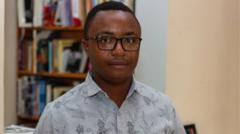
When Simbarashe Kundizeza won the Caine Prize for African Writing this year, it should have been a moment of pure triumph — a Zimbabwean writer, a £10,000 prize, a story that moved judges enough to beat out the entire field. Instead, within days, his victory was being questioned in the pages of one of America’s most prestigious magazines, and his name became the latest flashpoint in a debate that is shaking the literary world to its core.
The Atlantic published a piece by journalist Vauhini Vara arguing that AI-detection software Pangram had flagged Kundizeza’s short story, The Blue Fighter, as entirely AI-generated. The story — about a boy whose family struggles through Zimbabwe’s devastating economic collapse around 2002 — had already been published in The Shallow Tales Review before earning its prize. Now it was being treated as evidence of a crime Kundizeza insists he never committed. “For the avoidance of doubt, I wrote The Blue Fighter,” he posted on X, his words carrying the weight of someone who should not have had to say them at all.
The backlash was immediate and fierce. Caine Prize chair Ellah Wakatama told the BBC she was shocked that The Atlantic had not waited for a proper investigation before going to press. “I do wish The Atlantic had spent more time investigating this so that alongside Pangram, they did have evidence of real human investigation of it before tainting the prize and tainting this winner,” she said on BBC’s Front Row programme. Wakatama revealed she had only been contacted about the allegation on a Friday — and Vara’s article landed that Sunday, leaving almost no room for due process.
The story Kundizeza told about his inspiration is specific, personal and verifiable in the way that only lived experience tends to be. He described hearing South African poet Vangile Gantsho read a poem about her father’s obsession with building fish tanks, at an event in Ghana last year. That image fused with memories of his own father — an accountant who quit his job to grow tomatoes during Zimbabwe’s economic meltdown. “Much like the father in the story, my own dad was an accountant, but he quit his job to grow tomatoes,” he told BBC Newsday. “So it kind of touches on both of our fathers.” This is not the origin story of an algorithm. It is the origin story of a writer.
Vara’s case rested on more than just Pangram’s assessment. She noted that a 2021 story by the same author ran through the same software and came out as 100% human, and she argued the tonal difference between the two works was suspicious — as if, she implied, a different hand had written The Blue Fighter. Kundizeza’s response cut to the heart of what it means to grow as a writer. “To suggest that a writer cannot write in different styles or genres, or improve his writing substantially after five or more years fundamentally misunderstands the craft of writing,” he wrote. Five years is a long time. Writers evolve. That is, in fact, the point.
Vara also pointed to specific stylistic features she associates with AI — a recurring “X but Y” sentence construction, and an abundance of metaphors. She quoted a line from the story describing the mother character: “Not with anger, but with the quiet resignation of someone who had known all along this moment would come.” It is a striking sentence. It is also the kind of sentence that human writers have been constructing for centuries. The idea that such a construction is now suspicious, that lyricism itself has become a red flag, says something troubling about where this conversation is heading.
The research landscape on AI detection is far murkier than The Atlantic’s framing suggested. Studies have consistently shown that AI detectors can and do wrongly flag human writing as machine-generated. Even Vara herself conceded that no AI-detection product, “including one as good as Pangram,” would be “100% accurate.” A paper from the Free University of Brussels found zero cases of Pangram getting it wrong with English-language writing by non-native English speakers — a statistic Vara cited as reassurance, but which the study’s own authors framed as a reason to treat tools like Pangram only as “an initial flag for further investigation,” not as a verdict.
That distinction — flag versus verdict — matters enormously, and it sits at the centre of why so many African writers have responded with fury. Wale Lawal, the Nigerian founder of The Republic magazine, called the Atlantic article “crazy, racist and wildly unethical.” Zimbabwean novelist Joe Ruzvidzo declared it was time “to fight this literary stop-and-frisk.” Nigerian publisher Modupe Daramola of Noisy Streets Limited pointed out a fundamental irony: “Pangram is itself AI-powered. Why should its assessment be treated as definitive?” The pattern these writers are identifying is not abstract. Kundizeza’s case follows similar allegations against Trinidadian writer Jamir Nazir, who won the Commonwealth Short Story Prize despite AI accusations, and Canadian-Haitian author Thélyson Orélien, who withdrew from France’s prestigious Goncourt Prize under comparable pressure — allegations he also denies.
Wakatama has been direct about what she sees at stake. “I am not happy for the work of writers, and in this case especially black writers, to form the testing ground for something that is at best still rough and ready,” she told the BBC. The Caine Prize has launched an internal investigation: Kundizeza is submitting documentation of his drafts, judges are being consulted, and conversations are underway with The Shallow Tales Review. This is what due process looks like. It did not happen before The Atlantic published.
What this moment reveals is a collision between two anxieties — the literary world’s genuine fear of AI flooding creative spaces, and the older, uglier tendency to subject Black and African writers to a higher burden of proof. Both things can be true simultaneously: AI in literature is a real and complex issue worth examining, and the way that examination is currently playing out carries the fingerprints of bias. Young African writers watching this story unfold are being sent a message, whether anyone intends it or not — that their voices are more suspect, their craft more questionable, their wins more precarious. That message deserves to be challenged at every turn. Kundizeza ended his statement on X with a quiet declaration of resistance: “Most importantly, I will continue to write.”



