Physical Address
304 North Cardinal St.
Dorchester Center, MA 02124
Physical Address
304 North Cardinal St.
Dorchester Center, MA 02124

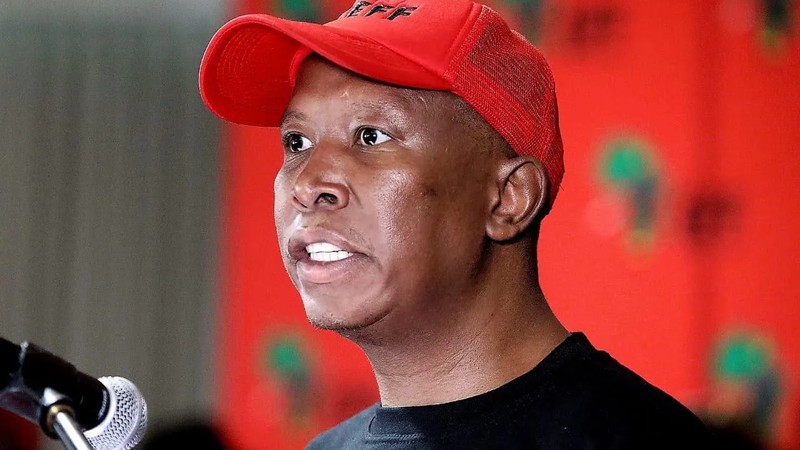
Julius Malema did not mince his words in Kokstad. Speaking before a charged crowd at the Riverview Sports Field during the Economic Freedom Fighters’ KwaZulu-Natal manifesto rally, the EFF leader delivered what amounted to a political verdict: President Cyril Ramaphosa is, in his words, “the biggest problem of South Africa” — and he should not just be removed from office, but locked away in prison. The central thesis Malema is pushing ahead of the local government elections is clear and provocative: no meaningful change can come to South Africa while Ramaphosa remains in power, and the EFF alone represents the future. Whether one agrees with that framing or not, the political stakes it raises for young South Africans — who live with unemployment, inequality, and institutional distrust every single day — deserve serious scrutiny.
Malema’s sharpest arrow on Saturday was the Marikana massacre, the 2012 tragedy in which 34 striking mineworkers were killed by police during a labour dispute at Lonmin’s platinum mine. Ramaphosa, who sat on Lonmin’s board at the time, has faced sustained criticism for his role in the events leading up to the killings, including emails in which he reportedly urged decisive action against the strikers. Malema leaned into this history with full force, telling his supporters to invoke the memory of the Marikana victims when they step into the voting booth. “You must say to the Marikana victims, in your name, in your spirit, we will never vote for Ramaphosa,” he declared. For a generation of young South Africans who were children when Marikana happened but now carry its legacy, this framing is designed to convert historical grief into electoral energy — and it is a strategy the EFF has refined over years of opposition politics.
Malema also drew a pointed contrast between Ramaphosa and former president Nelson Mandela, criticising the ANC for routinely invoking Mandela’s name during campaign seasons. His argument was blunt: Mandela was never caught with cash hidden inside furniture, a reference to the Phala Phala scandal that has dogged Ramaphosa since 2022, when allegations emerged that large sums of foreign currency were concealed in a sofa at his game farm. By placing these two figures side by side, Malema is not just attacking a sitting president — he is attempting to strip the ANC of its most powerful moral symbol and replace it with a narrative of corruption and betrayal.
Ramaphosa was not Malema’s only target on Saturday. He also turned his sights on the uMkhonto we Sizwe Party and its figurehead, former president Jacob Zuma, declaring flatly that “the future is the EFF.” The timing of this attack is strategically significant. The MK Party has emerged as a formidable force in KwaZulu-Natal, drawing significant support from Zuma loyalists and disaffected ANC voters in a province that has historically been a battleground. By dismissing Zuma as irrelevant to South Africa’s future while simultaneously hammering Ramaphosa, Malema is positioning the EFF as the only authentic radical alternative — the party that holds both wings of the establishment accountable. He urged voters to focus on local candidates and demand that elected representatives honour their promises, a message calibrated to resonate with young people who have watched politicians cycle through power without delivering tangible change in their communities.
What emerges from Kokstad is a portrait of a party fighting aggressively on multiple fronts, using the local government elections as a platform to reshape the broader national conversation. Malema’s rhetoric is deliberately incendiary, but beneath the fire lies a coherent political argument: that South Africa’s crisis is one of leadership accountability, and that the EFF is uniquely positioned to force that reckoning. For the youth of this country — who face a youth unemployment rate exceeding 60% and who increasingly distrust legacy institutions — the question Malema is really asking is whether anger alone can be converted into a governing mandate. That remains the EFF’s fundamental challenge, and no amount of rally heat can fully answer it.



