Physical Address
304 North Cardinal St.
Dorchester Center, MA 02124
Physical Address
304 North Cardinal St.
Dorchester Center, MA 02124

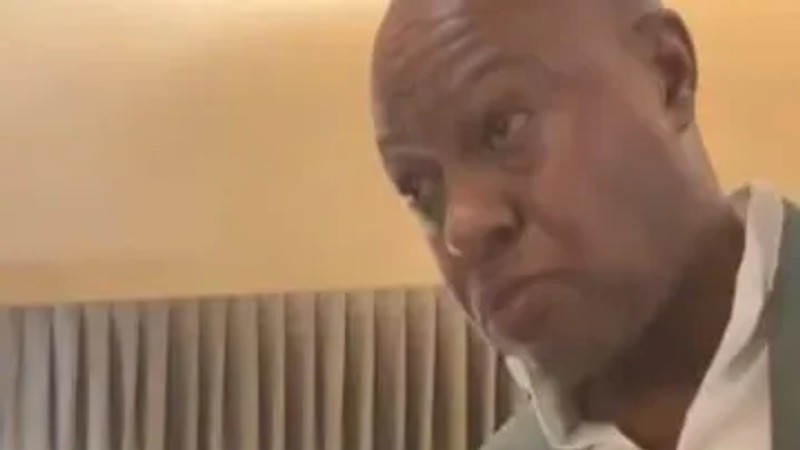
A video that began circulating on social media has ignited a national conversation that stretches far beyond the walls of a single upscale restaurant. The footage, recorded at Vlamo restaurant at Sandton Gate, shows a man identified as Zimbabwean businessman Lawrence Chamurwa Mudzingayima confronting a group of women, reportedly inside the restaurant’s ladies’ bathroom, after they allegedly rejected his romantic advances. The threats captured on camera are chilling in their directness — “I’ll murder you now and walk” and “I’ll put a bullet in all of you” — and the man is also heard boasting about his wealth, even claiming he could simply buy the restaurant. Restaurant management, once they became aware of the situation, removed him from the premises immediately, and Vlamo has since made clear that Mudzingayima had no affiliation with the establishment whatsoever.
The incident did not stay contained to social media outrage for long. A case of intimidation was opened at Randburg police station, and the Gauteng provincial investigation unit has since become involved, signalling that authorities are treating the matter with the seriousness it demands. The timing of the incident has amplified its resonance across South Africa, coming in the wake of the deeply disturbing discovery of nine women’s bodies in Ekurhuleni — a tragedy that has renewed urgent calls for women’s safety to be treated as a genuine national priority rather than a recurring afterthought.
This is where the story shifts from a disturbing viral moment into a question of public accountability and the integrity of state spending. Mudzingayima has been linked to Moriel Infrastructure Group, an engineering and construction firm that holds not one but two active contracts with the South African National Roads Agency (SANRAL) — both on major national arteries, the N1 and the N2. SANRAL’s own tender records reveal the scale of the relationship: a contract worth approximately R107.5 million was awarded to Moriel in October 2024, followed by another worth roughly R71.6 million in January 2025. That is nearly R180 million in public funds flowing to a company now under serious scrutiny.
The public outcry that followed the video’s circulation prompted Moriel Infrastructure Group to act swiftly, announcing that Mudzingayima had been removed from all positions within the company and would no longer represent, speak for, or act on its behalf in any capacity. The group issued a statement condemning his actions and affirming its commitment to fostering a safe, respectful, and inclusive environment, acknowledging the gravity of gender-based violence in the South African context. His LinkedIn profile and the company’s website have both since been disabled — a detail that speaks volumes about the reputational damage the incident has caused.
Transport Minister Barbara Creecy has directed SANRAL’s board to investigate whether Moriel Infrastructure Group was appointed in accordance with the law and whether the company is currently meeting the terms of its contracts. Acting SANRAL CEO Lehlohonolo Memeza confirmed that the investigation has already begun, and the agency is simultaneously consulting legal advisers about potential action against Moriel on the grounds that the company may have brought SANRAL’s reputation into disrepute. The speed of the institutional response is notable, and it reflects the kind of pressure that public accountability — amplified by social media — can generate when it is directed effectively.
The scrutiny does not stop at SANRAL. Public Works and Infrastructure Minister Dean Macpherson has directed the Construction Industry Development Board (CIDB) to immediately investigate a separate but equally troubling allegation: that Moriel Infrastructure Group obtained multiple CIDB gradings on the same day. CIDB gradings are the certifications that determine which government contracts a construction company is eligible to bid for, and irregularities in how they are obtained strike at the very foundation of fair and transparent public procurement. Two ministerial directives, two separate investigations — the weight of institutional attention being brought to bear on one company is significant.
Perhaps the most consequential development to emerge from this episode is the conversation it has sparked about the future of procurement policy. SANRAL has announced that it is reviewing its procurement policies and standard tender documents, and one proposal currently under consideration is a clause that would allow the exclusion of companies whose directors or senior managers are implicated in gender-based violence. If adopted, such a clause would represent a meaningful structural shift — one that formally links corporate eligibility for public contracts to the conduct of the individuals who lead those companies. SANRAL has also called on other public and private organisations across the construction industry to explore similar mechanisms.
For young South Africans watching this unfold, the stakes are clear and deeply personal. Gender-based violence is not an abstract policy problem — it is a lived reality that shapes how women move through public spaces, from restaurants to workplaces to the streets. The fact that a man who made explicit death threats against women in a bathroom was simultaneously a figure connected to nearly R180 million in state infrastructure contracts raises a fundamental question about the values embedded in how public money is spent. The outcome of these investigations will reveal whether South Africa’s institutions are willing to let that question produce real, lasting change — or whether the outrage will fade before the accountability does.



