Physical Address
304 North Cardinal St.
Dorchester Center, MA 02124
Physical Address
304 North Cardinal St.
Dorchester Center, MA 02124

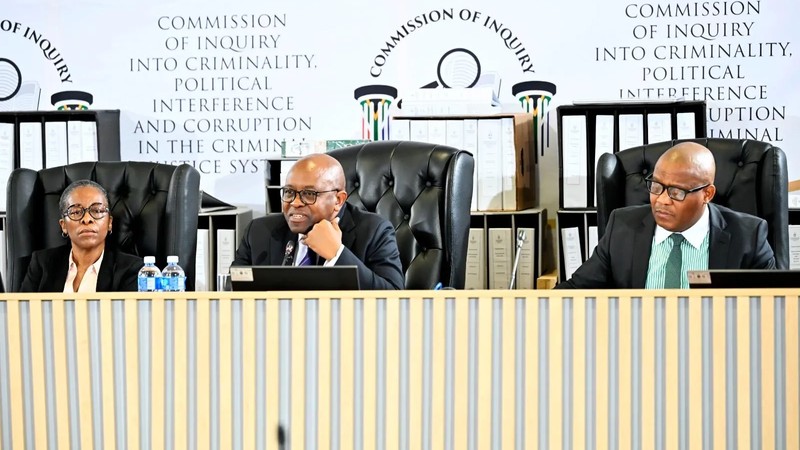
South Africa has the laws. It has the policies. It has, at least on paper, the billions of rands required to fight corruption and keep its criminal justice system clean. And yet, week after week, the Madlanga Commission is laying bare a more uncomfortable truth: that having the right frameworks means very little when the people and institutions meant to enforce them are themselves compromised.
This week’s hearings brought that reality into sharp focus, with three very different witnesses — a World Bank anti-corruption specialist, the national commissioner of Correctional Services, and the chairperson of the Public Service Commission — each peeling back a different layer of the same rotting structure.
The commission itself was established to investigate criminality, corruption and political interference inside South Africa’s criminal justice system. By Thursday, it had officially marked one year of public hearings. Commission Chair Justice Mbuyiseli Madlanga was careful to note that no final findings had been made, but acknowledged that the evidence so far pointed to what he described as “indications of serious criminality” within the very institutions meant to protect South Africans.
It was World Bank specialist Laura Pop who opened the week’s most technically damning testimony. Her argument was methodical and precise: South Africa’s asset declaration system — the mechanism through which public officials are meant to disclose their wealth and financial interests — is so limited that even the most capable oversight body in the world could not extract meaningful intelligence from it. “The asset declaration form in South Africa is very limited, so even if you had the best, most specialised institution in the world with that form, they couldn’t have done miracles,” she told the commission.
Pop explained that a credible vetting system cannot simply take what officials declare at face value. It must be able to cross-reference those declarations against records held by banks, tax authorities and property registries. Without that access, concealed wealth can sit hidden in plain sight, and corrupt officials can continue accumulating assets with little fear of detection.
She went further, urging the commission to think beyond vetting individuals in isolation. In some cases, she noted, the people who provide loans or financial benefits to officials are never themselves subject to any declaration requirements — they appear only as a source on a form, without scrutiny. Pop recommended that the commission’s eventual findings include a push for collaboration with SARS, so that investigators can trace whether a lender could even plausibly have afforded to provide what they claim to have given.
Pop also introduced the concept of “extraordinary vetting” — a more intensive, invasive form of integrity assessment that she described as a “medicine of last resort,” reserved for situations where corruption or institutional capture has progressed so far that ordinary accountability mechanisms have already failed. She argued that officials in senior or high-risk positions should face stronger integrity evaluations as a matter of course, before things reach that point.
Justice Madlanga himself pushed back on one dimension of her testimony, questioning whether a commission that had only examined a fraction of the criminal justice system — looking, as he put it, through “a very small window” — could legitimately conclude that a problem was systemic. Pop’s response was measured but firm: systemic failure should not be assessed purely on the number of individuals implicated. It should be evaluated using multiple sources, including criminal justice outcomes and broader research into organised crime. The commission’s limited view, she added, still provided information that some countries embarking on major reforms had never had access to at all.
Then came the testimony of Makgothi Samuel Thobakgale, national commissioner of Correctional Services, which shifted the conversation from financial opacity to something more visceral: the reality that putting someone behind bars does not automatically cut them off from the criminal networks they belong to. Thobakgale described how prison gangs and internal corruption can hollow out security from within, and he referenced a significant 2022 escape, revealing that officers involved had approached the department’s own head of security. Steps had since been taken, he said, to address those internal vulnerabilities — though the damage that escape represented was already done.
The final and perhaps most sweeping indictment came from Professor Somadoda Fikeni, chairperson of the Public Service Commission, who delivered what amounted to a structural critique of how South Africa governs itself. His argument was blunt: the country is capable of designing good policy and allocating real resources, but consistently fails to make any of it work in practice. Implementation, not intention, is where the system collapses.
Fikeni also raised a more personal dimension of that failure — the vulnerability of individual public servants. Officials who fear losing their jobs, he argued, become easy targets for political pressure, and can be pushed into following instructions they know to be unlawful. He called for stronger legislation to protect frontline employees across the criminal justice system from that kind of interference. “I do think that if we were to strengthen legislation protecting employees who are facing the pressures and political interference, that would be key,” he told the commission.
The human cost of all this is not abstract. Since the commission began its work, one whistleblower connected to the inquiry has been murdered. The commission’s own deadline has been extended three times — most recently to January — because the volume of evidence and the number of people implicated keep outrunning the original timeline.
Among those implicated, the police have moved against some: Major-General Feroz Khan, Major-General Richard Shibiri and Brigadier Rachel Matjeng have all been fired. But many others, including police deputy commissioner Lieutenant-General Shadrack Sibiya, remain in public employment while the commission continues its work.
Pop, for her part, was direct about what should happen to those found to have accumulated wealth unlawfully: remove them, ban them from re-employment in the same institution, and close off the adjacent institutions too, so that those pushed out of one door cannot simply walk in through another. “A time-limited bar on re-employment in the same institution and in related bodies should attach to removal and to any resignation tendered to avoid the process,” she said — because in a system this porous, the exits and the entrances are often the same door.



