Physical Address
304 North Cardinal St.
Dorchester Center, MA 02124
Physical Address
304 North Cardinal St.
Dorchester Center, MA 02124

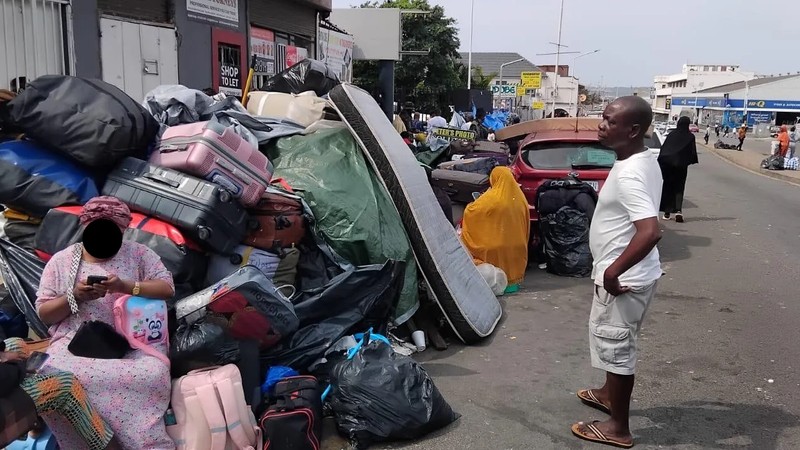
A man who calls himself “Abraham the chosen one” stands on the pavement of Che Guevara Road in Durban, bags packed, eyes tired. He is ready to board a government bus to Lindela Repatriation Centre — not because he wants to, but because the street has worn him down.
Since May 22, more than 200 documented refugees have been living outside the Department of Home Affairs reception centre on what was once known as Moore Road. They sleep on pavements, their few belongings stacked beside them. Some have turned their cars into makeshift bedrooms. They come from the Democratic Republic of Congo, Burundi, Uganda, Mozambique and Tanzania — all here for one reason: to sort out their documentation and get their lives back on track.
Now the South African government has handed them a choice. Move to the Lindela Repatriation Centre in Gauteng, or return to the local communities where they previously lived. For a community already pushed to its limits, neither option feels like a real solution.
The split is real and it runs deep. Bishop Raphael Bahebwa, one of the community’s leaders at the Che Guevara site, says more than 100 refugees — ground down by the dangers of street life — have agreed to make the move to Lindela. But the majority, over 250 people, have flatly refused. “Lindela is effectively a prison,” Bahebwa says, “and is notorious for human rights abuses.” His community’s priority, he insists, is reintegration — returning to the neighbourhoods where they had built their lives before ending up on the pavement.
Kafuti Muyumba, the community’s spokesperson, points out that this threat is not new. When the mayor visited the site roughly two months ago, the message was already clear: move back to your communities, or face transfer to Lindela. Many residents of the camp entered South Africa legally, holding valid refugee documentation, and they argue that a deportation-linked facility is simply not the right place for people who have broken no law.
Lindela is not a shelter in any ordinary sense. Situated in Krugersdorp, Gauteng, the centre is officially a repatriation facility — a holding point for undocumented foreign nationals ahead of deportation. Human rights monitors have long raised alarms about conditions there, citing reports of overcrowding, abuse and due-process violations. For documented refugees, the prospect of being sent there carries a specific and chilling message: your status may not protect you.
That fear is not abstract. Princess Adjei, a Congolese refugee going through the Home Affairs verification process before the transfer, acknowledges that she will board the bus — but only because she does not feel safe where she is. “People are going inside Home Affairs and coming out for verification as they are taking us to Lindela for shelter,” she explains, her voice careful and measured. Safety, not choice, is driving her decision.
“Abraham the chosen one” puts it plainly: “We have no choice. Street life is not easy. We are getting sick; our brothers are being arrested for defending themselves and their families.” His frustration at the delays is palpable, but he knows the process has to be followed. Once at Lindela, he says, they will figure out the next step. It is survival logic — pragmatic, exhausted and heartbreaking.
Those who refuse to go to Lindela are gambling on a different outcome. They remain on Durban’s streets, holding out hope that the government will eventually provide proper temporary accommodation — something that gives them breathing room to reconnect with their communities and rebuild without the shadow of deportation hanging over them.
On Friday, KwaZulu-Natal Premier Thamsanqa Ntuli visited the Che Guevara Road site alongside John Kalunga Nyakeru, the DRC’s Ambassador to South Africa. Their visit signals that this crisis has climbed high enough to demand political attention — both at a provincial and a diplomatic level. KwaZulu-Natal Home Affairs manager Cyril Mncwabe confirmed that plans for the Lindela transfer are still being finalised, with verification checks underway before any movement can happen.
The presence of the DRC ambassador matters. A significant portion of the camp’s population is Congolese, and their government’s engagement could either accelerate repatriation or push for better protections. Which direction that pressure lands will shape what happens next for hundreds of people.
This standoff on Che Guevara Road is not an isolated incident — it is a symptom. South Africa’s refugee reception system has been under strain for years, with backlogs, bureaucratic delays and inadequate infrastructure leaving documented refugees in legal and physical limbo. When the system fails, people end up on pavements. And when they end up on pavements, the government’s answer — at least here in Durban — is Lindela.
For young Africans watching this unfold, the stakes are impossible to ignore. These are not undocumented migrants trying to slip through the cracks. These are people with papers, with rights, with families — and they are being offered a deportation centre as a solution to a documentation backlog. That is a policy failure dressed up as a humanitarian response.
Back on Che Guevara Road, the buses have not yet arrived. Some people are packed and waiting. Others are staying put, watching, hoping. Bishop Bahebwa says each person and each family must make their own decision in this very difficult situation. That sentence, quiet and careful, carries the full weight of what it means to be a refugee in 2024 — to have your fate reduced to a choice between two kinds of uncertainty, on a pavement far from home.



