Physical Address
304 North Cardinal St.
Dorchester Center, MA 02124
Physical Address
304 North Cardinal St.
Dorchester Center, MA 02124

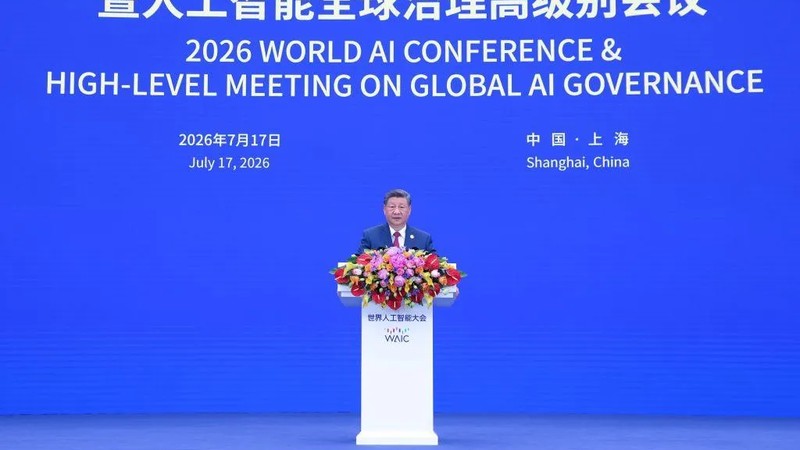
On the morning of July 17, 2026, the skyline of Shanghai framed something more than a technology summit. Standing before heads of state and international delegates on the banks of the Huangpu River, Chinese President Xi Jinping did not simply open another conference — he proposed a new architecture for how humanity governs artificial intelligence, and he did it with an institution already signed and sealed behind him.
The day before Xi took the stage at the 2026 World Artificial Intelligence Conference, twenty-nine countries had already put their names to the agreement establishing the World Artificial Intelligence Cooperation Organization, or WAICO — the world’s first intergovernmental body dedicated exclusively to AI cooperation and governance, headquartered in Shanghai. That sequence was not accidental. China arrived at the conference not with a proposal, but with a fait accompli.
Xi’s keynote, titled “Joining Hands to Build a Just and Equitable System for Global AI Governance,” wove together two threads that China has been pulling on for years: domestic industrial ambition and a carefully structured appeal to countries that feel locked out of the global technology order. The speech was as much a diplomatic document as a policy statement, and its intended audience was unmistakable — the Global South, a bloc of nations that has watched the rules of the digital age get written largely without them.
The founding membership of WAICO reflects exactly that pitch. Among the 29 founding members sit China, Russia, Brazil, and a range of countries from Asia and Africa — a coalition built around a shared grievance as much as a shared vision. The organization’s stated objectives are to ensure the beneficial, safe, and equitable use of AI, and to create an international platform where countries, particularly developing ones, can participate in shaping global rules free from what the founding documents describe as “ideological constraints or monopolies.”
That language is pointed. It signals a direct challenge to the governance frameworks championed by Western institutions, which China characterizes as rule-setting exercises that entrench existing technological hierarchies rather than dismantle them. Where Western models have tended to lead with regulation and standard-setting — processes that require technical capacity many developing nations simply do not yet have — China’s alternative leads with access: shared infrastructure, capacity-building programmes, and concrete financial commitments designed to lower the barrier to entry.
United Nations Secretary-General António Guterres was present, as were Kazakh President Kassym-Jomart Tokayev, Cambodian Prime Minister Hun Manet, and Thai Prime Minister Anutin Charnvirakul. Each echoed the call for AI’s benefits to be distributed equitably across the globe — a chorus that gave China’s vision the kind of multilateral legitimacy it was clearly seeking. For young people across Africa and the broader developing world, that chorus carries a particular weight: it signals that the conversation about who controls the most powerful technology of this generation is no longer confined to Washington, Brussels, or Silicon Valley.
China has backed the rhetoric with tangible initiatives, including the AI Capacity-Building Action Plan for Good and for All and the AI Plus International Cooperation Initiative — programmes designed to transfer technical knowledge and infrastructure to countries that currently sit on the margins of the AI economy. The underlying argument is straightforward: if AI is going to reshape economies, labour markets, and political systems everywhere, then the countries most exposed to that disruption deserve a seat at the table where the rules are made.
“AI development should not be a solo performance by a single country,” Xi told the assembled delegates, “but a symphony of international cooperation.” The metaphor is elegant, but the stakes it describes are real and immediate. For a generation of young Africans entering an economy already being restructured by automation and algorithmic decision-making, the question of who governs AI — and in whose interest — is not abstract. It is the question that will shape the opportunities available to them for decades to come. WAICO may be new, and its power untested, but its founding moment marks a genuine shift in where that question gets debated.



