Physical Address
304 North Cardinal St.
Dorchester Center, MA 02124
Physical Address
304 North Cardinal St.
Dorchester Center, MA 02124

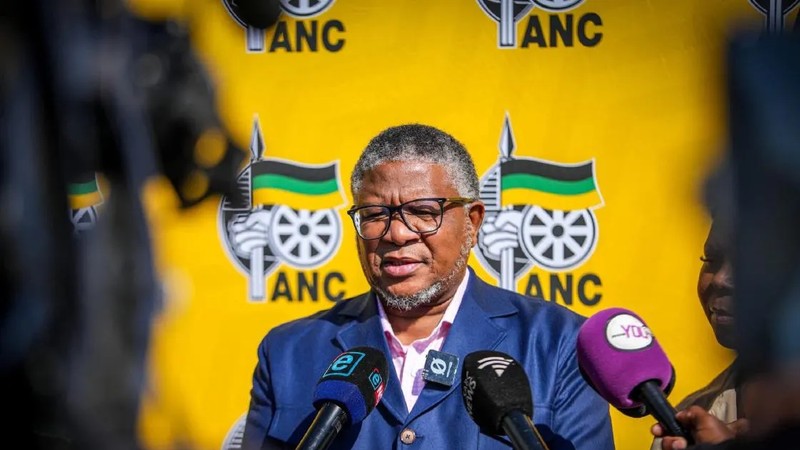
African National Congress Secretary-General Fikile Mbalula has threatened to take former African Union chairperson Nkosazana Dlamini-Zuma to court after she publicly accused him of distributing money to delegates during the party’s 55th National Conference in 2022 at Nasrec, Johannesburg — allegations that Mbalula flatly denies and describes as deeply damaging to his reputation. Speaking on the sidelines of the ANC’s National Executive Committee (NEC) meeting in Durban on Friday, Mbalula confirmed that his legal team had already written to Dlamini-Zuma demanding that she either retract the claims or back them up with concrete evidence. The confrontation marks one of the most openly hostile exchanges between two senior ANC figures in recent memory, unfolding just as the party braces for local government elections scheduled for November 4, 2026.
The controversy erupted after Dlamini-Zuma, herself a sitting NEC member, made the allegations during an interview on the African Renaissance Podcast, hosted by Mbuyiseni Ndlozi, where she spoke candidly about the state of internal democracy and leadership contests within the governing party. She alleged that money changed hands openly during the 2022 conference — the same gathering at which President Cyril Ramaphosa was re-elected as ANC president and Mbalula was elected secretary-general — and that the funds were intended to secure votes for both men. Her words were pointed and specific: “Mbalula was dishing the money in the clinic,” she said, also referencing a separate incident in which a large sum of cash was reportedly discovered in a delegate’s room on the first morning of the conference. She insisted the practice was far from hidden, arguing that anyone who worked at the clinic at the time, and even media present, could attest to what she described.
Beyond the specific accusations against Mbalula, Dlamini-Zuma raised a broader and more unsettling question about the integrity of ANC governance itself — one that resonates far beyond internal party politics. She questioned how leaders who were elected through financial inducements could ever exercise truly independent judgement once in office, asking aloud whether such individuals make decisions freely or remain beholden to whoever funded their rise. She was unequivocal in her conclusion that ANC elective conferences have ceased to be legitimate democratic contests, and that the use of money during these gatherings directly violates the party’s own rules.
Mbalula did not mince his words in response, characterising Dlamini-Zuma’s statements as “erratic” and “unexpected” from someone of her standing within the organisation, and expressing frustration that she had chosen a public podcast rather than the party’s formal internal structures to air her grievances. He argued that the correct path would have been to refer the matter to the ANC’s Integrity Commission, which exists precisely to handle allegations of this nature, and that by bypassing that process she had denied him the opportunity to clear his name through proper channels. His position was unambiguous: there is no political fix for an accusation of this gravity. “There’s no political solution to a charge that you have stolen money,” he told journalists, framing the legal route not as a threat but as an inevitable consequence of her failure to either substantiate or withdraw the claims.
Mbalula also defended the legitimacy of his 2022 election, pointing out that the results were independently supervised by an Electoral Commission and that no party structure challenged the outcome at the time — a detail he presented as evidence that the process met the required standards of credibility. He acknowledged a prior incident in which he had made inappropriate remarks about Dlamini-Zuma, for which he later apologised publicly, signalling an awareness that the relationship between the two has a complicated history. He also took a broader swipe at the podcast culture now shaping political discourse, cautioning that public platforms carry responsibilities and that making damaging, unsubstantiated claims about individuals — regardless of the medium — has real consequences.
The public clash between two of the ANC’s most prominent figures lands at a particularly sensitive moment for a party already navigating the pressures of coalition governance and declining electoral support among younger South Africans. The allegations, whether ultimately proven or not, feed into a growing perception among youth that the ANC’s internal processes are compromised by money and patronage networks — a perception that the party can ill afford as it mobilises ahead of the 2026 local government elections. Mbalula himself acknowledged this tension, urging members to look past the controversy and focus on grassroots organising, even as the legal machinery he has set in motion threatens to keep the story alive in the public eye for months to come. The outcome of this standoff — whether it ends in a courtroom, a retraction, or an uncomfortable silence — will say a great deal about where accountability within Africa’s oldest liberation movement actually begins and ends.



