Physical Address
304 North Cardinal St.
Dorchester Center, MA 02124
Physical Address
304 North Cardinal St.
Dorchester Center, MA 02124

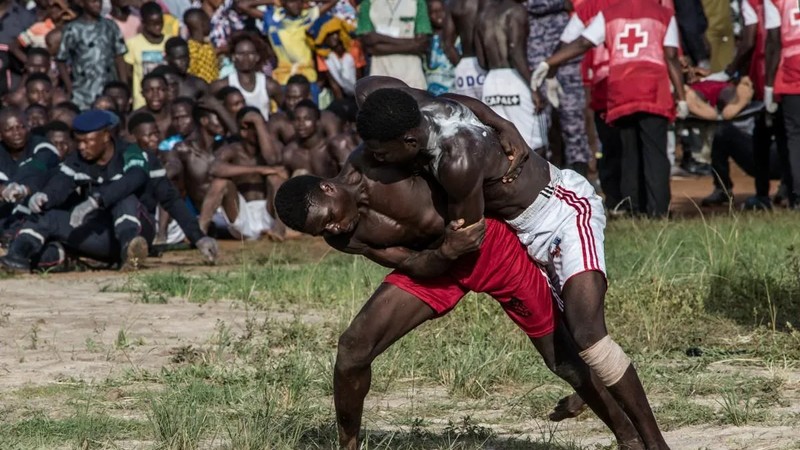
Every July in northern Togo, thousands of bare-chested young men pour out of the forest, chanting war songs and ready to fight. This is Evala — an ancestral rite of passage that has shaped Kabye manhood for generations, and one that still carries enormous weight today.
The ritual takes place in the Kara region, hundreds of kilometres from the capital Lomé. Each year, ethnic Kabye men aged 18 to 20 — called “Evalo” — gather to wrestle their peers and, in doing so, cross the threshold into adulthood. Togo’s authorities are now pushing for UNESCO recognition of the tradition as part of the country’s cultural heritage.
Before any wrestling begins, each participant must receive three small blade-cut scars near each ear — a mark of entry into the ritual. Then comes something more confronting: the Evalo must dance with a dog until the animal dies of exhaustion, after which they eat its meat for the very first time in their lives.
Tchitchao canton chief Achille Samah Bidiwana explains the symbolism plainly: “The dog is a strong, hardy and cunning animal.” Consuming it is not cruelty — it is a transfer of qualities, a way of absorbing the animal’s resilience before stepping onto the wrestling ground.
Training starts as early as May. Coaches drill the young men in technique, stamina, and discipline over several months. “You have to be courageous, strong and, above all, patient,” says coach Tchamien Petchereza. Veterans pass down knowledge to newcomers, keeping the chain of tradition unbroken across generations.
The competitions themselves run for a full week, organised by neighbourhood, village, and canton across the entire Kara region, drawing crowds of locals and international tourists alike every July.
Participation in Evala is technically voluntary, but social pressure runs deep. Wrestling coach Tchaa Tidiye puts it directly: “We don’t force a young Kabye to wrestle, but if he doesn’t, especially if he is in good shape, he brings shame on society.” Chief Bidiwana goes further, noting that according to ancestral standards, a man cannot take a wife before becoming an Evalo.
For families, the stakes feel personal and generational. “I am very proud,” says Nabede Kpatcha, who came to watch his son compete. “What my parents showed me, I must pass on to my child and he will also pass it on to his children.” That chain of transmission is exactly what gives Evala its staying power — not coercion, but a shared sense of belonging and pride.
The ritual has also produced some of Togo’s most prominent figures. Several ministers, army officers, and even former president Faure Gnassingbé — now leader of the Council of Ministers — went through Evala. The rite does not belong to the margins of Togolese society; it sits at its centre.
According to legend, Evala wrestling evolved from an older stick-based sport. Two competitors once lost their batons mid-fight and instinctively grabbed each other instead — and a tradition was born. That spontaneous, human moment now anchors one of West Africa’s most powerful coming-of-age rituals, still very much alive in the 21st century.



