Physical Address
304 North Cardinal St.
Dorchester Center, MA 02124
Physical Address
304 North Cardinal St.
Dorchester Center, MA 02124

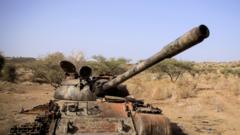
Seven of Ethiopia’s most significant armed opposition groups have announced the formation of a unified coalition called the Alliance for Survival, marking what could be the most consequential shift in the country’s turbulent political landscape in years. The alliance brings together the Fano militia from the Amhara region, the Oromo Liberation Army (OLA), the Tigray People’s Liberation Front (TPLF), the Ogaden National Liberation Front (ONLF), and three other smaller armed groupings, collectively representing communities spread across six of Ethiopia’s twelve regional states. Together, these groups accuse Prime Minister Abiy Ahmed‘s government of presiding over what they describe as “war, genocide, mass destruction and utter poverty,” and warn that Ethiopia itself is at risk of breaking apart. It is a sweeping indictment, and one that the government has not yet formally answered — though Abiy’s spokesperson Billene Seyoum suggested the groups had already been quietly collaborating long before this public announcement.
To understand why this alliance matters so deeply, you need to understand the geography of Ethiopia’s conflicts — which are not isolated flare-ups but overlapping, long-running crises rooted in the country’s system of ethnic federalism. Ethiopia is home to more than 80 ethnic groups, and its regional states are structured largely around dominant ethnicities, a design that grants meaningful autonomy to regions but simultaneously creates fertile ground for ethnic tension, political exclusion and armed resistance. Oromia and Amhara, the country’s two most populous states, have both been theatres of sustained armed conflict for years. In the northern Tigray region, a devastating two-year civil war left hundreds of thousands dead and displaced millions more before an African Union-brokered peace deal ended the fighting in 2022 — a deal that both sides have since accused the other of violating, and which has done little to quiet fears of a return to full-scale war.
Perhaps the most striking dimension of this new coalition is not its breadth, but the history that its members are being asked to set aside. The Fano militia, for instance, fought alongside federal forces against the TPLF during the Tigray war — a conflict in which the TPLF is now its coalition partner. Fano then turned against the federal government itself less than a year after that war ended, refusing government orders to disarm and launching an armed insurgency in Amhara. The OLA, meanwhile, has been in active conflict with Abiy’s government since 2018. These groups have not merely disagreed in the past — they have, in some cases, fought and killed each other’s members. Edward Bach, an analyst at advisory firm Verisk Maplecroft, captured the fragility of this arrangement bluntly when he told AFP that the groups were “unlikely to share weapons… as your ally today can be your enemy tomorrow.” That scepticism is well-founded, and yet the coalition’s very formation signals a shared calculation: that the threat posed by the current government outweighs the mistrust between its members.
Abdikadir Addaani Hirmooge, the spokesman for the ONLF, articulated the coalition’s stated ambitions in an interview with the BBC, framing the alliance not as a military project alone but as a political one aimed at rebuilding fractured communities. “Our objective is for the communities to have democracy and to exercise their right to self-determination, to genuinely govern themselves,” he said, adding that the government had failed to honour a 2018 peace agreement meant to resolve the conflict in the Somali region. His words point to a recurring grievance across the alliance’s member groups: that Addis Ababa has consistently made and broken promises, leaving ethnic communities locked in cycles of insecurity and mutual antagonism that the government has neither the will nor the capacity to resolve.
The political backdrop to this coalition is equally telling. Ethiopia held a general election in June, in which Abiy’s Prosperity Party retained its overwhelming parliamentary majority — but the vote was widely overshadowed by ongoing conflict, credible accusations of repression, and a near-total absence of meaningful opposition participation. The Fano and OLA both rejected the election outright, and the entire Tigray region, with its six million inhabitants, was excluded from the poll altogether. When a government wins an election from which half its opponents are absent and one of its major regions cannot vote, the legitimacy of that victory is difficult to defend. Abiy, for his part, has responded to the rising tide of opposition with characteristic defiance, telling lawmakers in July: “Even if others were added, we do not have an iota of fear regarding Ethiopia’s sovereignty.” The announcement of the Alliance for Survival, coming months after reports of a separate alleged alliance between the TPLF and neighbouring Eritrea, suggests that the prime minister’s confidence will soon face a serious test.
What this moment reveals, above all, is the depth of the legitimacy crisis facing Abiy Ahmed’s government — a government that came to power in 2018 on a wave of reformist optimism, won the Nobel Peace Prize in 2019, and has since presided over some of the worst violence Africa has seen in decades. For young Ethiopians living in regions where conflict is not a news story but a daily reality, the formation of the Alliance for Survival is less a surprise than a reckoning. Whether this coalition holds together long enough to translate its political grievances into meaningful change, or whether it fractures along the same ethnic fault lines that produced its members, remains to be seen. But its very existence forces a question that Addis Ababa can no longer afford to ignore: how long can a government govern a country that half its regions no longer recognise as their own?



