Physical Address
304 North Cardinal St.
Dorchester Center, MA 02124
Physical Address
304 North Cardinal St.
Dorchester Center, MA 02124

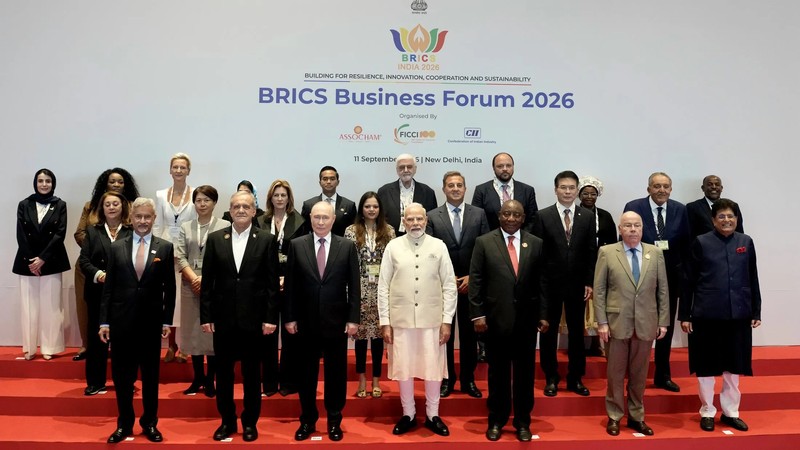
The 18th BRICS Summit, now underway in New Delhi under India’s 2026 chairship, is not just another diplomatic photo opportunity — it is a high-stakes geopolitical experiment playing out in real time, and its outcomes will ripple far beyond the conference halls of the Indian capital. The thesis is straightforward: BRICS has outgrown its origins as an economic acronym and is fast becoming the most consequential institutional challenge to Western-led global governance, and this summit, more than any before it, puts that ambition to the test. With leaders representing nearly half of the world’s population gathered under one roof, the bloc’s ability to coordinate across deep divisions will determine whether it can translate its demographic and economic weight into genuine global influence — or fracture under the pressure of its own contradictions.
Prime Minister Narendra Modi is hosting an attendance roster that reads like a who’s who of the Global South’s most consequential leaders: Russian President Vladimir Putin, Iranian President Masoud Pezeshkian, South African President Cyril Ramaphosa, Egyptian President Abdel Fattah el-Sisi, and Indonesian President Prabowo Subianto, among others. Each of these figures brings not only their country’s interests to the table but also the weight of their respective regions — and for young Africans watching from Johannesburg to Nairobi, the presence of Ramaphosa and el-Sisi signals that this is not a conversation happening without the continent. Africa is in the room, and the decisions made here will shape the economic and political landscape that this generation inherits.
The single most watched moment of this summit is almost certainly the presence of Chinese President Xi Jinping in New Delhi — his first visit to India since 2019. To understand why this matters, you have to understand that India and China share one of the most contested borders on the planet, the Line of Actual Control, where troops from both sides have faced off in deadly skirmishes as recently as 2020. These are not abstract territorial disputes; they are live sovereignty questions that have defined the relationship between Asia’s two largest powers for decades. And yet, here they are, sitting across the same table, because both governments recognise that institutional frameworks like BRICS create a channel for high-level communication that bilateral hostility would otherwise close off entirely.
Foreign policy analysts have long argued that strategic competition and pragmatic cooperation are not mutually exclusive — and the New Delhi summit is perhaps the most vivid illustration of that principle in recent memory. Xi’s arrival allows both nations to signal to the world that shared global priorities, from reforming international financial institutions to challenging dollar dominance in trade, can coexist with unresolved territorial tensions. For the bloc as a whole, this dynamic is both its greatest strength and its most persistent vulnerability: BRICS works precisely because it does not demand ideological uniformity, but that same flexibility makes it difficult to project a coherent, unified position when geopolitical fault lines run directly through its membership.
Beyond the diplomatic theatre, the economic workstreams driving this summit carry the most transformative long-term potential, particularly for African nations still navigating the structural inequalities baked into the current global financial architecture. Member states are pushing hard on the development of alternative payment systems designed to reduce dependence on the US dollar in international trade — a project that, if successful, would fundamentally alter the leverage that Western financial institutions currently hold over developing economies. For a young African entrepreneur or policymaker, this is not an abstract monetary debate; it is a question of whether African governments will continue to be exposed to the destabilising effects of dollar fluctuations and US sanctions regimes that were never designed with African interests in mind.
The summit’s agenda, structured across closed plenary sessions, business forums, and outreach dialogues with partner countries, reflects the bloc’s ambition to operate simultaneously at the level of heads of state and at the level of concrete economic policy. This dual-track approach is deliberate: BRICS understands that geopolitical credibility must be backed by institutional infrastructure, and that infrastructure takes years to build. The de-dollarisation push is still in its early stages, and significant obstacles — including the lack of a unified currency and the divergent economic interests of members ranging from resource-exporting African states to manufacturing powerhouses like China — remain formidable. But the direction of travel is clear, and New Delhi is accelerating it.
One of the sharpest tests of BRICS cohesion at this summit comes from Iran, which is expected to push aggressively for explicit declarations on the West Asian crisis — a demand that cuts directly to the heart of the bloc’s internal divisions. Iran’s inclusion in BRICS was itself a controversial expansion decision, and its desire to use the platform as a vehicle for geopolitical positioning on conflicts where member states hold sharply different positions risks exposing the limits of the coalition’s unity. Russia and China may be broadly sympathetic to Iranian positions, but India — which has historically maintained carefully calibrated neutrality in West Asian conflicts and maintains strong economic ties with Gulf states — is unlikely to sign onto language that could compromise its own diplomatic flexibility.
This tension is not a sign of BRICS’s failure; it is, rather, the defining challenge of any genuinely multipolar institution. The New Delhi summit is not a celebration of expansion — it is a stress test. Whether the bloc can navigate Iran’s demands, manage the China-India dynamic, advance the de-dollarisation agenda, and still produce a coherent joint declaration will determine whether BRICS graduates from a forum of shared grievances into a functioning alternative pole of global governance. For Africa’s youth, who stand to gain the most from a reformed international order, that question is not academic. It is the question that will shape the world they lead.



