Physical Address
304 North Cardinal St.
Dorchester Center, MA 02124
Physical Address
304 North Cardinal St.
Dorchester Center, MA 02124

It began, as these tragedies so often do, with a discovery that should never have been made. Sometime before September 17, 2025, the body of a woman was found in Dawn Park, a township on the eastern edge of Ekurhuleni, in Gauteng province. Then another body was found. And another. By the time the South African Police Service confirmed the ninth victim on that Thursday, a region — and a country — was shaking with grief and rage.
The deaths did not emerge from nowhere. South Africa has long carried the weight of one of the world’s most severe gender-based violence crises, a crisis that disproportionately claims the lives of Black women in townships and working-class communities. Ekurhuleni, a sprawling metropolitan municipality east of Johannesburg that encompasses areas like Kempton Park and the broader East Rand, became in those weeks the sharpest symbol of a wound that has never properly healed.
As the bodies were discovered one by one, police mobilised a multidisciplinary team to investigate, working urgently to determine whether the deaths were connected and to reconstruct the final moments of each woman’s life. Detectives offered few public details, but the scale of the discoveries — nine women, found in and around the same region within a compressed timeframe — was enough to send a chill through communities across Gauteng and far beyond.
Public anger followed quickly. Memorial events took shape in the streets. Women’s rights organisations, already exhausted from years of demanding accountability, called again for protection and justice. The Commission for Gender Equality added its institutional voice to the chorus, pressing the state to take urgent, concrete action and insisting that women must be able to move through public spaces without living in fear of violence.
Then, into that charged atmosphere, came an unexpected voice.
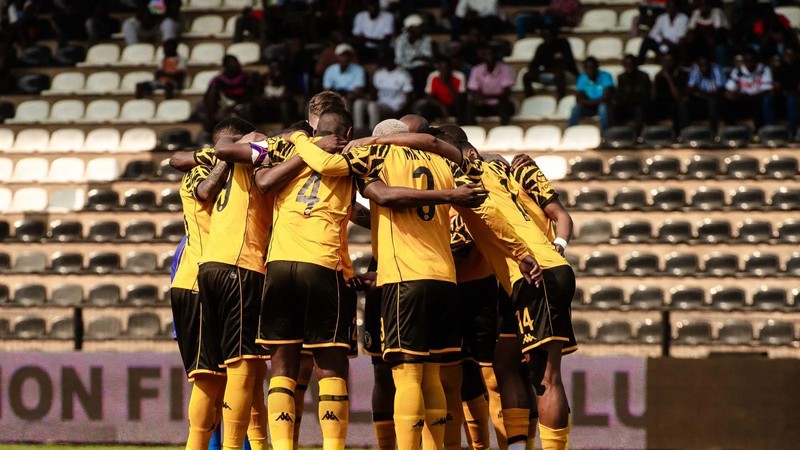
Kaizer Chiefs — one of the most supported and culturally significant football clubs on the African continent, with a fanbase that stretches across South Africa’s townships and youth communities — took to its social media platforms to condemn the killings in direct, unambiguous terms. “No To Gender-Based Violence,” the club declared. “We are heartbroken by the tragic violence and killings in Ekurhuleni. Kaizer Chiefs FC condemns Gender-Based Violence and the senseless loss of life in our communities.”
The club extended its condolences specifically to the families of the victims and addressed the residents of Kempton Park and the wider East Rand directly, telling them: “We stand with you. No woman should live in fear. Enough is Enough!” It was a short message. But in the context of South Africa’s often-silent public institutions, it carried weight.
Sport has a particular power to reach young people in ways that formal politics rarely does, and Kaizer Chiefs — known simply as “Amakhosi” to millions of fans — wields that power with unusual reach. When a club of that stature speaks on gender-based violence, it signals to a generation of young men that silence is not neutral, that fandom comes with a social conscience, and that the deaths of women in their communities are not abstract statistics but a collective emergency.
For now, the investigation in Ekurhuleni continues. Detectives are still piecing together the circumstances surrounding each death, still working to establish whether a single perpetrator or a pattern of violence connects the nine cases. The families of the victims are waiting for answers. The communities of the East Rand are waiting for safety. And South Africa, once again, is being forced to reckon with the question it has been asking — and failing to fully answer — for decades: when will women finally be safe?



