Physical Address
304 North Cardinal St.
Dorchester Center, MA 02124
Physical Address
304 North Cardinal St.
Dorchester Center, MA 02124

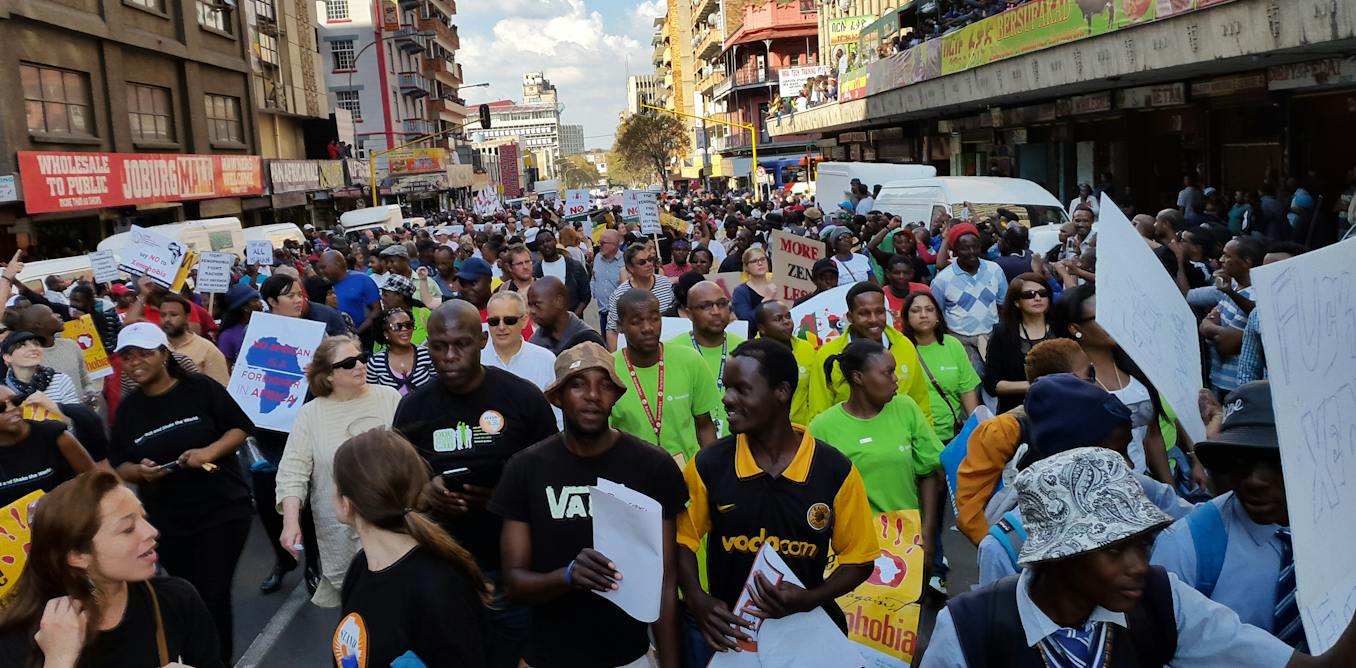
Anti-immigrant violence tore through South Africa again in March 2026. In the months that followed, an estimated 56,000 Malawians and 115,000 Zimbabweans were forced to flee their homes. At least 11 foreign nationals were killed, and President Cyril Ramaphosa took months to publicly condemn what was happening.
Groups like Operation Dudula and March and March led the charge, blaming undocumented African migrants for crime, unemployment and collapsing public services. The isiZulu word abahambe — “they must leave” — echoed through communities as foreign nationals were targeted in burglaries and sexual assaults. Governments in Nigeria, Ghana, Zimbabwe, Mozambique and Malawi eventually paid for tens of thousands of their citizens to return home and called on the International Criminal Court to step in.
The South African government, under an ANC-led coalition, deported 19,000 migrants in just a few months. More strikingly, officials publicly shook hands with protest leaders, effectively endorsing the movement. Ramaphosa, for his part, claimed without evidence that “quite a bit of the violence” was “being propelled from outside South Africa.”
So is this a new South Africa, or a very old one? Historians of southern African migration argue it is both — and that understanding the difference matters enormously right now.
The roots of anti-immigrant sentiment in South Africa run more than a century deep, stretching back to the very founding of the African National Congress in 1912. From the beginning, some of the country’s most prominent Black nationalists and pro-democracy voices harboured real hostility toward foreign migrants, viewing them as economic competitors who drove down wages and blocked opportunities for Black South Africans.
South Africa’s population has always been diverse, shaped by British and Dutch colonialism, the slave trade, and aggressive labour recruitment programmes. Indian indentured workers arrived on sugar plantations from the 1860s. Chinese labourers were brought in for the gold mines in the early 20th century. Migrant workers from Malawi, Mozambique and across southern Africa followed, recruited by mining companies or simply making their own way toward farms and city jobs.
That labour history created the fault lines still visible today. Mining and farming industries used migrant workers specifically to suppress African wages — and some early ANC founders responded not by targeting the industries, but by targeting the migrants themselves. Henry Selby Msimang, a moderate ANC executive member, complained in the mid-1920s that South Africa had become a “dumping ground for the unskilled workers of the African continent.” He pushed for restrictions on Mozambican immigrants and promoted a South African “race consciousness” that explicitly excluded Malawians.
In December 1926, a large anti-Malawian riot in Johannesburg killed six people and injured 25. A petition co-promoted by Msimang and the ANC’s pro-communist general secretary, Eddie Khaile, subsequently demanded the deportation of all Malawians and Zimbabweans from South Africa. Anti-immigrant demands, in other words, came from across the early ANC’s political spectrum — moderates and communists alike.
But the story does not end there, and this is where it gets genuinely complex. There were powerful pro-migrant voices inside the ANC too, including former general secretaries Sol Plaatje and Richard Victor Selope Thema. Lawyer Richard Msimang — no relation to Henry — publicly accused Khaile of retreating “behind the barbed wires of racialism and provincialism.” The internal debate was real, and fiercely contested.
On the shop floor, cross-border solidarity produced some of the era’s most significant labour victories. Clements Kadalie, a Malawian, founded and led the Industrial and Commercial Workers’ Union of Africa — the first major Black trade union in southern Africa. His union won wage increases in Cape Town and Bloemfontein, defeated segregationist plans in Johannesburg and Durban, and successfully overturned deportation orders against Kadalie himself. The union’s core argument was sharp and still relevant: wages are undercut by bosses, not by migrants.
That spirit of solidarity carried into the Second World War years. In August 1946, as many as 100,000 mine workers in the Witwatersrand went on strike under the banner of the African Mine Workers’ Union — a union that had deliberately recruited members from Malawi, Lesotho, Botswana, Swaziland, Mozambique and Angola, as well as South Africa itself. Its secretary, James Jacob Majoro from Lesotho, urged workers to unite around wages rather than “tribal” divisions.
Apartheid, introduced in 1948 after an all-white election that brought the National Party to power, crushed these cross-border movements. The government brutally dismantled the African Mine Workers’ Union, the ANC and the Communist Party. Activists went underground or into exile. African nations boycotted South Africa — Julius Nyerere’s first act as Tanzania’s prime minister in 1964 was to end the recruitment of Tanzanian workers for Johannesburg’s mines. The ANC, like many African liberation movements of the era, increasingly defined its struggle in narrowly national terms.
Solidarity briefly re-emerged in the 1980s, as apartheid’s grip weakened. The rise of the ANC-aligned National Union of Mineworkers — a central force in the anti-apartheid struggle — was built on tight collaboration between South African and Lesotho workers. Its general secretary at the time was Cyril Ramaphosa, who worked closely with worker-leaders from Lesotho to secure the union’s victories. The same Ramaphosa who, as president in 2026, has shown little sympathy for those same migrants’ descendants.
The ANC’s 1994 electoral victory, celebrated globally as the birth of the “rainbow nation” — a phrase coined by Archbishop Desmond Tutu — did not translate into openness toward migrants. In its very first year in power, the ANC used apartheid-era laws to deport a record 157,084 people, most of them refugees from Mozambique’s devastating civil war. The rainbow, it turned out, rarely included those labelled “foreign Africans.”
What today’s violence reveals, then, is not a sudden rupture in South African identity. It is the latest eruption of a tension that has run through the country’s political life for over a hundred years — a tension between a nationalism that excludes and a solidarity that builds. Both traditions are real. Both have shaped South Africa. The question facing young South Africans today is which one their generation chooses to carry forward.



