Physical Address
304 North Cardinal St.
Dorchester Center, MA 02124
Physical Address
304 North Cardinal St.
Dorchester Center, MA 02124

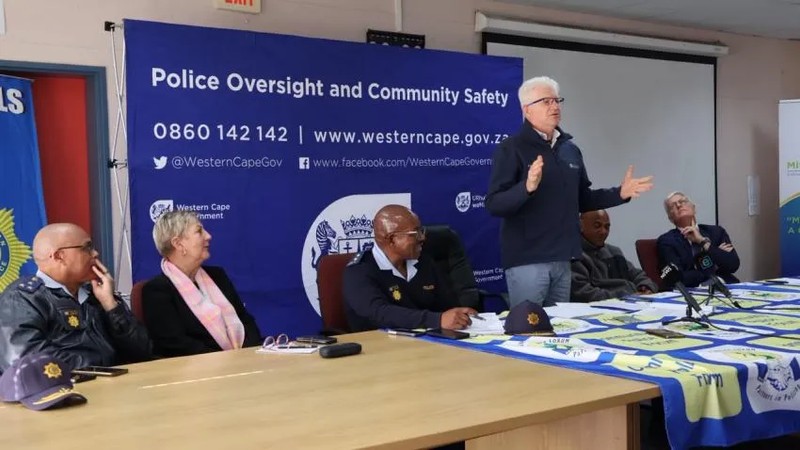
A police docket can make or break a criminal case — and right now, too many are breaking.
On 18 August 2026, Western Cape Premier Alan Winde and provincial Minister of Police Oversight and Community Safety Anroux Marais officially launched the Lawyers in Police Stations Project at the Mitchells Plain Policing Precinct. The initiative places qualified, experienced legal practitioners directly inside police stations, where they work full-time alongside detectives and officers to strengthen cases from the ground up — before they ever reach a courtroom.
The project is a three-way collaboration between the Western Cape provincial government, the South African Police Service (SAPS), and the Global Initiative Against Transnational Organized Crime (GI-TOC). Senior SAPS officials and GI-TOC representatives stood alongside the Premier and Minister at the launch, signalling that this is not a symbolic gesture — it is a structured, funded intervention with institutional backing.
The core problem the project targets is painfully familiar to anyone who has watched a criminal case collapse. Defective witness statements, gaps in evidence, poorly assembled dockets — these are the quiet failures that unravel prosecutions long before a judge ever hears a word. Violent criminals and gang members walk free not always because police failed to arrest them, but because the paperwork that should lock them away simply wasn’t airtight. Communities in areas like Mitchells Plain know this reality intimately, and the distrust it breeds in the justice system runs deep.
Lawyers deployed under the project will mentor officers on statement-taking, charge formulation and evidence management — the technical, often unglamorous work that determines whether a conviction happens or a perpetrator walks. These are not outside consultants parachuted in with no context; Premier Winde stressed that the deployed lawyers are local practitioners with real court experience, people who already understand where dockets fail and what communities need when they report a crime.
The initiative was first piloted at the Grassy Park SAPS station, where a single lawyer embedded with station personnel and built trust gradually — a slow, deliberate process that reflects just how significant a cultural shift this represents inside a police station environment. The Western Cape government has now committed to funding two lawyers at Mitchells Plain, following the lessons learned from that pilot, with the explicit goal of producing stronger dockets that result in actual convictions.
Winde was direct about the wider context driving this move. Police stations across the Western Cape and the rest of South Africa face serious resourcing constraints that consistently hit service delivery hard, and the provincial government has been vocal about demanding more equitable national funding for law enforcement in the region. But rather than waiting, the Western Cape is pursuing what Winde called “innovative solutions and partnerships” — this project being one of the most concrete examples yet of that approach in action.
“While law enforcement agencies must work hard to prevent crime and increase arrests, this must be followed by successful prosecutions,” Winde said at the launch. “Through this project we are tangibly offering assistance to officers to build up watertight cases.” He was equally clear-eyed about the limits: one lawyer cannot fix a systemic crisis, and Mitchells Plain is explicitly framed as a test and refinement opportunity — a model that, if it works, can be replicated across other stations in the province and potentially beyond.
For young people in communities where gang violence is not an abstract statistic but a daily reality, the stakes of this project are immediate. A justice system that consistently fails to convert arrests into convictions sends a devastating message — that reporting crime is pointless, that the system does not work for ordinary people. The Lawyers in Police Stations Project is a direct challenge to that cynicism, built on the straightforward premise that getting the basics right at station level is where the fight against crime actually begins.



