Physical Address
304 North Cardinal St.
Dorchester Center, MA 02124
Physical Address
304 North Cardinal St.
Dorchester Center, MA 02124

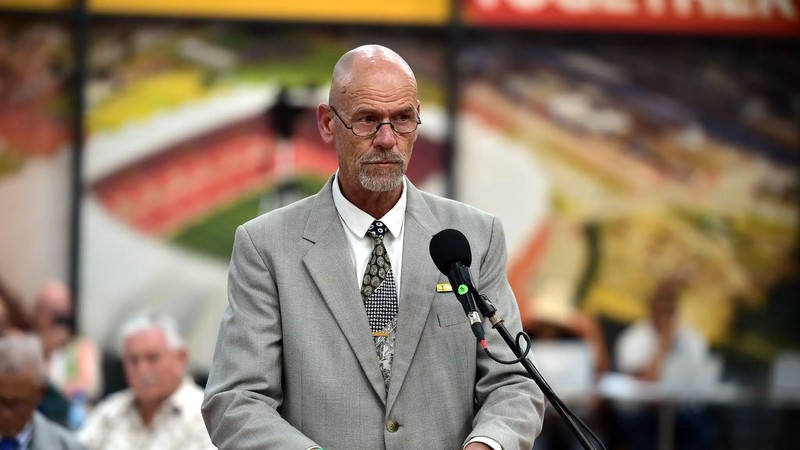
South Africa has always wrestled with the ghosts of its apartheid past, but rarely do those ghosts announce themselves as mayoral candidates. The Freedom Front Plus has put forward Bill Harington — a former apartheid-era police officer who served nearly fourteen years in prison for the 1991 murder of ANC activist Mbongeni Jama — as its candidate to lead Nelson Mandela Bay. This is not merely a controversy about one man’s criminal record. It is a revealing test of how seriously South Africa’s political class takes the weight of its own history, and whether the country’s youth are willing to accept a political culture that treats apartheid-era violence as a manageable administrative detail.
The central thesis here is straightforward and demands to be stated plainly: fielding a convicted murderer from the apartheid security apparatus as a candidate for one of South Africa’s most prominent metropolitan municipalities is not a bold act of rehabilitation — it is a political miscalculation that disrespects both the victims of apartheid violence and the democratic aspirations of the communities these politicians claim to serve. The FF Plus may insist that Harington has paid his debt to society, but debt repayment and democratic fitness are two entirely different standards, and conflating them is intellectually dishonest.
Harington was just twenty-one years old in 1991 when, as a section head commanding a unit of young Inkatha special constables in KwaZulu-Natal, he became involved in the killing of Mbongeni Jama, an ANC activist. He was initially sentenced to eight years in prison, a term that was later extended to eighteen years on appeal — a judicial signal that the original sentence had been considered insufficient. He ultimately served thirteen years and ten months behind bars. These are not abstract statistics. They represent a court’s formal determination that a man had taken another person’s life in the context of apartheid’s machinery of repression, during one of the most violent periods in South African political history.
Harington joined the FF Plus knowing the party was aware of his conviction, and he was selected as a councillor candidate as far back as 2021, going on to serve in that role in Nelson Mandela Bay. His elevation to the number one position on the party’s mayoral list is therefore not a sudden misstep but a deliberate, considered choice — which makes it all the more important to interrogate. When Harington says his past is “not a secret,” he is technically correct, but transparency alone does not equal suitability, and openness about a violent history is not the same as reckoning with it.
FF Plus MP and party chairperson Wouter Wessels has defended the decision by arguing that Harington should not “be punished for the rest of his life” and that the party conducts individual assessments of criminal records rather than applying blanket exclusions. Wessels further contends that Harington has demonstrated genuine remorse and committed himself to community upliftment. These are not unreasonable principles in the abstract — rehabilitation is a cornerstone of any progressive justice system, and permanently barring reformed individuals from civic life would be its own form of injustice.
Yet the FF Plus argument collapses under its own logic the moment it is applied to this specific context. Running for mayor of a major South African metropolitan municipality is not a routine act of civic participation — it is a bid for executive political power over a city whose very name honours Nelson Mandela, the most iconic symbol of resistance to the apartheid system that Harington served. The party’s insistence that this is purely a matter of individual merit sidesteps the symbolic and structural reality: that placing a former apartheid security operative at the head of a ballot in a post-apartheid city sends a message to survivors and their descendants that is impossible to misread. Remorse, however genuine, does not erase that signal.
For South Africans between fifteen and twenty-five years old — born entirely after the end of apartheid — this episode carries a particular urgency. This generation did not live through the violence of the 1980s and early 1990s, but they inherit its consequences every day, in the form of inequality, spatial segregation and a political culture still negotiating the terms of its own transition. When a party presents a candidate whose conviction is rooted in that era of state violence and frames criticism of that choice as mere political opportunism, it effectively asks young South Africans to treat history as irrelevant to the present.
Civil society organisations and opposition parties have pushed back, arguing that Nelson Mandela Bay deserves leadership untainted by the country’s violent segregationist past. That argument is not simply sentimental — it is structurally sound. Democratic legitimacy depends on the trust of the governed, and trust is not built by asking communities to look past the political symbolism of who stands before them asking for power. The FF Plus may win some votes with Harington on the ticket, but in doing so it signals to an entire generation that the party’s understanding of transformation is, at best, skin-deep. South Africa’s youth deserve political actors who treat the past not as a bureaucratic checkbox to be cleared, but as a living responsibility that shapes every decision made in the present.



