Physical Address
304 North Cardinal St.
Dorchester Center, MA 02124
Physical Address
304 North Cardinal St.
Dorchester Center, MA 02124

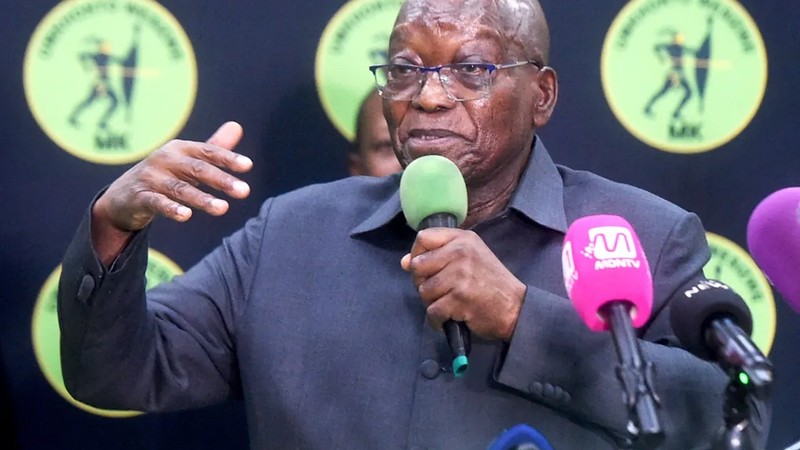
Jacob Zuma does not do subtle.
Standing before a congregation at the Bridge to Heaven Christian Fellowship Church in Mthatha, Eastern Cape, the former South African president and current MK Party leader unleashed one of his most pointed attacks yet on President Cyril Ramaphosa — stopping just short of naming him, but leaving absolutely no room for doubt. “We currently have a crook running the country,” Zuma declared, adding with theatrical effect, “I forget his name.” The crowd, of course, knew exactly who he meant.
The remarks, delivered on a Sunday as Zuma toured the Eastern Cape to build momentum for the MK Party ahead of November’s local government elections, cut straight to the heart of one of South Africa’s most charged political rivalries. Zuma painted a picture of a leader who “hides money under the bed” while ordinary South Africans — orphans included — are left to suffer. He called this unnamed figure a criminal and challenged anyone to name a single thing he had done for the people. The reference was unmistakable: the 2020 burglary at Ramaphosa’s Phala Phala farm, where a significant and still-disputed sum of foreign currency was allegedly concealed inside furniture, has dogged the president ever since, fuelling persistent questions about legality, transparency, and accountability that have never been fully put to rest.
What makes this moment politically significant is not just the venom of the words, but the context surrounding them. These are two men who once occupied the same executive table — Ramaphosa served as Zuma’s deputy president before the corruption scandals that ultimately consumed Zuma’s presidency grew too heavy to ignore. Their relationship, always transactional and fragile beneath the surface, cracked publicly when Ramaphosa later admitted to the Zondo Commission on State Capture that he had nearly resigned in 2015 after Zuma abruptly fired Finance Minister Nhlanhla Nene in a move that rattled markets and shocked the nation. The trust, if it ever truly existed, is long gone.
Zuma also took aim at the ANC itself, arguing that the party Ramaphosa leads today bears no resemblance to the liberation movement he once knew. In his framing, the MK Party is not a rival to the ANC’s legacy — it is the rescue mission. It is a narrative that resonates with a specific slice of the South African electorate, particularly in KwaZulu-Natal and parts of the Eastern Cape, where disillusionment with the ruling party runs deep and where the MK Party has been aggressively expanding its footprint since its breakthrough performance in the May 2024 general elections.
For young South Africans watching this unfold — many of whom have grown up entirely under ANC governance and inherited its promises alongside its failures — the spectacle raises a harder, more uncomfortable question than simply who is right and who is wrong. It forces a reckoning with what political accountability actually looks like in a country where the man throwing accusations of corruption was himself removed from office under the weight of state capture findings, and where the man being accused has yet to face a criminal charge despite the Phala Phala controversy. Two figures, each carrying serious unresolved baggage, trading blows in a church while millions wait for the electricity to come back on and the jobs to materialise.
Zuma’s Mthatha appearance has already ignited fierce debate across political circles and social media, and that reaction is itself telling. South Africa’s youth are not passive observers in this drama — they are the electorate that will decide, come November, whether the MK Party’s combative brand of opposition politics translates into genuine local governance power. The question is no longer just who is calling whom a crook. The question is what comes after the sermon ends.



