Physical Address
304 North Cardinal St.
Dorchester Center, MA 02124
Physical Address
304 North Cardinal St.
Dorchester Center, MA 02124

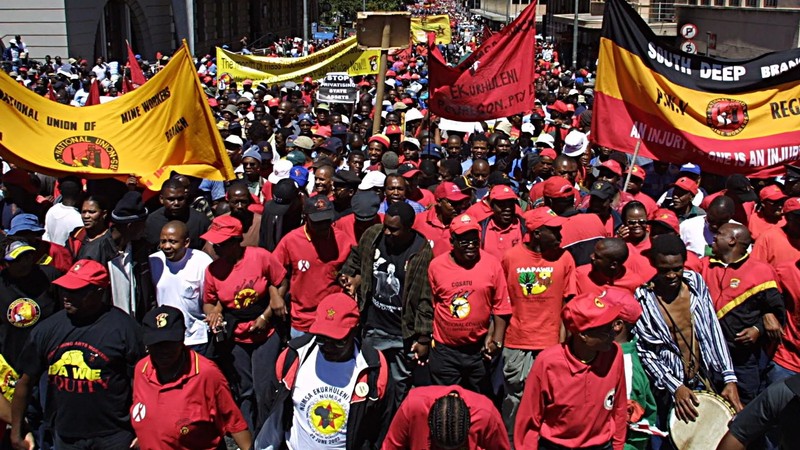
On Wednesday, October 7, South Africa’s streets will fill with workers demanding what should already be guaranteed: fair wages, secure jobs and basic dignity. The Congress of South African Trade Unions, better known as Cosatu, is orchestrating a nationwide wave of marches, pickets and demonstrations timed to coincide with World Day for Decent Work — and the timing could not be more loaded. This is not just a labour dispute. It is a political signal, directed at a government, a business class and a generation of young South Africans who are watching their economic futures erode in real time. The central thesis here is clear: Cosatu’s mobilisation exposes a structural failure in South Africa’s post-apartheid economic model, one that disproportionately punishes working people while shielding corporate profits.
The protests stretch from Johannesburg and Tshwane to Cape Town, Bloemfontein, Polokwane, Durban and Mpumalanga. Every major urban centre is implicated. That geographic spread matters — it signals that the grievances are not localised frustrations but a systemic crisis touching every corner of the country. From the National Union of Mineworkers picketing at Richards Bay Minerals to nurses marching in Durban under the Democratic Nursing Organisation of South Africa, the coalition is broad, the anger shared.
Perhaps the most damning case study in Wednesday’s protests is the confrontation with Sun International. Cosatu and its affiliate SACCAWU are marching to Sun City in the North West and GrandWest Casino in Cape Town to oppose planned retrenchments by the hospitality giant. The numbers tell a brutal story: Sun International’s land-based casino business recorded income of approximately R3.4 billion in the first half of 2026 alone, a return to growth by any measure. Yet the company is pushing ahead with job cuts. This is the contradiction at the heart of South Africa’s labour crisis — profitability and worker welfare have been decoupled, and corporations face little consequence for it. When a thriving company still chooses to slash its workforce, it exposes the myth that economic growth automatically lifts workers.
The situation at Massmart is equally telling. Cosatu is targeting the retail giant in both Johannesburg and Tshwane over the dismissal of nearly 600 Makro workers. Six hundred people. That is six hundred households, six hundred rent payments, six hundred families absorbing a shock that the company’s balance sheet will barely register. The federation plans to deliver memorandums directly to Massmart’s leadership — a symbolic act, yes, but also a documented escalation that puts corporate decision-makers on notice ahead of the November municipal elections.
South Africa introduced the National Minimum Wage in 2019 with genuine optimism. Since then, the figures look impressive on paper: a 100% increase for domestic workers, 66% for farm workers and 50% across the general workforce. Progress, surely? Not so fast. An estimated 40% of workers are still being paid below the NMW today, which means the law exists but enforcement does not. Cosatu is calling for the appointment of 10,000 additional labour inspectors to close this gap — a demand that sounds radical only until you consider that a law without enforcement is barely a law at all. The compliance failure is not accidental; it reflects a structural tolerance for wage theft that the state has yet to confront seriously.
Compounding the wage crisis is an economy battered by external shocks. The US-Iran war has disrupted global supply chains, pushing up the cost of fuel, food and electricity for ordinary South Africans. Workers are absorbing these price spikes on wages that are already legally insufficient in far too many cases. Cosatu spokesperson Zanele Sabela captured it plainly: workers are under siege from rampant retrenchments, the casualisation of jobs, attacks on collective bargaining rights and the erosion of social protection. These are not abstract policy concerns — they are the daily arithmetic of survival for millions of people under 25 who entered a labour market that was already broken before they arrived.
South Africa’s municipal elections are scheduled for 4 November. The protests on October 7 land less than a month before voters go to the polls, and that proximity is impossible to ignore. Cosatu’s mobilisation puts labour rights squarely on the political agenda at the moment when parties are most sensitive to public pressure. In Bloemfontein, the Free State march will deliver memorandums to government departments and private companies alike — a dual-target strategy that blurs the line between industrial action and political accountability. This is how organised labour has always operated at its most effective: not as a passive interest group, but as a force that shapes the terms of political competition. For young South Africans watching this unfold, the lesson is straightforward. The workers marching on Wednesday are not waiting for politicians to fix things. They are making noise loud enough to force the issue before ballots are cast. That is a model of civic engagement worth paying attention to — because the economic conditions driving these protests will still be there long after election day.