Physical Address
304 North Cardinal St.
Dorchester Center, MA 02124
Physical Address
304 North Cardinal St.
Dorchester Center, MA 02124

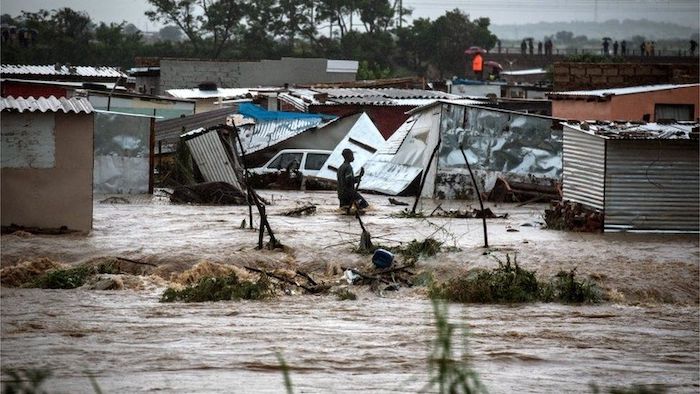
Two dead, three missing, and entire communities submerged: the price of climate instability and failing infrastructure unfolds in real-time.
While the country slides toward its festive season rituals—long drives to family homes, crowded malls and township braais—a different kind of December descent is under way. One marked not by joy, but by a brutal confrontation with a truth few officials dare to name: the South African state is consistently outpaced by disaster.
Severe weather in South Africa has already claimed two lives and left at least three missing, as torrential rains and sudden floods swept through parts of KwaZulu-Natal, the Eastern Cape, and Gauteng. The storm, though not entirely unforeseen, proved again that early warnings mean little without functioning infrastructure and a responsive state.
In KwaZulu-Natal, MEC for Transport and Human Settlements Siboniso Duma confirmed the death of one individual in Nyandezulu, Ugu District, and the disappearance of three others in Amanzimtoti when their vehicle was dragged into the currents. In Olievenhoutbosch, Gauteng, a man in his early 30s was found lifeless next to a river after a thunderstorm battered Tshwane.
Flash floods, landslides, and washed-out roads marked the weekend’s chaos—symptoms not only of La Niña-induced turbulence, but of long-ignored municipal decay.
Even before the floodwaters receded, the private sector and NGOs were already doing what municipalities couldn’t. As so often in South Africa, it wasn’t a government department leading the way, but the ubiquitous Gift of the Givers.
“Our teams have assisted over 200 families whose homes were either damaged or completely destroyed,” said Ali Sablay. “King William’s Town was hardest hit.”
The organisation has already deployed aid to Middledrift, Lady Grey, Diepsloot, and parts of Mpumalanga, delivering food parcels, blankets, water, and hygiene packs. The state, meanwhile, appeared largely reactive—clearing roads and issuing condolences while civil society stepped in.
The death in Olievenhoutbosch came as Tshwane’s emergency services scrambled to respond to multiple distress calls across Centurion, Temba, Hammanskraal, and the N14 Highway. A landslide was reported. Traffic snarled. Emergency shelters hastily opened. And still, residents waded through waist-deep water to retrieve what they could from submerged shacks and homes.
Tebogo Maake, spokesperson for Tshwane EMS, confirmed that high-risk areas across the city were being monitored. A Yellow Level 4 warning remains in place. The advice to the public: stay home, avoid low-lying bridges, and don’t underestimate the current. But for thousands without the luxury of “home” as shelter, such guidance rings hollow.
The meteorological instability is real, but not surprising. As Jacqueline Modika from the SA Weather Service noted, the 2025/26 summer season is shifting into a weak La Niña phase—predictably bringing increased rainfall to the north and east of the country.
Yet this knowledge does little to change the reality on the ground: that most municipalities are ill-equipped for even average weather, let alone a seasonal uptick in storms. And each new downpour reveals the same fault lines—informal settlements on floodplains, underfunded disaster management, neglected stormwater infrastructure.
Weather forecasts for the Christmas period suggest warm-to-cool conditions with afternoon thunderstorms in Gauteng, Limpopo, Mpumalanga, and KZN. Rain will likely persist into late summer.
Minimum temperatures are expected to rise nationwide. Northeastern provinces will remain under cloud cover, while the Western and Northern Cape face drier, hotter days—another recipe for imbalance. Those dreaming of a peaceful festive season would do well to brace for further disruption.
Official advice now floods the airwaves: have an emergency kit ready, don’t cross rivers, switch off your electricity if water enters your home. But the real emergency is governance itself.
South Africans know the drill, not because they’ve been educated by a responsive state, but because survival has demanded it. Aid numbers. Evacuation routes. The smell of mold and the weight of soaked bedding.
Informal settlements, like those in Diepsloot, sit exposed—despite being “known high-risk areas” for years. The term now feels like bureaucratic theatre.