Physical Address
304 North Cardinal St.
Dorchester Center, MA 02124
Physical Address
304 North Cardinal St.
Dorchester Center, MA 02124

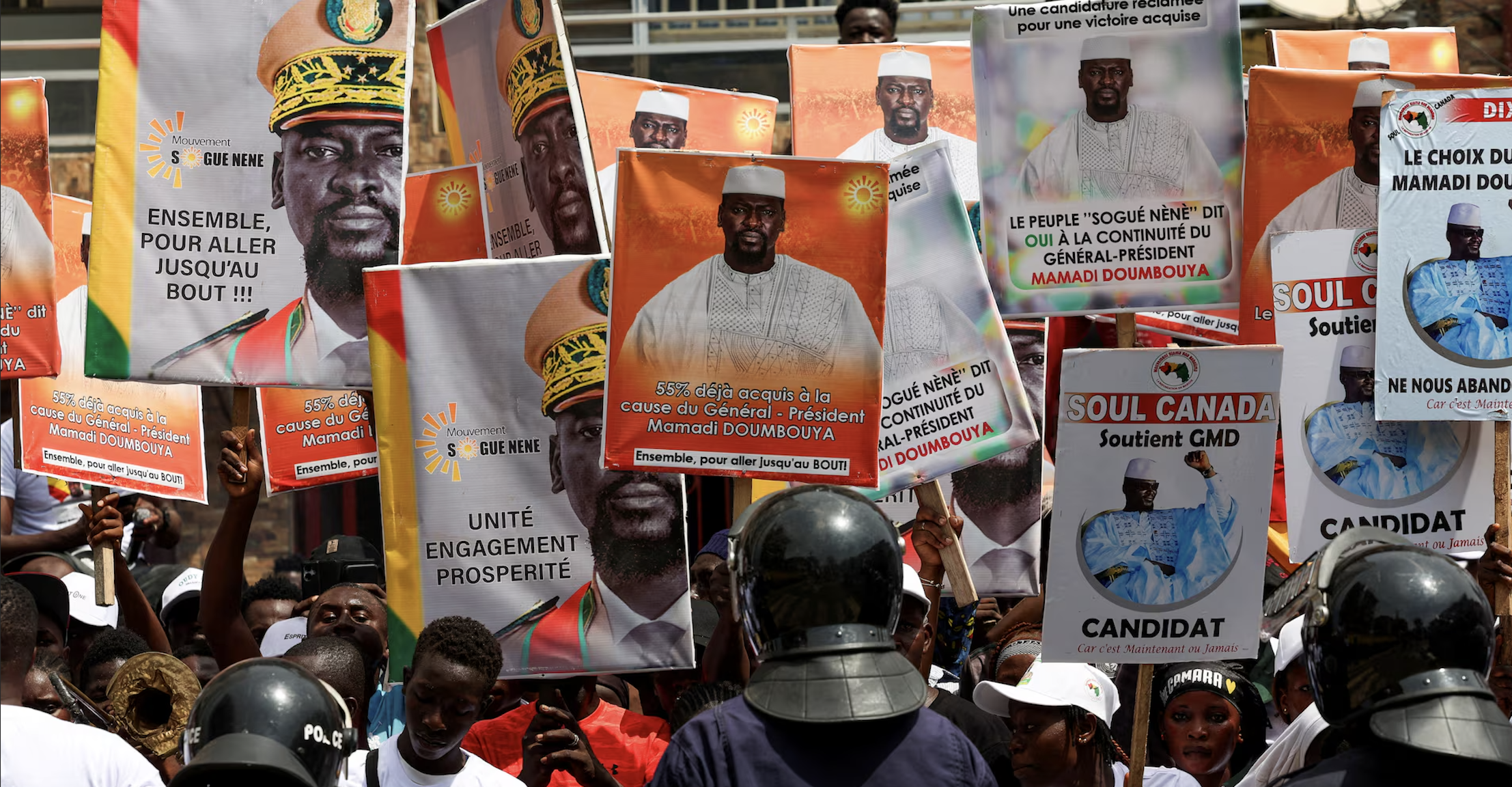
With no credible opposition and a choreographed vote, Guinea’s presidential election now enters its post-electoral phase: result management. General Mamadi Doumbouya, who seized power in 2021, appears set to secure a formal victory by Monday, in a process more symbolic than democratic.
More than four years after the military coup that unseated Alpha Condé, Guinea returns to the ballot box. But this Guinea presidential election bears little resemblance to a competitive process. Instead, it mirrors the controlled transitions seen across a region increasingly allergic to pluralism.
On Sunday night, the head of the General Directorate of Elections (DGE), Djenabou Touré, confirmed on state television (RTG) that the centralization of results had begun. Nine candidates were officially on the ballot—but only one mattered.
“The partial results should be announced starting Monday, December 29,” said Touré, outlining a process both manual and digital, but largely devoid of suspense.
According to official figures, voter turnout reached 85%. In most democracies, such numbers would be met with cautious optimism; in Guinea’s current context, they ring hollow. With major opposition figures barred, silenced, or exiled, the vote became a ritual, not a choice.
Roughly 6.8 million voters were registered, including around 125,000 abroad. But participation is not necessarily engagement, and the lack of international observers with real independence casts a long shadow over the result’s credibility.
The Guinea presidential election, stripped of its pluralism, became an affirmation of authority—not a contest of ideas.
At 41, General Doumbouya has effectively rebranded himself. Once the face of a military coup, he now appears as the nation’s stabilizer-in-chief, invoking sovereignty and order in a language that resonates with a population weary of political infighting and economic stagnation.
This positioning is no accident. In many African states, particularly in Francophone West Africa, the military now occupies the vacuum left by discredited civilian elites. Doumbouya’s electoral coronation is merely the final act in this carefully constructed narrative.
The other candidates, largely unknown, served only to provide the thinnest layer of electoral legitimacy.
Touré stated that results would be announced progressively: starting with regional prefectures, followed by African diaspora votes, then Europe, Asia, and the Americas. The rhythm mimics international democratic practices, but without their substance.
This sequencing offers the appearance of transparency, but in reality, nothing is left to chance. No incidents were reported, conveniently. No disruptions occurred, conveniently. And no serious observers were present, conveniently.
Once again, Western governments watch quietly from the sidelines—unwilling to risk alienating a military partner who ensures domestic order and international business continuity.
The Guinea presidential election will change little. It is not a return to democratic normalcy but the continuation of military rule under the veil of constitutionalism. In a region plagued by instability, Doumbouya’s firm hand is tolerated—perhaps even preferred—by foreign actors more interested in mining rights than ballot integrity.
No surprises are expected. Only confirmation. Guinea’s future, for now, remains tightly in the grip of its uniformed president—elected by default, governed by decree.